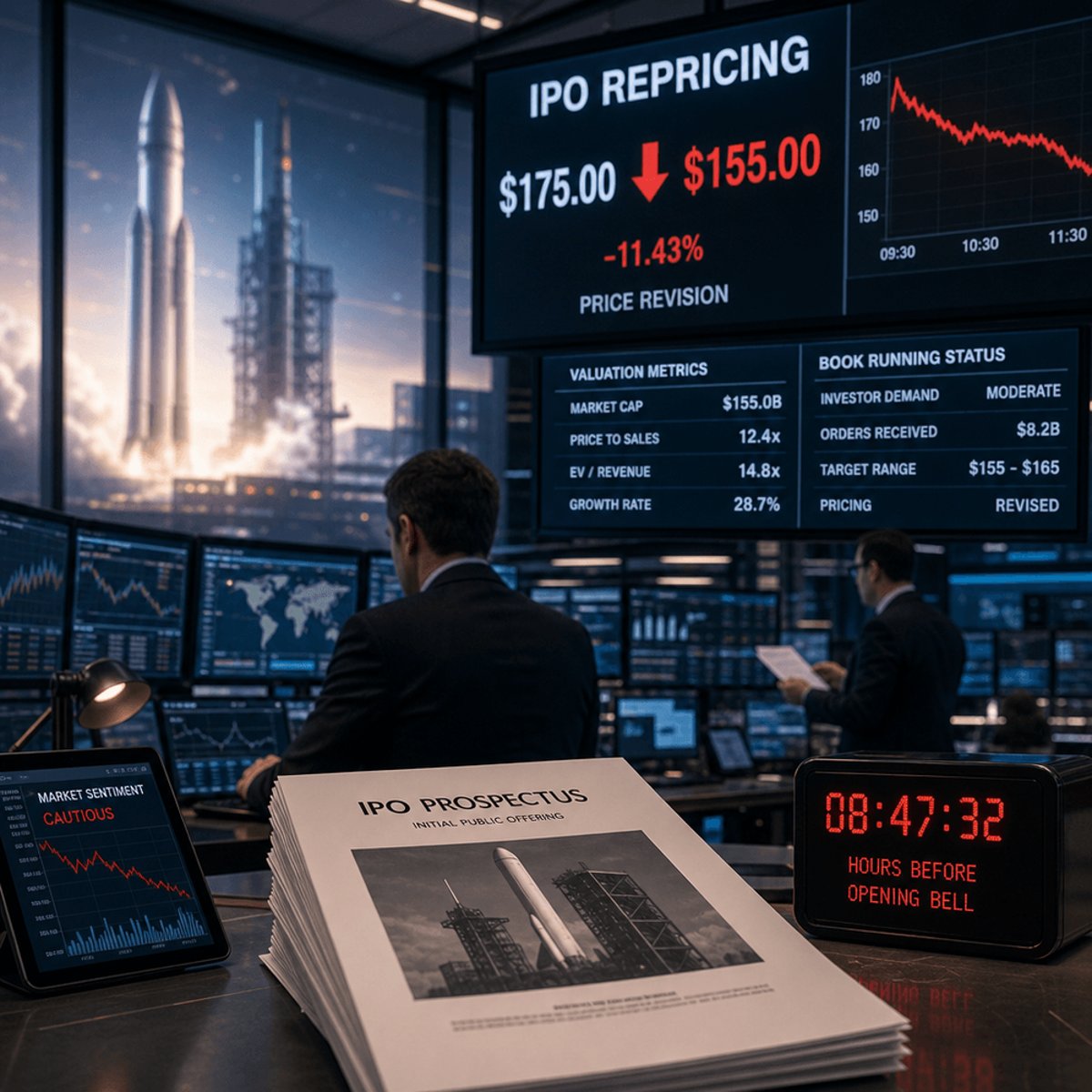
SpaceX just slashed its IPO opening price to around $155 per share, down sharply from the initial indication of $175 announced earlier today. The 11% price cut signals softer-than-expected institutional demand for what was supposed to be the decade's hottest public debut. The revision comes as Elon Musk's space venture attempts to pull off the largest tech IPO since Rivian's $66 billion listing in 2021, with investors now questioning whether the commercial space market can support the company's massive valuation expectations.
SpaceX is repricing its blockbuster IPO just hours before the opening bell, cutting the anticipated opening price to around $155 per share from an earlier indication of $175. The abrupt 11% reduction reveals unexpected pressure on what was billed as the most anticipated public offering since the pandemic-era SPAC boom collapsed.
The revision surfaced in live trading updates from CNBC as underwriters scrambled to finalize pricing ahead of the debut. While the company hasn't issued an official statement on the markdown, sources close to the deal told Bloomberg the adjustment reflects "recalibrated institutional appetite" rather than fundamental concerns about SpaceX's business.
But the optics aren't great. Elon Musk's space empire was supposed to be immune to the market jitters that have pummeled other tech IPOs this year. SpaceX dominates commercial launches with roughly 80% market share, operates the world's largest satellite internet constellation through Starlink, and holds multi-billion dollar contracts with NASA and the Pentagon. The company's last private funding round in late 2025 valued it at $180 billion, making this a down-round debut that will sting early investors.
The pricing gymnastics echo Instacart's troubled 2023 IPO, when the grocery delivery giant cut its valuation by 75% from private market peaks. While SpaceX isn't facing that kind of haircut, the $175-to-$155 slide suggests underwriters overestimated how much investors would pay for exposure to the commercial space sector.
Several headwinds are converging on the offering. Amazon's Project Kuiper is finally launching operational satellites, threatening Starlink's monopoly on satellite broadband. Chinese competitors are slashing launch prices, with state-backed firms offering rides to orbit at half SpaceX's Falcon 9 rates. And Starlink's path to profitability remains murky - the service is burning through cash to build out ground infrastructure while subscriber growth in developed markets plateaus.
"The $175 price implied SpaceX could do no wrong," said Michael Pachter, managing director at Wedbush Securities, in an email to clients this morning. "At $155, you're pricing in some execution risk, some competition, and the reality that space is still a capital-intensive business with long payback periods."
The markdown also arrives during a volatile stretch for tech IPOs broadly. The Renaissance IPO Index is down 8% year-to-date as rising interest rates make high-growth, cash-burning companies less attractive. Reddit postponed its March offering after similar pricing pressure, while AI chip startup Groq pulled its IPO entirely last month citing "unfavorable market conditions."
For SpaceX, the lower opening price could actually benefit retail investors if the stock pops on its first day. Classic IPO strategy involves slight underpricing to generate opening-day momentum and positive headlines. But an 11% cut this close to the bell suggests the underwriters - led by Goldman Sachs and Morgan Stanley - may have initially misjudged demand.
The company is reportedly offering around 100 million shares in the IPO, which at $155 would raise roughly $15.5 billion in fresh capital. SpaceX plans to use the proceeds to accelerate Starship development, expand Starlink's global footprint, and fund its ambitious Mars colonization timeline. Musk has repeatedly said the company needs to go public to finance the multi-hundred-billion-dollar cost of making humanity multiplanetary.
Investors will be watching whether the $155 opening price holds or if shares trade down further in early action. Recent tech IPOs have shown a disturbing pattern of opening below their final pricing, then sliding another 10-20% in the first week as lockup-free selling pressure hits. Stripe's April debut fell 23% in its first five trading days despite pricing at the low end of its range.
The SpaceX situation is complicated by Musk's other commitments. The CEO remains heavily involved with Tesla, X (formerly Twitter), Neuralink, and The Boring Company. Some institutional investors have privately expressed concern about how much attention Musk can realistically dedicate to a newly public SpaceX dealing with quarterly earnings pressure and activist shareholders.
Still, the company's core business fundamentals remain strong. SpaceX completed 96 orbital launches in 2025, more than the rest of the world combined. Starlink surpassed 4 million subscribers globally and is the only satellite internet provider with demonstrable traction in consumer markets. And the company's Starship rocket - if it achieves full operational status - could reduce launch costs by another order of magnitude, cementing SpaceX's competitive moat for years.
The question is whether those strengths justify a $140-150 billion valuation in today's market. At $155 per share, SpaceX would trade at roughly 25-30 times estimated 2026 revenue, a premium multiple but not outrageous compared to other high-growth infrastructure plays. Tesla trades at 8 times revenue, while defense contractors like Lockheed Martin sit closer to 1.5 times.
Trading is expected to begin around 11:30 AM ET under the ticker SPCX on the Nasdaq. The revised $155 opening price represents the final calibration before market forces take over and investors render their verdict on whether SpaceX is worth the bet.
The $155 opening price marks a reality check for SpaceX and the broader commercial space sector. While the company remains the undisputed leader in launch services and satellite internet, investors are demanding a discount to account for emerging competition, unclear profitability timelines, and Musk's divided attention. If shares hold steady or climb from the revised opening price, it'll signal the market still believes in SpaceX's long-term vision. But if they slide further, expect a wave of think pieces questioning whether space really is the final frontier for investor returns. Either way, the next few hours will set the tone for how public markets value the new space economy.