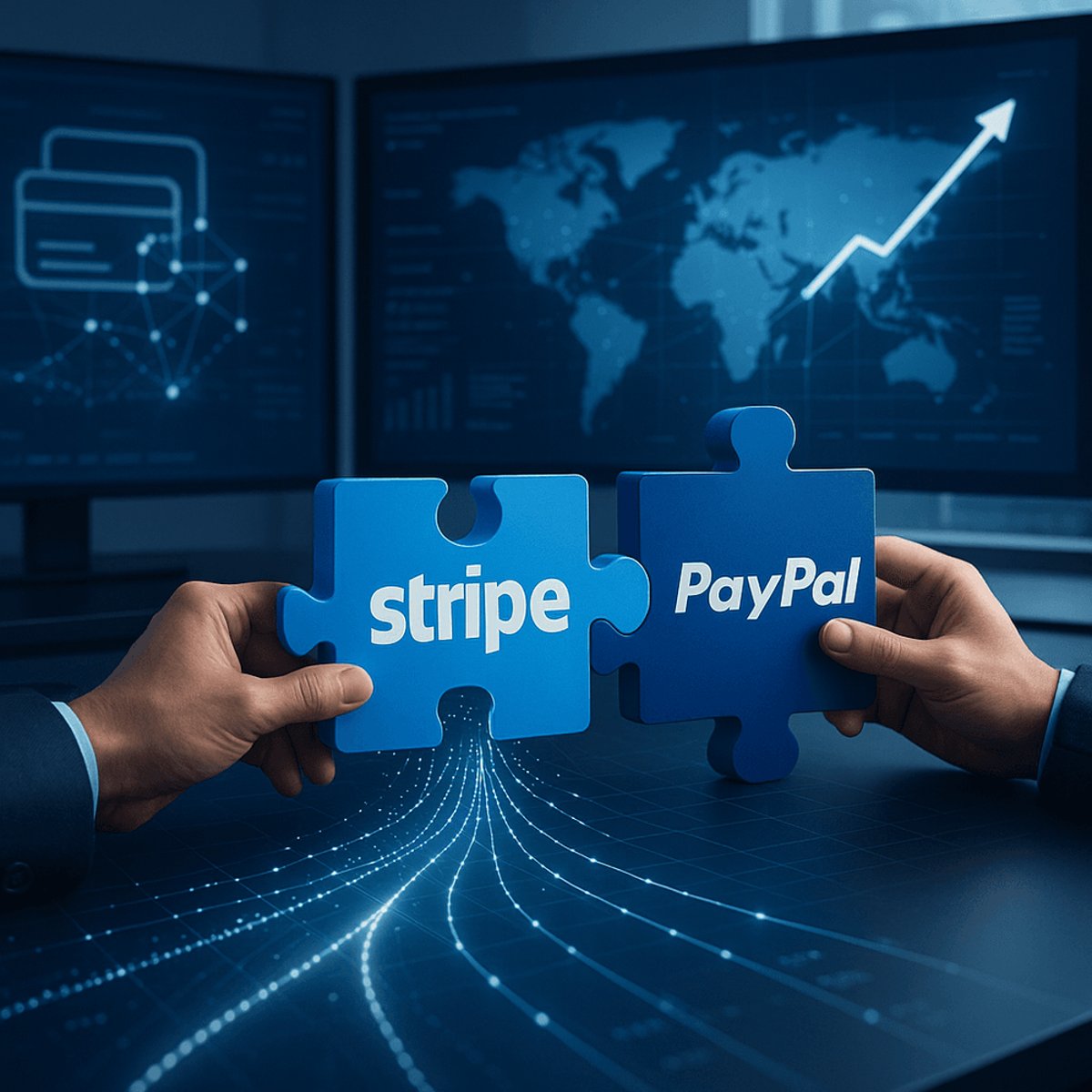
PayPal shares jumped nearly 7% after-hours following reports that Stripe, the fintech darling valued at $159 billion, is exploring an acquisition of the struggling payments pioneer. The potential deal would mark one of the largest fintech mergers in history and could reshape the digital payments landscape, bringing together Stripe's developer-first platform with PayPal's massive consumer base of over 400 million users. PayPal lost nearly a third of its value last year amid mounting competition and slowing growth.
Stripe is reportedly exploring what could be the fintech industry's most consequential acquisition to date. The payments infrastructure company, privately valued at $159 billion, is weighing a potential deal for PayPal, sending the legacy payments giant's stock up nearly 7% in after-hours trading Tuesday.
The market reaction signals investor enthusiasm for a deal that would unite two fundamentally different approaches to digital payments. Stripe built its empire by providing invisible payment infrastructure for developers and platforms like Amazon and Shopify, while PayPal dominated consumer-facing transactions with its ubiquitous checkout buttons and Venmo app. Together, they'd command enormous leverage across both enterprise and consumer payment flows.
For PayPal, the potential acquisition comes at a critical juncture. The company shed nearly a third of its market value over the past year as growth stalled and competitors chipped away at its once-dominant position. Apple Pay grabbed mobile wallet share, while Stripe won over developers with its elegant APIs and transparent pricing. PayPal's attempts to pivot toward cryptocurrency and buy-now-pay-later services failed to reignite momentum.
The timing reflects broader consolidation pressures across fintech. As interest rates normalized and venture funding dried up, the industry's growth-at-all-costs era ended abruptly. Companies that thrived on cheap capital and customer acquisition suddenly needed to prove profitability. PayPal's struggles embodied this shift - its transaction volume growth slowed to single digits even as it processed over $1.5 trillion annually.
Stripe's interest in PayPal represents a dramatic strategic pivot for the Collison brothers' company. The payments processor has historically grown through product expansion rather than acquisitions, building everything from fraud prevention tools to corporate cards in-house. Acquiring PayPal would instantly give Stripe access to hundreds of millions of consumers and merchants, plus valuable assets like Venmo and PayPal Credit.
The deal structure remains unclear, but the math is complicated. PayPal's current market cap hovers around $70 billion after last year's selloff, making it theoretically affordable for Stripe at a modest premium. But Stripe would likely need to tap public markets or take on significant debt to finance the transaction, potentially forcing the private company toward an IPO it has long delayed.
Competitive dynamics add urgency to potential deal talks. Block, formerly Square, built a similar empire spanning consumer (Cash App) and merchant services. Adyen captured enterprise market share with its unified commerce platform. Meanwhile, traditional banks like JPMorgan Chase invested billions in payment technology to compete directly with fintech upstarts.
PayPal's brand recognition and distribution network remain valuable despite recent struggles. The company still processes payments for millions of small businesses and maintains deep integrations with e-commerce platforms worldwide. Its Venmo app, though losing ground to competitors, retains cultural relevance among younger users. Stripe could leverage these assets to accelerate its push into consumer payments.
Regulatory scrutiny would be intense. Any combination creating such a dominant payments processor would face antitrust reviews in multiple jurisdictions. The combined entity would control massive shares of both online and mobile payment volume, raising concerns about market concentration and pricing power. Recent regulatory skepticism toward big tech deals could complicate approval.
The reported acquisition talks follow Stripe's most recent valuation round, which priced the company at $159 billion and positioned it as one of the world's most valuable private startups. That valuation reflected confidence in Stripe's ability to expand beyond payment processing into broader financial infrastructure, from treasury management to embedded finance tools for platforms.
If completed, the deal would rank among the largest technology acquisitions ever and mark a stunning reversal of fortune for PayPal. The company that pioneered online payments and survived the dot-com crash would become part of the startup that reinvented payments infrastructure for the mobile era. For Stripe, it would represent a bet that combining developer tools with consumer reach creates unbeatable competitive moats.
The potential Stripe-PayPal combination would fundamentally reshape fintech's competitive landscape, uniting infrastructure dominance with consumer reach in ways no other player can match. But the path from acquisition rumors to closed deal is long and uncertain, particularly for a transaction of this scale and complexity. Investors are betting on synergies, but regulators will scrutinize whether combining two payment giants concentrates too much power. For now, PayPal's 7% pop shows the market believes the company is worth more as part of someone else's vision than continuing on its current trajectory.