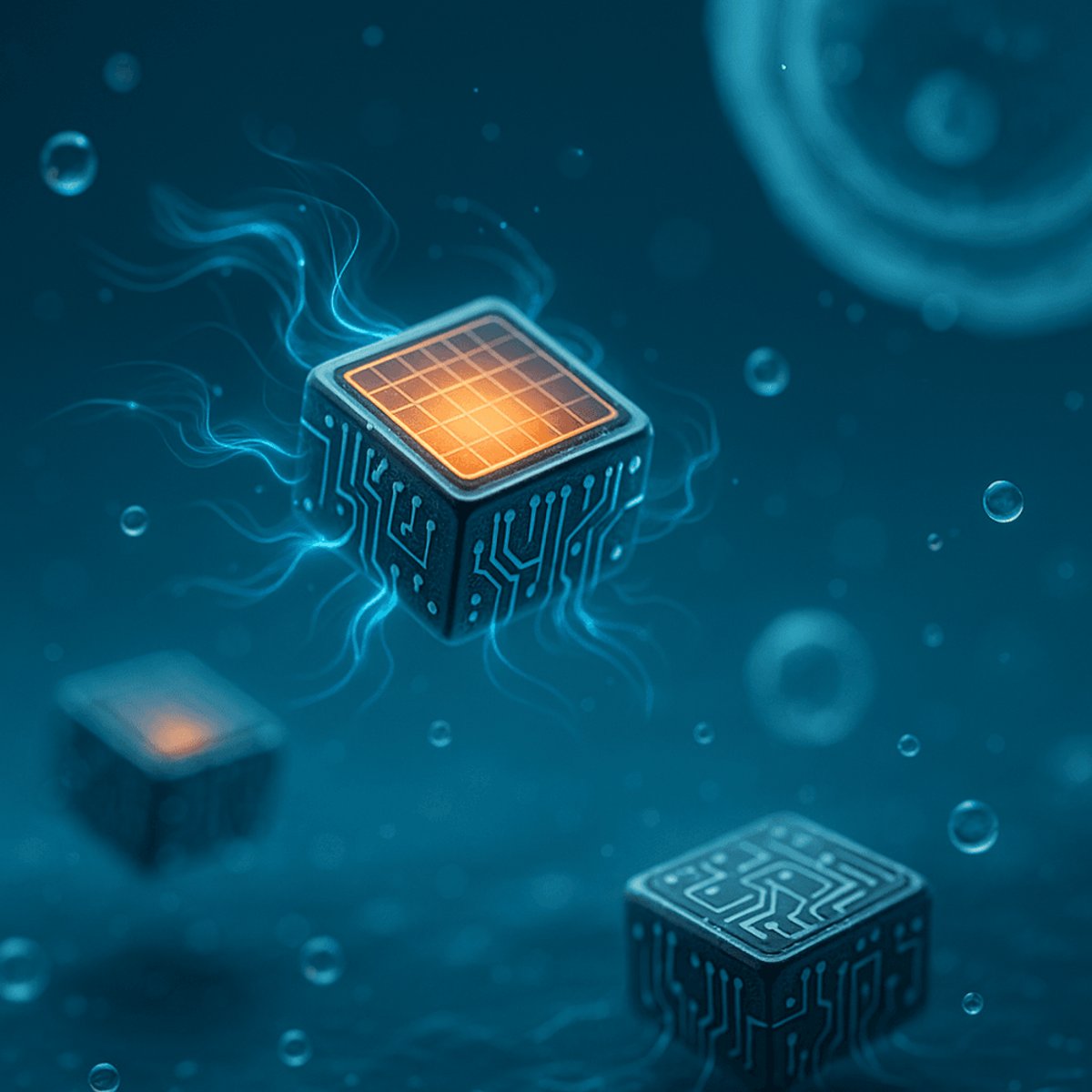
Researchers from the University of Pennsylvania and University of Michigan just shattered a 40-year robotics challenge, building the world's smallest fully autonomous robot at just 0.3 millimeters - smaller than a grain of salt. The breakthrough device can sense its environment, make independent decisions, and swim underwater for months powered only by light, all while costing just 1 cent per unit to manufacture. This marks the first time engineers have successfully miniaturized a complete autonomous robot below the 1-millimeter threshold that's stumped the field for decades.
The race to miniaturize robotics just hit a historic milestone. A joint team from the University of Pennsylvania and University of Michigan announced they've built a fully autonomous robot measuring just 200 x 300 x 50 micrometers - roughly 0.3 millimeters on its longest side. That's smaller than a grain of salt and far below the 1-millimeter threshold that's eluded engineers for four decades.
"We've succeeded in miniaturizing an autonomous robot to 1/10,000th the size of a conventional robot," Mark Miskin, assistant professor of electrical systems engineering at Penn, told the university in a public statement. "This opens up a whole new scale for programmable robots."
The breakthrough isn't just about size. These microscopic swimmers can sense their surroundings, make independent decisions, and operate for months without any external controls like wires or magnetic fields. The team published their findings in Science Robotics this week, documenting how they overcame fundamental physics problems that change dramatically at microscopic scales.
The propulsion system represents a complete departure from conventional robotics. While fish and larger organisms swim by pushing water backward - following Newton's third law of motion - that approach fails at microscopic scales where water viscosity becomes overwhelming. "Pushing water on a microscopic scale is like pushing sludgy tar," the researchers explain in their paper.
Miskin's team solved this by ditching mechanical movement entirely. Instead, the robot generates an electric field around its body, gently pushing charged particles in the liquid. Those moving particles drag nearby water molecules, creating currents that propel the robot forward. It's as if the ocean itself is moving while the robot stays still. The device can travel its own body length in one second and change direction by adjusting the electric field, allowing it to follow complex paths or move in coordinated groups like a school of fish.
The biggest advantage? Zero moving parts means extreme durability. According to Miskin, these robots can swim continuously for months on end - a feat impossible for traditional mechanical designs at this scale.
But propulsion alone doesn't make a robot autonomous. David Blau's team at Michigan tackled the computing challenge, building on their record for creating the world's smallest computer. When Blau first met Miskin at a Defense Advanced Research Projects Agency presentation, they realized their technologies could complement each other perfectly. Five years later, they've made it work.
The power constraints were brutal. The robot's tiny solar panels generate just 75 nanowatts - less than 1/100,000th what a smartwatch consumes. Blau's team designed special circuits operating at extremely low voltages to make the numbers work. Space was equally tight, with solar panels consuming most of the surface area and leaving almost no room for computational infrastructure.
The solution required radical rethinking. Instead of writing traditional programs with many instructions, the researchers condensed everything into a single special instruction that fits into the robot's minuscule memory. The result is the first complete computer with processor, memory, and sensors ever mounted on a sub-millimeter robot.
Communication presented another puzzle. The microscopic body can't carry robust communications components, so the team borrowed a trick from nature. The robot translates sensor readings - it can detect minute temperature changes - into programmed "dance moves" that researchers decode through a microscope. "This is very similar to the way honeybees communicate with each other," Blau explains.
Each robot gets a unique ID and can receive different instructions, allowing multiple units to collaborate on complex tasks with different roles. The manufacturing process can produce several hundred robots simultaneously, with production costs hitting just 1 cent per unit.
The implications stretch across medicine and engineering. Operating at the same scale as microbes, these robots could help doctors monitor individual cells or assist engineers in assembling tiny devices. The team sees applications anywhere precise, autonomous operation is needed at microscopic scales - from targeted drug delivery to environmental monitoring in hard-to-reach spaces.
What makes this breakthrough particularly significant is how it solves problems that have plagued micro-robotics for decades. Engineers have successfully miniaturized electronics, but autonomous robots remained stuck above the 1-millimeter barrier. Small mechanical parts are fragile and difficult to manufacture, while the physics change dramatically at microscopic scales where drag and viscosity dominate over gravity and inertia.
By eliminating mechanical movement and radically constraining power and computational requirements, the Penn-Michigan team found a path forward that simply wasn't possible with conventional approaches. The work represents a new paradigm for thinking about robotics at extreme scales.
This breakthrough opens entirely new territory for robotics at scales previously thought impossible. By reimagining propulsion, computation, and communication from the ground up, the Penn-Michigan collaboration solved problems that stymied the field for 40 years. With manufacturing costs at just pennies per unit and operational capabilities lasting months, these grain-of-salt-sized robots could soon be monitoring cells in your bloodstream or assembling microscopic devices too small for human hands. The real revolution isn't just that they made robots smaller - it's that they proved autonomous operation works at the scale of life itself.