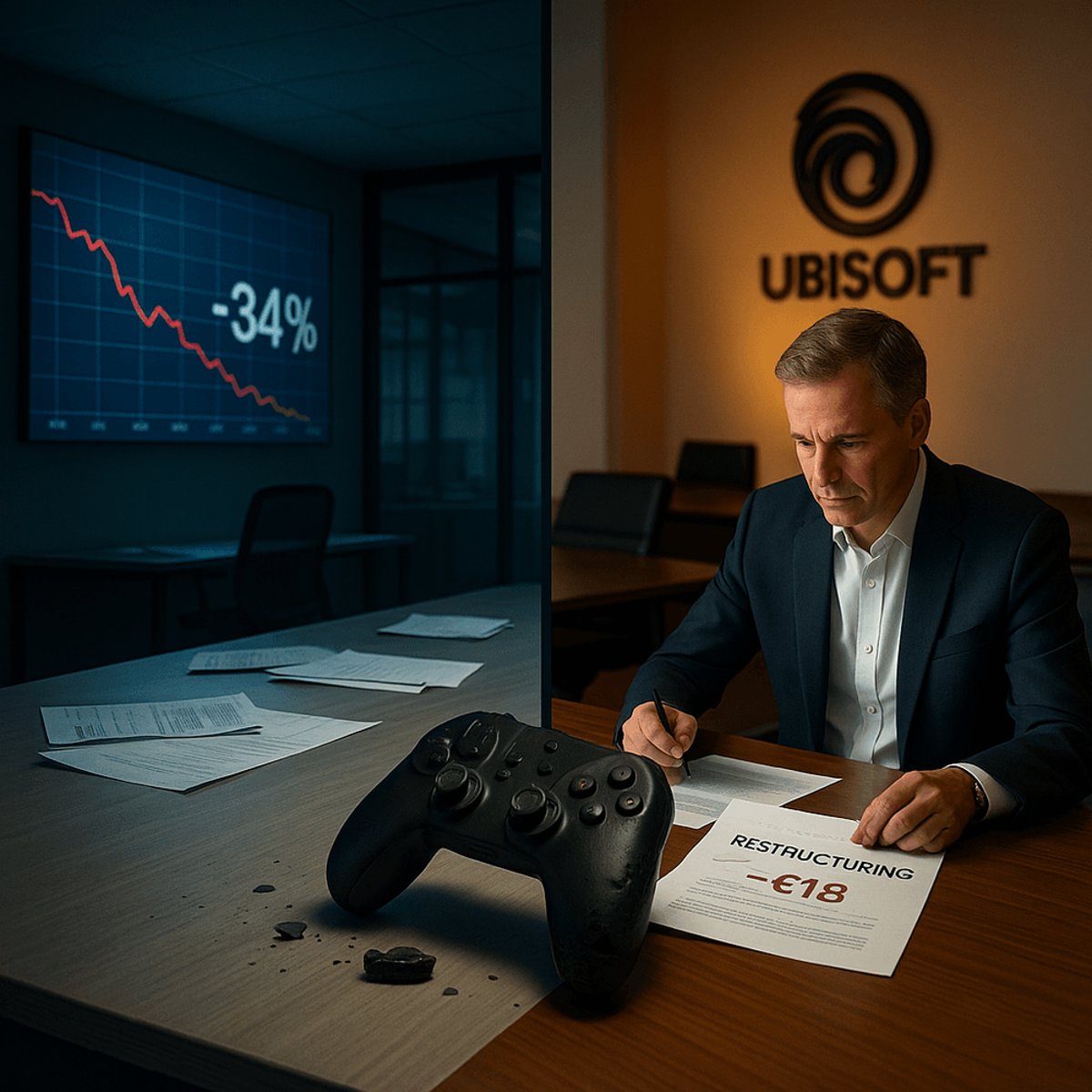
Ubisoft shares nosedived 34% Thursday after the Assassin's Creed publisher unveiled a brutal restructuring plan that cancels six games, closes multiple studios, and forecasts a €1 billion ($1.17 billion) operating loss for 2026. The shake-up marks the company's most drastic move yet to halt years of financial decline that accelerated after the pandemic, with the Paris-listed gaming giant now exploring asset sales to stabilize its bleeding balance sheet.
Ubisoft just delivered the harshest reality check in its 40-year history. The French gaming powerhouse behind Assassin's Creed and Far Cry watched its stock crater 34% Thursday after CEO Yves Guillemot announced a massive restructuring that wipes six games off the development slate and shutters studios across three continents.
The carnage is immediate and sweeping. Studios in Halifax, Nova Scotia, and Stockholm are closing entirely, while facilities in Abu Dhabi, Helsinki, and Malmö face restructuring. According to Ubisoft's Wednesday evening statement, the company expects to book a €1 billion ($1.17 billion) operating loss for the fiscal year ending 2026, driven by a €650 million write-down tied directly to the portfolio reset.
"Today's market environment requires that the Group step-changes how it is organized and operates," Guillemot said in the official statement. It's corporate-speak for what everyone in the gaming industry already knows - Ubisoft's bet on live-service games and delayed blockbusters has spectacularly backfired.
The numbers tell a grim story of decline. Ubisoft slashed its net bookings guidance for fiscal 2026 by €330 million, now expecting just €1.5 billion in revenue. That's a brutal comedown for a company that once dominated AAA gaming. The company's struggles began accelerating after the pandemic gaming boom faded, compounded by high-profile delays to major releases and mounting financial struggles throughout 2025.
But Guillemot is betting big that slashing costs will save the company. Ubisoft expects its restructuring to deliver €500 million in annual savings, driving fixed costs down from €1.75 billion in fiscal 2023 to €1.25 billion by March 2028. That's a 29% reduction in the company's cost base, achieved through layoffs, studio closures, and killing projects that weren't meeting internal benchmarks.
The most telling detail? Ubisoft said it would "consider selling assets" as part of the turnaround plan. For a company that's spent decades building franchises like Rainbow Six, Watch Dogs, and The Division, putting properties on the auction block signals just how dire the situation has become. Industry observers are already speculating which IPs might hit the market - and which rivals like Microsoft, Sony, or Tencent might swoop in.
The restructuring hits at a particularly vulnerable moment for the gaming industry. Major publishers are grappling with skyrocketing development costs, longer production cycles, and increasingly selective consumer spending. Electronic Arts, Activision Blizzard, and others have similarly shed staff and canceled projects over the past two years, but Ubisoft's 34% single-day collapse stands out as one of the sector's most dramatic implosions.
Guillemot acknowledged the pain ahead, noting that "the portfolio refocus will have a significant impact on the Group's short-term financial trajectory, particularly in fiscal years 2026 and 2027." Translation: things get worse before they get better. Investors aren't waiting around to find out if the turnaround works, with Thursday's selloff wiping billions off Ubisoft's market cap.
The six canceled games represent years of development work and millions in sunk costs, though Ubisoft hasn't disclosed which titles got the axe. The company's pivot suggests it's doubling down on proven franchises while abandoning riskier experimental projects - a conservative playbook that might stabilize finances but could also stifle innovation.
For employees at the affected studios, the news is devastating. The Halifax and Stockholm closures will displace hundreds of developers in markets that were growing gaming hubs. Ubisoft's remaining studios will absorb some talent, but the restructuring makes clear that headcount reduction is a key part of hitting those €500 million savings targets.
Ubisoft's brutal restructuring is a bet that shrinking to survive will work better than the company's previous strategy of expansion and diversification. Guillemot promises the reset will deliver "sustainable growth and robust cash generation," but investors just delivered their verdict with a 34% haircut. The next 18 months will determine whether this is a necessary course correction or the beginning of the end for one of gaming's most storied publishers. Watch whether major acquisitions materialize - if Ubisoft starts selling crown jewel franchises, it signals management sees no other path forward.