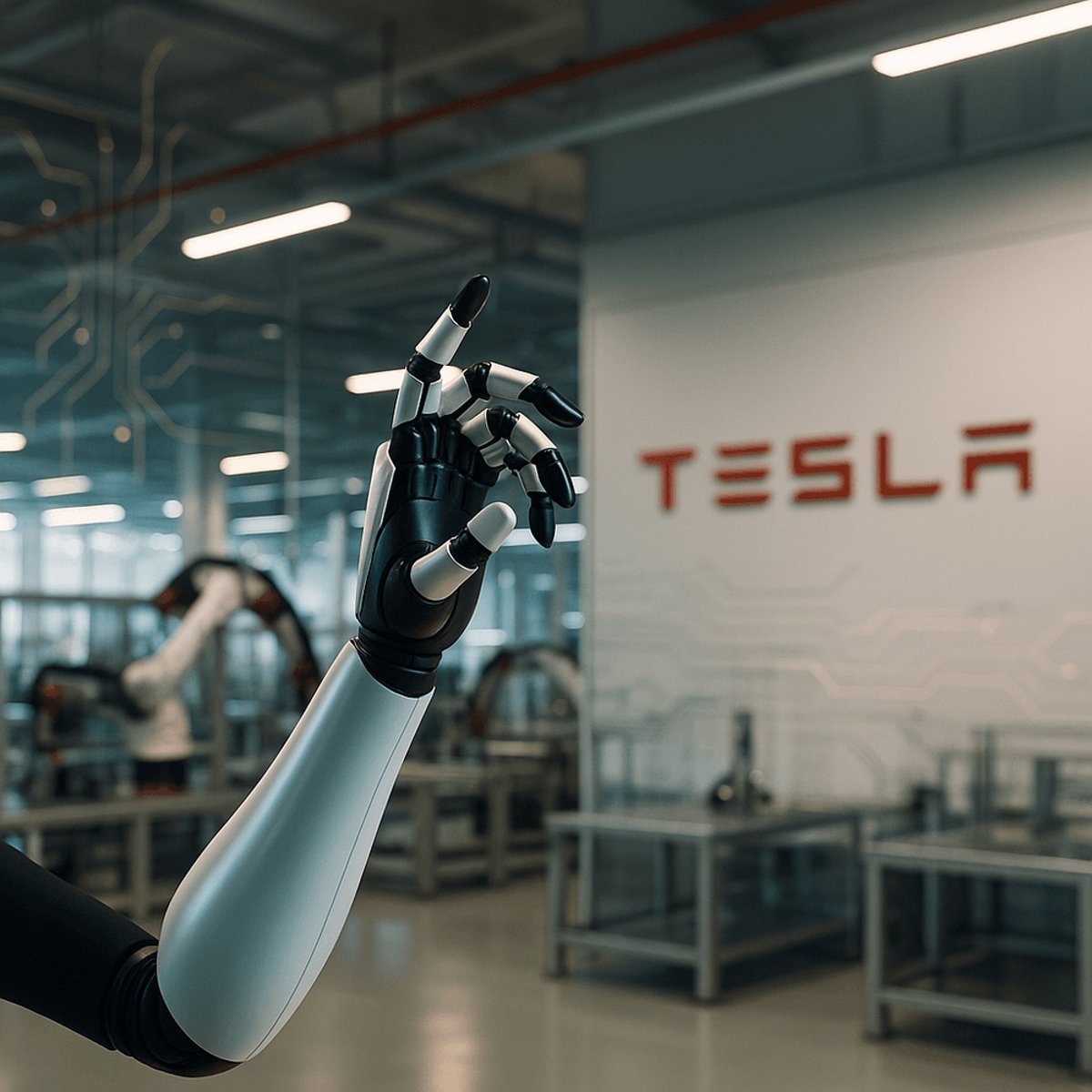
Tesla just announced it's more than doubling capital spending to $20 billion in 2026, marking what analysts are calling a definitive break from its past as an automaker. The company revealed it's ending production of the Model S and Model X - the vehicles that made EVs mainstream - to convert those Fremont factory lines into manufacturing space for Optimus humanoid robots. With automotive revenue down 10% last year and total revenue falling for the first time ever, Elon Musk is making what Canaccord Genuity calls a "burn the ships" commitment to AI, robotics, and autonomous technology.
Tesla is placing a massive bet that its future lies beyond cars. The company disclosed Wednesday it will more than double capital expenditures to $20 billion this year, funding an aggressive push into humanoid robots, autonomous vehicles, and AI chip manufacturing that represents a fundamental transformation of its business model.
The announcement sent Tesla shares down 3.5% to $417.89, extending the stock's January decline past 7%. But the market reaction barely captures the scale of what Musk is attempting - a wholesale reinvention of a company whose automotive revenue still accounts for roughly 70% of its business.
"Forget the Tesla you knew," wrote analysts at Canaccord Genuity in a note following Tesla's fourth-quarter earnings report. "The Tesla of yesterday is gone. We believe Elon Musk has reached a definitive 'burn the ships' inflection point - a total commitment to a vision that leaves no room for retreat."
The most dramatic signal of that commitment came during the earnings call, when Musk announced Tesla is ending production of the Model S sedan and Model X SUV. These weren't just any vehicles - they were the cars that proved EVs could be desirable, high-performance machines. But they represented less than 3% of delivery volume last year, and Musk needs the factory space.
Those Fremont, California production lines will now manufacture Optimus, Tesla's bipedal humanoid robot that the company claims will eventually handle everything from factory work to surgery. Musk admitted on the call that Optimus isn't being used in Tesla factories "in a material way" yet, and described the project as still "very much at the early stages." He said the company wouldn't expect significant production volume "until probably end of this year" - though Musk's timeline predictions have historically proven optimistic.
The company is planning a production line capable of building a million Optimus units annually, an ambitious target for a robot that hasn't hit the market yet. Musk has previously claimed that Optimus could make Tesla a $25 trillion company (current market cap sits at $1.4 trillion) and that 80% of Tesla's value will eventually come from the robots.
CFO Vaibhav Taneja said the $20 billion will fund initiatives across six factories, including a battery storage refinery, development of the driverless Cybercab, the Semi electric truck, and the Optimus factory. "On top of it, we'll also be spending money for building our AI compute infrastructure, and we'll continue investing in our existing factories to build more capacity," Taneja told investors.
The timing is crucial. Tesla's automotive revenue declined 10% in 2025 as the company failed to launch new EV models while facing intensifying competition globally. China's BYD and European automakers like Volkswagen and BMW have been eating into Tesla's market share. Total revenue at Tesla fell last year for the first time on record.
Tesla is also accelerating its robotaxi ambitions. The company launched a Robotaxi-branded ride-hailing app and has been piloting service in Austin, Texas. Last week, Tesla executives said they removed human safety supervisors from some Austin fleet vehicles to conduct fully driverless passenger rides. According to the investor deck released Wednesday, Tesla plans coverage in seven additional U.S. markets during the first half of this year: Dallas, Houston, Phoenix, Miami, Orlando, Tampa, and Las Vegas.
But the competition is fierce. Alphabet's Waymo is rapidly expanding its robotaxi service across U.S. cities, while Baidu's Apollo Go dominates in China. In humanoid robots, Tesla faces challengers like Apptronik and Boston Dynamics domestically, with Chinese companies Unitree and Agibot also pushing hard.
Musk outlined another massive spending category: semiconductor manufacturing. He told investors that key suppliers like Samsung, Taiwan Semiconductor Manufacturing Co., and Micron can't produce enough chips to meet Tesla's future needs. "In order to remove the constraint, the probable constraint in three or four years, we're going to have to build a Tesla TeraFab, a very big fab that includes logic, memory and packaging domestically," Musk said, citing geopolitical risk concerns.
He added that Tesla will be "paranoid" about ensuring it can "continue to build batteries and robots and AI chips no matter what happens." Taneja clarified that the $20 billion spending target for this year doesn't include any TeraFab construction yet, nor does it account for Musk's stated vision to begin solar cell manufacturing in the U.S.
Analysts at Barclays, who rate Tesla as a hold, wrote Thursday that while automotive may still be the core business, ending the Model S and X "marks the symbolic baton pass" into what they call "physical AI." Their assessment: "In case it wasn't clear before, it's more than abundantly clear now that Tesla is not an auto company."
Tesla's $20 billion spending surge represents more than a financial commitment - it's Musk declaring that the company's identity as an automaker is over. With automotive revenue falling and competition intensifying, the pivot to AI, robotics, and chip manufacturing isn't just strategic ambition, it's existential necessity. The big question isn't whether Tesla will spend the money, but whether Optimus robots, robotaxis, and domestic chip fabs can generate returns before the core EV business erodes further. Investors are essentially betting on Musk's ability to build entirely new markets while competitors like Waymo and Boston Dynamics have multi-year head starts. The symbolic end of Model S and X production marks the point of no return - Tesla is all-in on becoming an AI and robotics company, with cars as the side business.