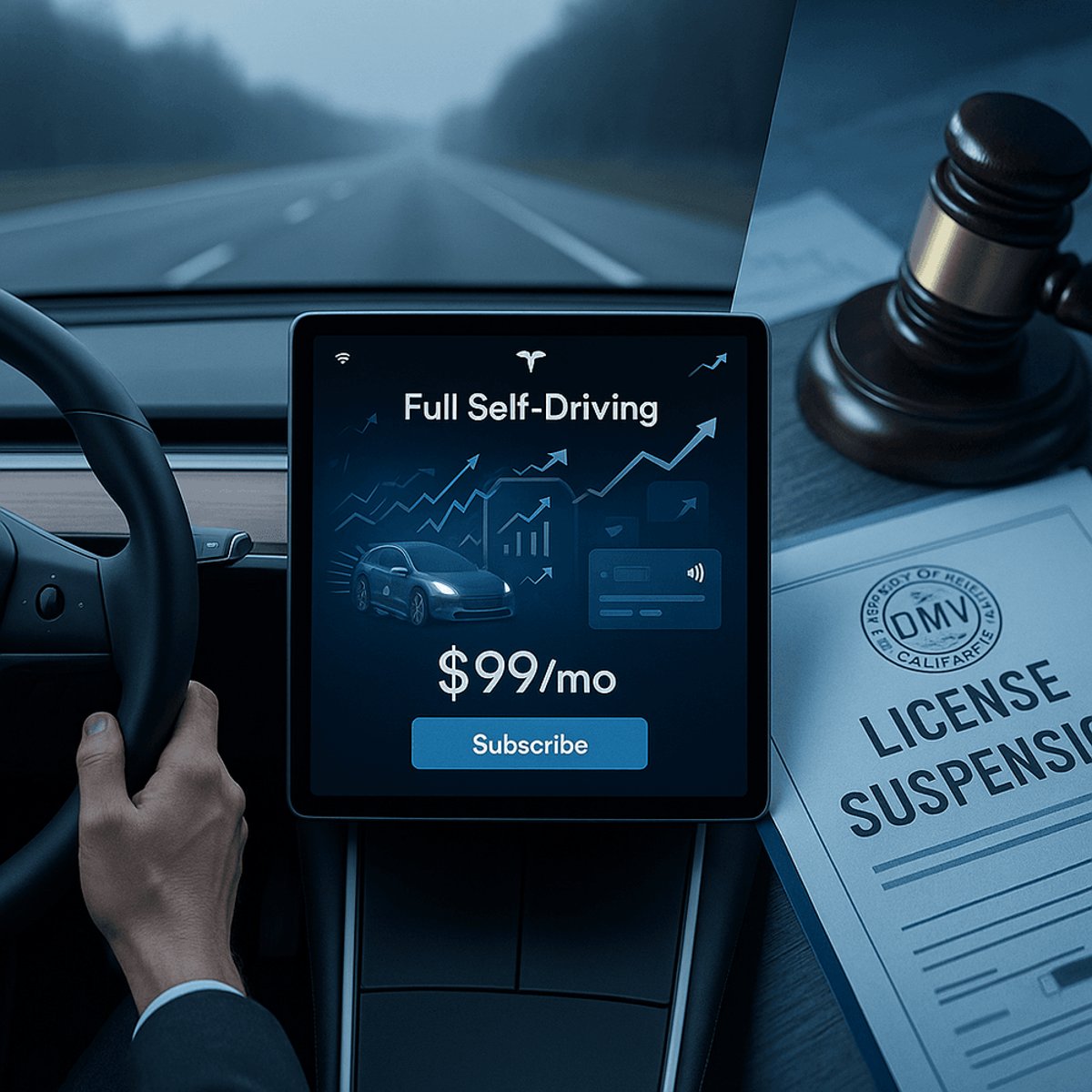
Tesla just pulled the plug on Autopilot, the driver-assistance system that's been standard on its cars since 2019. The move comes as the automaker scrambles to push customers toward its more expensive Full Self-Driving software - and as California prepares to suspend the company's manufacturing and dealer licenses for 30 days over what a judge called years of deceptive marketing about those very same features. It's a high-stakes gamble that could reshape how millions of Tesla owners interact with their vehicles.
Tesla is making a drastic play to rescue its struggling autonomous driving business. The company quietly discontinued Autopilot this week, stripping new vehicles of the lane-centering Autosteer feature that's been a signature capability since the system launched over a decade ago. Now, buyers only get Traffic Aware Cruise Control - basic adaptive cruise that maintains speed and distance from cars ahead - unless they pony up for a Full Self-Driving subscription.
The timing couldn't be more loaded. Tesla faces a 30-day suspension of its manufacturing and dealer licenses in California, its largest U.S. market, after a judge ruled in December that the company engaged in deceptive marketing by overstating Autopilot and FSD capabilities for years. The California DMV stayed the ruling for 60 days to let Tesla comply by dropping the Autopilot name - and the company appears to be doing exactly that, albeit in the most aggressive way possible.
"Tesla's online configuration site now states new cars now only come standard with Traffic Aware Cruise Control," according to TechCrunch. It's unclear whether existing customers will lose access to Autosteer or if the changes only affect new purchases.
The move comes exactly one week after Tesla announced it would eliminate the $8,000 one-time purchase option for FSD starting February 14. From that point forward, customers will only be able to access the software through a $99 monthly subscription - though CEO Elon Musk wrote on X that the price "will increase as the software's capabilities improve." Do the math and that subscription model could extract far more revenue over a vehicle's lifetime than the old upfront fee, assuming Tesla can actually get people to subscribe.
But there's the problem. FSD adoption has been anemic. Tesla CFO Vaibhav Taneja admitted in October 2025 that only 12% of Tesla customers had paid for the software. That's a disaster for Musk personally - hitting "10 million active FSD subscriptions" by 2035 is one of the key targets required for him to collect the full payout of his controversial $1 trillion compensation package.
So now Tesla is essentially forcing the issue. Take away the middle-tier option, and suddenly that $99 monthly fee starts looking more palatable to customers who want anything beyond basic cruise control. It's a classic product tiering strategy, except it's happening against the backdrop of regulatory action and a decade of overpromising on autonomous driving capabilities.
Autopilot first appeared in the early 2010s after acquisition talks broke down between Musk and Google over leveraging technology from what would eventually become Waymo. Tesla made the system standard on all vehicles in April 2019, combining Traffic Aware Cruise Control with Autosteer for lane-centering on highways and curves.
But across that decade-plus run, Tesla consistently struggled to communicate what Autopilot could and couldn't do. The name itself suggested full autonomy to many drivers, leading to over-reliance that contributed to hundreds of crashes and at least 13 fatalities, according to the National Highway Traffic Safety Administration. Federal investigators have documented instances of drivers sleeping, watching movies, and playing video games while Autopilot was engaged.
Musk continues to push the boundaries of what he claims the technology can do. In December, he said a new FSD version allows drivers to text while driving - even though texting while driving is illegal in almost all states. He's promised "unsupervised" driving where occupants can "be on your phone or sleeping for the entire ride."
Those promises are starting to materialize in limited forms. On Thursday, Tesla launched robotaxi versions of its Model Y SUVs in Austin with no human safety drivers in the vehicles - though company cars still follow them for supervision. The vehicles run a more advanced version of the driving software that's not yet available to consumers.
Meanwhile, competitors like Waymo are already operating fully driverless taxi services in multiple cities without the need for follow cars. The gap between Musk's vision and Tesla's actual capabilities remains vast, even as the company bets its product strategy on closing it.
For Tesla owners who've come to rely on Autosteer for daily commutes, the discontinuation represents a significant feature downgrade unless they subscribe to FSD. And for the broader industry watching California's regulatory crackdown, it's a warning shot about the consequences of overpromising on autonomous capabilities.
Tesla's decision to kill Autopilot is a calculated risk that could either finally drive FSD adoption or alienate customers who see it as a cynical cash grab. With California regulators breathing down the company's neck and Musk's compensation package hanging in the balance, the pressure to convert customers into monthly subscribers has never been higher. But forcing people to pay $99 a month for features that still require constant supervision - and that have been linked to fatal crashes - is a tough sell. The next few months will reveal whether Tesla can successfully reposition FSD as indispensable, or whether customers simply stick with basic cruise control and look elsewhere for their next vehicle.