Tesla is holding its ground in China's brutal EV battlefield, but the fight's getting tougher. The company shipped 69,129 vehicles from its Shanghai Gigafactory in January, up 9% year-over-year, according to data from the China Passenger Car Association. But the modest bump masks deeper trouble - Tesla's annual China sales actually fell 4.8% in 2025, making it one of only two manufacturers in Beijing reporting declining numbers. And now there's a new curveball: China just announced regulations that'll effectively ban Tesla's signature flush door handles starting January 2027.
Tesla just posted numbers that tell two very different stories about its China business. The surface looks fine - 69,129 vehicles shipped from Shanghai in January, a 9% bump from the same month last year. But dig deeper and the cracks start showing.
The January delivery figures landed Tesla in third place among Chinese EV manufacturers, miles behind BYD's commanding 205,518 units and Geely's 124,252, according to China Passenger Car Association data published Wednesday. More concerning is what happened over the full year - Tesla's China-produced EV sales dropped 4.8% in 2025, making it one of only two manufacturers in Beijing that reported declining annual sales.
The disconnect between January's modest growth and 2025's overall decline reveals the fundamental challenge Tesla faces in the world's largest EV market. Those monthly delivery numbers represent total shipments from the Shanghai Gigafactory to domestic and foreign markets across Europe and Asia-Pacific, not actual Chinese consumer demand. New registrations in Europe rose slightly in January, according to Reuters, suggesting some of that Shanghai production is just flowing overseas.
Back in China, Tesla's pricing problem is getting worse. The company's base Model 3 sedan runs around 235,500 yuan ($33,943), nearly three times the 79,800 yuan price tag on BYD's Seal. That's a brutal gap when Chinese consumers are increasingly price-sensitive and spoiled for choice among dozens of competitive local brands.
Tesla's response has been to lean harder into promotional financing. The company's Chinese website now advertises five-year 0% interest loans or seven-year "ultra-low" rate financing for orders placed before February 28. It's the kind of desperate-sounding offer that signals just how intense the competition has become.
"We have really intense price wars that have gone on, although the government and industry have called on automakers to not engage with aggressive pricing strategies," Abby Tu, principal research analyst from S&P Global Mobility, told CNBC. Despite government pleas for restraint, Chinese EV makers keep slashing prices in what's become a race to the bottom.
The broader market isn't helping either. New energy vehicle sales in China - which include both battery and hybrid-powered cars - grew just 1% year-over-year in January, according to CPCA data. That marks the fourth consecutive month of slowing growth, a trend that's expected to continue after Beijing reinstated a 5% purchase tax on NEVs starting January 1. Chinese buyers had been exempt from the full 10% tax for more than a decade.
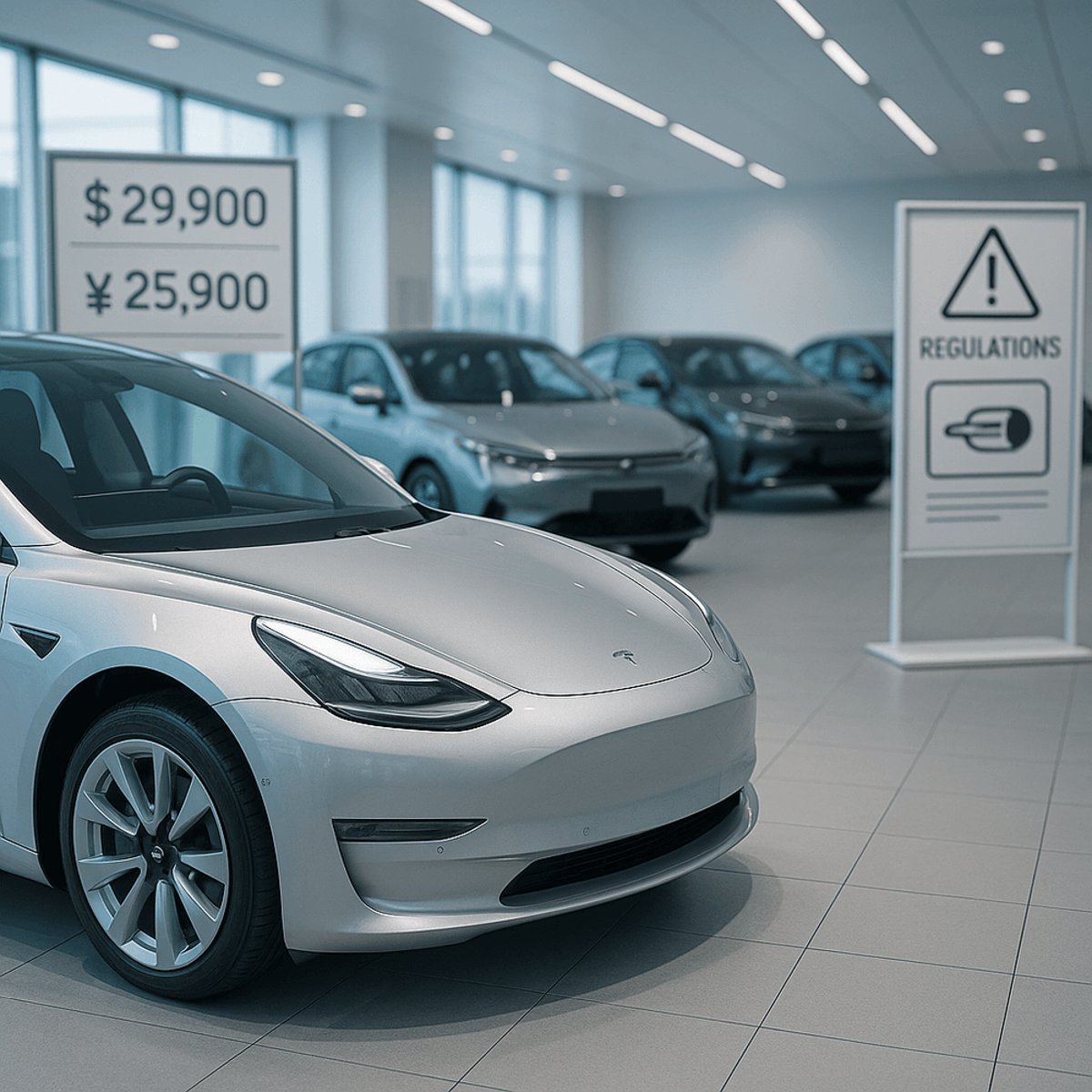
But here's where things get really interesting for Tesla. On Monday, China's Ministry of Industry and Information Technology announced new safety regulations that'll effectively ban concealed door handles starting January 1, 2027. All cars sold in China will need interior and exterior mechanical door releases - a direct challenge to Tesla's signature flush door handle design.
The regulations follow several high-profile incidents in the U.S. and China where EV occupants couldn't escape after vehicles caught fire because power failures disabled the door-locking mechanisms. It's a genuine safety concern, but it also happens to target one of Tesla's most recognizable design elements.
Tu Le, founder and managing director of consulting firm Sino Auto Insights, sees China's new door handle restrictions as likely to pose a "decent sized headache" for Tesla. The company popularized flush door handles as part of its minimalist aesthetic, and redesigning them for mechanical releases could dilute that signature look.
For most Chinese automakers, though, the regulations won't come as a shock. "I think for lots of Chinese brands, this new regulation [will not] take them by surprise, because when regulators were drafting the new regulations, they consulted OEMs and industry experts intensively," Le said. That consultation process suggests Chinese manufacturers had advance warning and input - an advantage Tesla may not have enjoyed as a foreign player.
The timing couldn't be worse for Tesla. The company's already struggling with pricing pressure, slowing market growth, reduced government incentives, and declining annual sales. Now it needs to redesign a signature feature to comply with safety regulations that give it less than a year to adapt. Automakers have until January 2027, but retooling production and updating designs across model lines isn't a quick fix.
What makes this particularly challenging is that Tesla can't simply absorb the redesign costs through scale the way it might in other markets. With the Model 3 already priced at nearly triple what BYD charges for comparable vehicles, there's limited room to pass along expenses to Chinese consumers who've shown they'll happily switch to local brands offering better value.
Tesla's China story is becoming a case study in how quickly market dynamics can shift. A 9% monthly bump looks decent on paper, but it can't hide the reality of declining annual sales, crushing pricing pressure from local competitors, and new regulations that'll force expensive redesigns of signature features. With Chinese EV growth slowing to just 1% and government incentives evaporating, Tesla faces a narrowing path forward in the world's largest electric vehicle market. The company has less than a year to figure out how to adapt its iconic flush door handles while somehow closing a pricing gap that puts its vehicles at nearly triple the cost of competitive Chinese alternatives. For a company that built its brand on design and innovation, having to compromise on aesthetics for regulatory compliance - while competitors who helped shape those regulations sail through unscathed - represents a new kind of challenge in China's increasingly protectionist automotive landscape.