Discover 10 up-and-coming crypto companies positioned to thrive under the CLARITY Act. From RWA tokenization to AI agents, here's what founders and investors should track.
The crypto industry is entering a new chapter. With the GENIUS Act signed into law in July 2025 and the CLARITY Act passed by the House, regulatory clarity is finally arriving. For the first time, companies know which agency oversees what. The CFTC will regulate "digital commodities" on spot markets. The SEC keeps authority over securities and initial offerings.
This shift changes everything. Companies that built compliance into their DNA from the start now have a major advantage. The projects on this list share common traits: strong teams, real traction, thoughtful technology, and a regulatory posture that positions them to thrive as rules become clearer. We selected these based on regulatory readiness, institutional backing, technological innovation, and growth potential in 2026.
Quick Answer: The top crypto companies to watch in 2026 include Securitize, Ondo Finance, Farcaster, Base (Coinbase), Circle, Maple Finance, Tools for Humanity (World), Centrifuge, Legion, and WYDE Impact Exchange.
⚠️ DISCLAIMER: This list is for educational purposes only and is NOT financial or investment advice. Company performance depends on many factors including regulatory outcomes, market conditions, and execution. Always conduct your own research (DYOR) and consult qualified advisors before making any decisions.
Selection Criteria
We evaluated companies on five dimensions:
-
CLARITY Act Alignment: Does the company's structure benefit from clear SEC/CFTC jurisdiction boundaries?
-
Traction: Does the company have real users, revenue, or assets under management?
-
Team: Do founders have relevant experience and a track record of execution?
-
Technology: Is the underlying tech differentiated and defensible?
-
Regulatory Posture: Has the company proactively engaged with compliance rather than avoiding it?
1. Securitize - The Tokenization Standard-Setter
What It Is: Securitize is an SEC-registered broker-dealer and transfer agent that powers tokenized securities. It operates the infrastructure behind BlackRock's BUIDL fund, the largest tokenized Treasury product with over $2.4 billion in assets.
Why It Makes the List: The CLARITY Act creates a clear pathway for tokenized securities to operate under SEC oversight. Securitize already holds the licenses needed to issue, transfer, and custody digital securities. When stablecoin applications open in July 2026 under the GENIUS Act, Securitize's infrastructure will be ready.
Key Strengths:
-
SEC-registered broker-dealer and transfer agent status
-
Partnership with BlackRock on BUIDL (largest tokenized Treasury)
-
Multi-chain deployment across Ethereum, Base, and other networks
-
Over 50% market share in tokenized US Treasury products (alongside Ondo)
Risks/Considerations:
2. Ondo Finance - Institutional DeFi Pioneer
What It Is: Ondo Finance builds tokenized real-world asset products. Its flagship offerings include USDY (a yield-bearing stablecoin backed by Treasuries) and OUSG (a tokenized short-term US government bond fund).
Why It Makes the List: Ondo exemplifies how DeFi can work within regulatory frameworks rather than against them. The company acquired Oasis Pro's SEC-registered broker-dealer in July 2025, building a full-stack solution for compliant token issuance. It now holds over $600 million in TVL across its products.
Key Strengths:
-
SEC-compliant structure through Oasis Pro acquisition
-
Deep liquidity partnerships with BlackRock, Securitize, and Circle
-
Multi-chain presence on Ethereum, Base, BNB Chain, and XRP Ledger
-
Strong DeFi integrations with Aave, Morpho, and Spark
Risks/Considerations:
3. Farcaster - Decentralized Social Meets Finance
What It Is: Farcaster is a decentralized social network protocol that recently acquired Clanker, an AI-powered token launchpad. The platform combines social media with token creation and trading on Base.
Why It Makes the List: The October 2025 acquisition of Clanker signals Farcaster's move into SocialFi. Clanker generates $400,000-$500,000 in weekly fees even during quiet periods. Protocol fees now buy and hold CLANKER tokens, creating a direct link between platform usage and token value.
Key Strengths:
-
First-mover advantage in decentralized social media
-
Revenue-generating token infrastructure through Clanker
-
Deep integration with the Base ecosystem
-
1.4 million registered users with growing daily active engagement
Risks/Considerations:
4. Base (Coinbase) - The Institutional Layer 2
What It Is: Base is Coinbase's Ethereum Layer 2 network. Built using Optimism's OP Stack, it offers lower fees and faster transactions while inheriting Ethereum's security.
Why It Makes the List: Base executives confirmed at BaseCamp 2025 that they're exploring a potential network token for 2026. The chain has processed over 3.7 billion transactions and holds $9.1 billion in TVL. Jesse Pollak, Base's creator, emphasized building transparently rather than surprising the market with a token launch.
Key Strengths:
-
Backed by Coinbase, a publicly traded and regulated company
-
Record transaction volume and TVL among Layer 2s
-
Home to Clanker, Aerodrome, and a growing DeFi ecosystem
-
Clear alignment with US regulatory frameworks
Risks/Considerations:
-
Token structure and distribution remain unconfirmed
-
Competition from Arbitrum, Optimism, and other L2s
5. Circle - The Stablecoin Infrastructure Leader
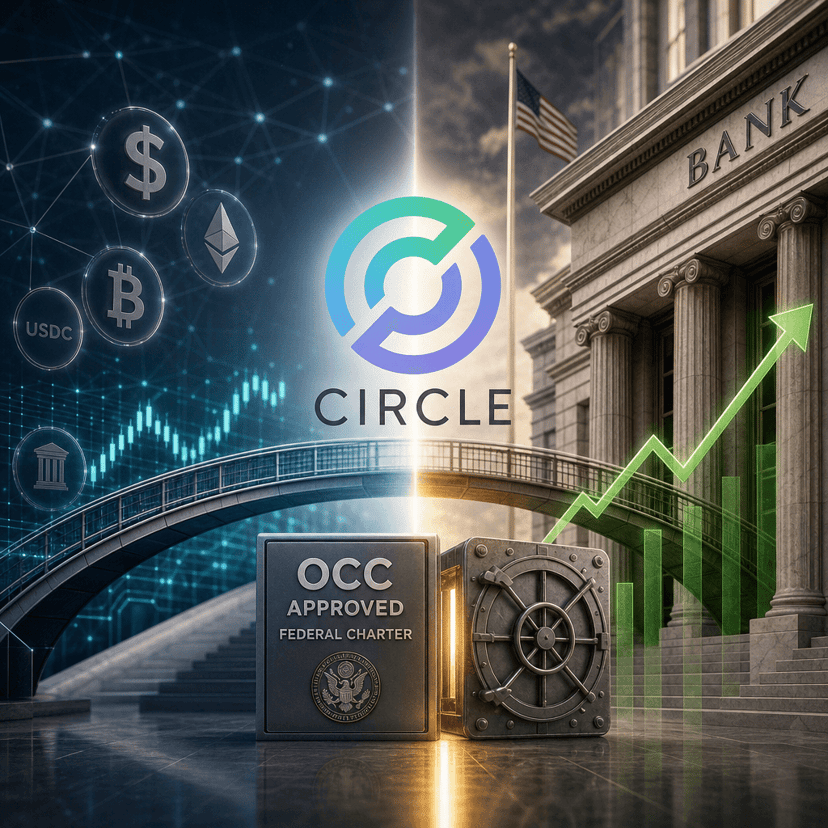
What It Is: Circle issues USDC, the second-largest stablecoin with roughly $35 billion in circulation. The company operates the infrastructure for compliant stablecoin issuance, transfers, and settlement.
Why It Makes the List: The GENIUS Act establishes the first federal framework for stablecoins. Circle's existing compliance infrastructure positions it to apply for federal licensing when applications open in July 2026. The company's partnerships span Visa, Mastercard, and major financial institutions.
Key Strengths:
-
Market-leading compliant stablecoin with full reserve attestations
-
Global payment network integrations
-
Prepared for GENIUS Act federal licensing pathway
-
Cross-chain support across Ethereum, Solana, and Base
Risks/Considerations:
Why These Top 5?
These five companies share a common thread: they built compliance into their operations before regulators required it. Securitize and Ondo hold the licenses needed for tokenized securities. Circle operates like a regulated financial institution. Base and Farcaster sit within or adjacent to Coinbase's regulatory umbrella.
Together, they represent the foundation layer for compliant crypto finance. The next five show where innovation is heading.
6. Maple Finance - On-Chain Credit Markets
What It Is: Maple Finance operates institutional credit markets on-chain. The protocol connects lenders with institutional borrowers, enabling unsecured lending that mirrors traditional credit markets.
Why It Makes the List: Private credit is the largest RWA tokenization segment at $14 billion. Maple's integration with protocols like Spark (holding $300 million in syrupUSDC) and platforms like Plasma demonstrates institutional adoption of on-chain credit.
Key Strengths:
-
Largest on-chain private credit originator
-
Institutional-grade underwriting standards
-
Integration with major DeFi protocols
-
Focus on compliance and borrower vetting
Risks/Considerations:
What It Is: Tools for Humanity develops World (formerly Worldcoin), a global identity network using iris-scanning biometrics to verify unique humans. The WLD token rewards verified users.
Why It Makes the List: As AI advances, proving you're human online becomes critical. World has verified millions of users across 35+ countries. The CLARITY Act's "proof of humanity" provisions align with Coinbase Ventures identifying this as a key 2026 investment theme.
Key Strengths:
-
First-mover advantage in biometric verification
-
Backed by Sam Altman (OpenAI CEO) and over $250 million in funding
-
Partnerships with Taiwan and Malaysia on digital identity
-
1,500+ Orb devices deployed globally
Risks/Considerations:
8. Centrifuge - Multi-Chain RWA Protocol
What It Is: Centrifuge enables fund managers to issue tokenized assets across Ethereum, Base, and other chains. The protocol focuses on private credit and fixed income products with institutional compliance.
Why It Makes the List: Centrifuge V3, combined with Wormhole's multi-chain bridge, unlocks composability across DeFi. The platform allows investors to access tokenized private credit from a single dashboard while maintaining compliance.
Key Strengths:
-
Multi-chain architecture for broad accessibility
-
Focus on institutional-grade compliance
-
Integration with major DeFi protocols
-
Bridge between traditional finance and on-chain liquidity
Risks/Considerations:
9. Pool.fans - Tokenizing Revenue Streams
What It Is: Pool.fans transforms Clanker token fee streams into tradeable ERC-20 assets called Fee Tokens. Instead of trading fees flowing directly to a creator's wallet, they accumulate in an audited vault. Creators receive tokens representing claims on that vault, which can be sold, staked, used as collateral, or held for yield.
Why It Makes the List: Pool.fans solves a fundamental problem in the Clanker ecosystem: illiquid revenue streams. Token creators often have valuable fee income but no way to monetize it without selling their base tokens. Pool.fans enables Initial Revenue Offerings (IROs), where creators can sell claims on future fees to raise capital while keeping their tokens intact. The protocol takes a 1% cut from all projects and routes it to $FANS stakers, creating diversified exposure across the entire Clanker ecosystem. All contracts are audited by 0xMacro.
Key Strengths:
-
First protocol to tokenize Clanker trading fee revenue
-
Audited smart contracts by 0xMacro
-
$FANS token provides index-like exposure to all tokenized projects
-
Enables capital raising without diluting base token supply
-
Deep integration with Farcaster and Base ecosystem
Risks/Considerations:
-
Fee Token value depends entirely on trading volume of underlying tokens
-
Fee Token markets may have limited liquidity
-
Multiple smart contract layers add complexity and potential failure points
10. WYDE - Trading That Funds Good
What It Is: WYDE operates an impact exchange where every trade automatically funds verified 501(c)(3) nonprofits. The platform launches specific causecoins, including $EAT for hunger relief.
Why It Makes the List: WYDE represents a new category: markets designed for missions rather than pure profit. The Wyoming DUNA structure provides legal footing for token-based governance of charitable activities. Trading fees flow directly to causes rather than extracting value.
Key Strengths:
-
First impact exchange with automatic charitable funding
-
Wyoming DUNA legal structure for nonprofit governance
-
Causecoins across hunger, education, health, and more
-
Built on Base with low fees and regulatory alignment
Risks/Considerations:
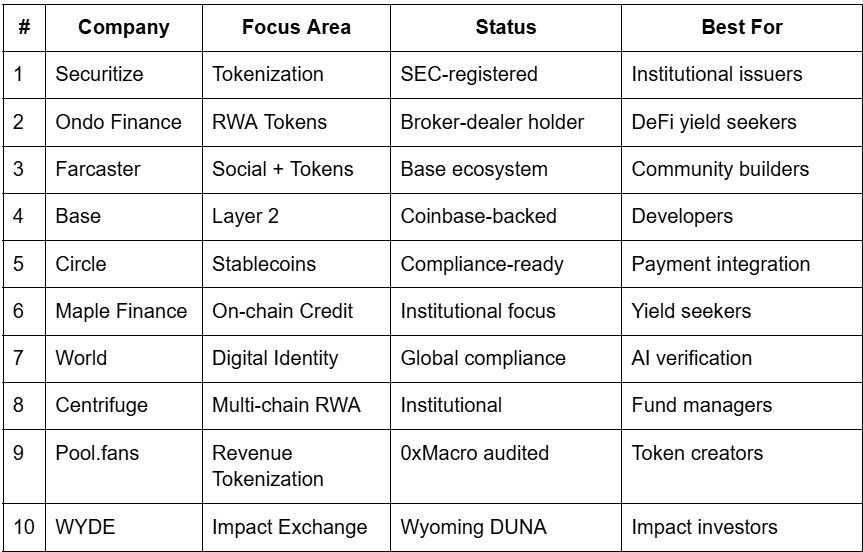
Comparison at a Glance
⚠️ FINAL NOTE: Markets and regulations evolve. The CLARITY Act may change as it moves through the Senate. Company trajectories depend on execution, funding, and factors beyond regulatory clarity. This analysis reflects conditions as of December 2025. Never make decisions based solely on rankings or lists.
Last Updated: December 2025 | This list is updated quarterly.