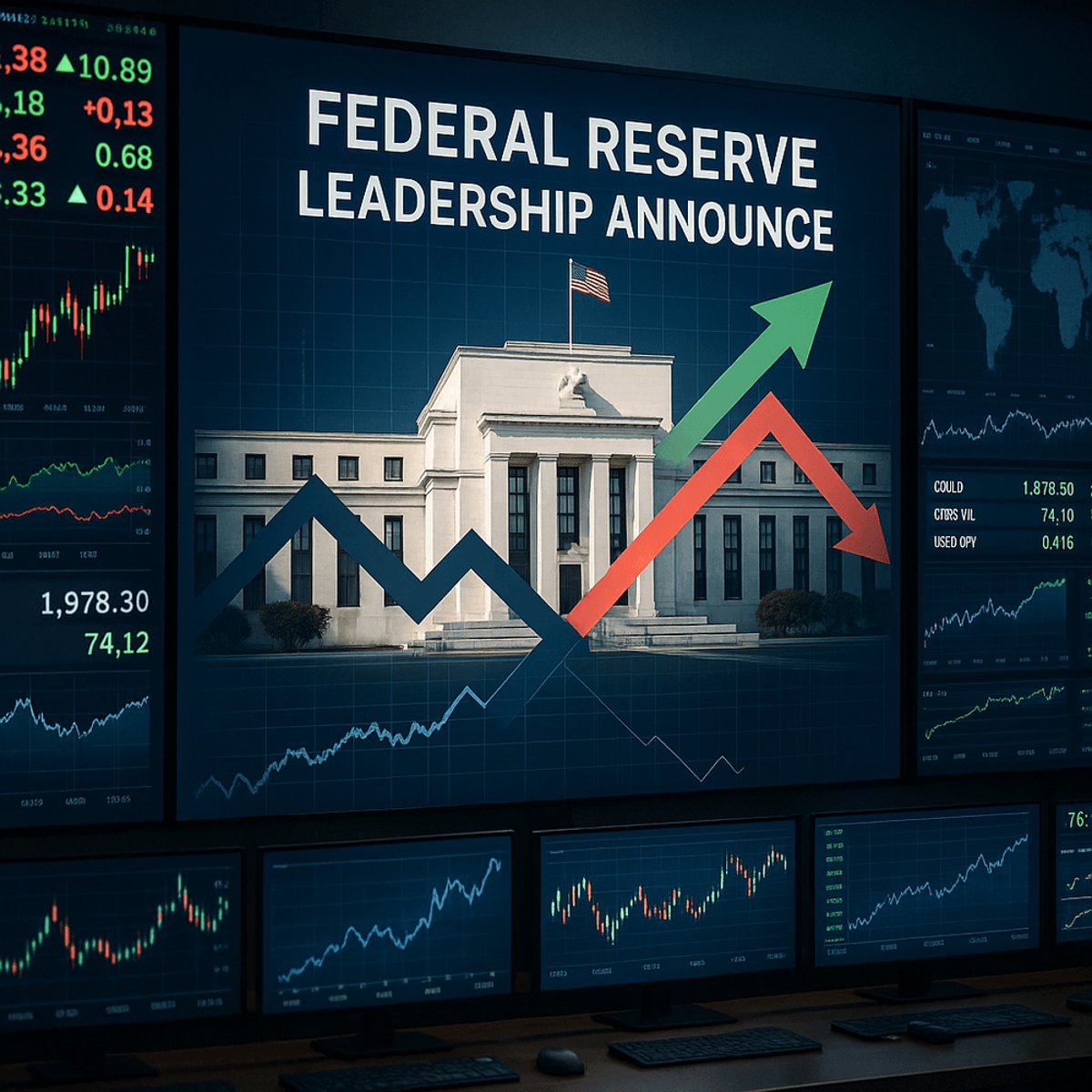
The financial world is about to find out who will steer the $112 trillion global economy. President Donald Trump announced Thursday he'll reveal his pick for Federal Reserve chair Friday morning, with former Fed Governor Kevin Warsh emerging as the clear frontrunner on prediction market Kalshi. The timing couldn't be more charged - markets are already rattled after Microsoft's $357 billion one-day wipeout, and investors are watching every signal from Washington as the current Fed chair's term winds down.
The suspense is nearly over. President Donald Trump said Thursday he'll announce his choice for the next Federal Reserve chair Friday morning, ending months of speculation about who will lead the world's most powerful central bank. Former Fed Governor Kevin Warsh has become the overwhelming favorite on Kalshi, a prediction market platform that's been closely tracking the race.
The timing of Trump's announcement adds another layer of uncertainty to already jittery markets. An administration source told CNBC that Warsh was at the White House on Thursday, the clearest signal yet that he's the likely pick. Trump made his comments on the sidelines of the premiere of the "Melania" film, casually dropping what amounts to one of the most consequential economic appointments of his presidency.
Warsh isn't a household name outside financial circles, but his credentials run deep. He served as a Fed governor from 2006 to 2011, right through the teeth of the financial crisis. At just 35 when he joined the board, he was one of the youngest governors in Fed history. His hawkish views on inflation and skepticism toward extensive monetary stimulus have made him a favorite among conservative economists and Wall Street veterans who've grown wary of the Fed's balance sheet expansion.
The announcement comes as markets are processing a brutal divergence in Big Tech. Microsoft shares cratered 10% Thursday, wiping out $357 billion in market value in its worst single day since March 2020. Investors punished the software giant for disappointing cloud growth and aggressive AI spending plans that raised questions about near-term profitability.
Meta, on the other hand, surged more than 10% as investors bought into the company's AI vision and efficiency gains. Apple landed somewhere in the middle, posting a 16% revenue jump on strong iPhone demand but getting only a tepid 0.5% bump in after-hours trading. The tech-heavy Nasdaq Composite fell 0.72% Thursday while the Dow managed a 0.11% gain.
By Friday morning in Asia, the risk-off mood had spread globally. Bitcoin slid to its lowest level in nearly two months, spot gold dropped over 4%, and Hong Kong's Hang Seng Index retreated nearly 2%. Investors are clearly nervous about what comes next, and the Fed chair announcement isn't helping settle anyone's nerves.
Whoever Trump picks inherits a complex landscape. Inflation has moderated but remains above the Fed's 2% target. Interest rates are still elevated by historical standards. And the new chair will need to navigate Trump's economic agenda, which includes tariff threats and calls for lower rates that could put the Fed's independence to the test. Trump has already renewed threats to bring a lawsuit against current Fed Chair Jerome Powell over building renovations, a sign of the contentious relationship between the White House and the central bank.
The geopolitical backdrop adds another wrinkle. Trump warned the U.K. it would be "very dangerous" to do business with China, according to Reuters, just as British Prime Minister Keir Starmer was in Beijing cutting deals on tariffs and investment. The Fed chair will need to factor global trade tensions into monetary policy decisions, especially if tariffs start showing up in inflation data.
Prediction markets have proven surprisingly accurate in recent political contests, and Kalshi traders are putting their money heavily on Warsh. But Trump has shown a fondness for surprise picks, and the market could still be wrong. Other names that have circulated include current Fed Governor Christopher Waller and economist Kevin Hassett, though neither has gained the traction Warsh has in recent days.
The Fed chair position carries a four-year term and enormous influence over borrowing costs, employment, and economic growth. The chair's decisions ripple through mortgage rates, credit card interest, business loans, and stock valuations. Getting this pick right matters not just for markets but for millions of Americans trying to buy homes, start businesses, or save for retirement.
Wall Street is already gaming out what a Warsh chairmanship would mean. His inflation-fighting credentials suggest he'd be less inclined to cut rates quickly, which could support the dollar but weigh on risk assets. His experience during the 2008 crisis gives him credibility, but his relatively hawkish stance could clash with Trump's stated preference for lower rates to juice economic growth.
Friday morning's announcement will end the speculation but likely start a whole new round of analysis and market volatility. Confirmation hearings will follow, giving senators a chance to grill the nominee on everything from inflation strategy to Fed independence. But for now, all eyes are on Trump and whatever he decides to tweet or announce at what feels like the finale of a high-stakes reality show where the prize isn't a million dollars - it's control over the levers of the global economy.
Trump's Friday morning Fed chair announcement will end months of speculation but kick off a new phase of market uncertainty. If Kevin Warsh gets the nod as prediction markets expect, investors will need to recalibrate their expectations for interest rate policy and Fed independence under an administration that's made no secret of wanting lower borrowing costs. The pick comes at a precarious moment - tech stocks are fracturing, global trade tensions are escalating, and inflation remains stubbornly above target. Whoever takes the helm will face immediate pressure from all sides, with Wall Street, the White House, and Main Street all watching every word and every rate decision. The suspense ends Friday, but the real test begins after that.