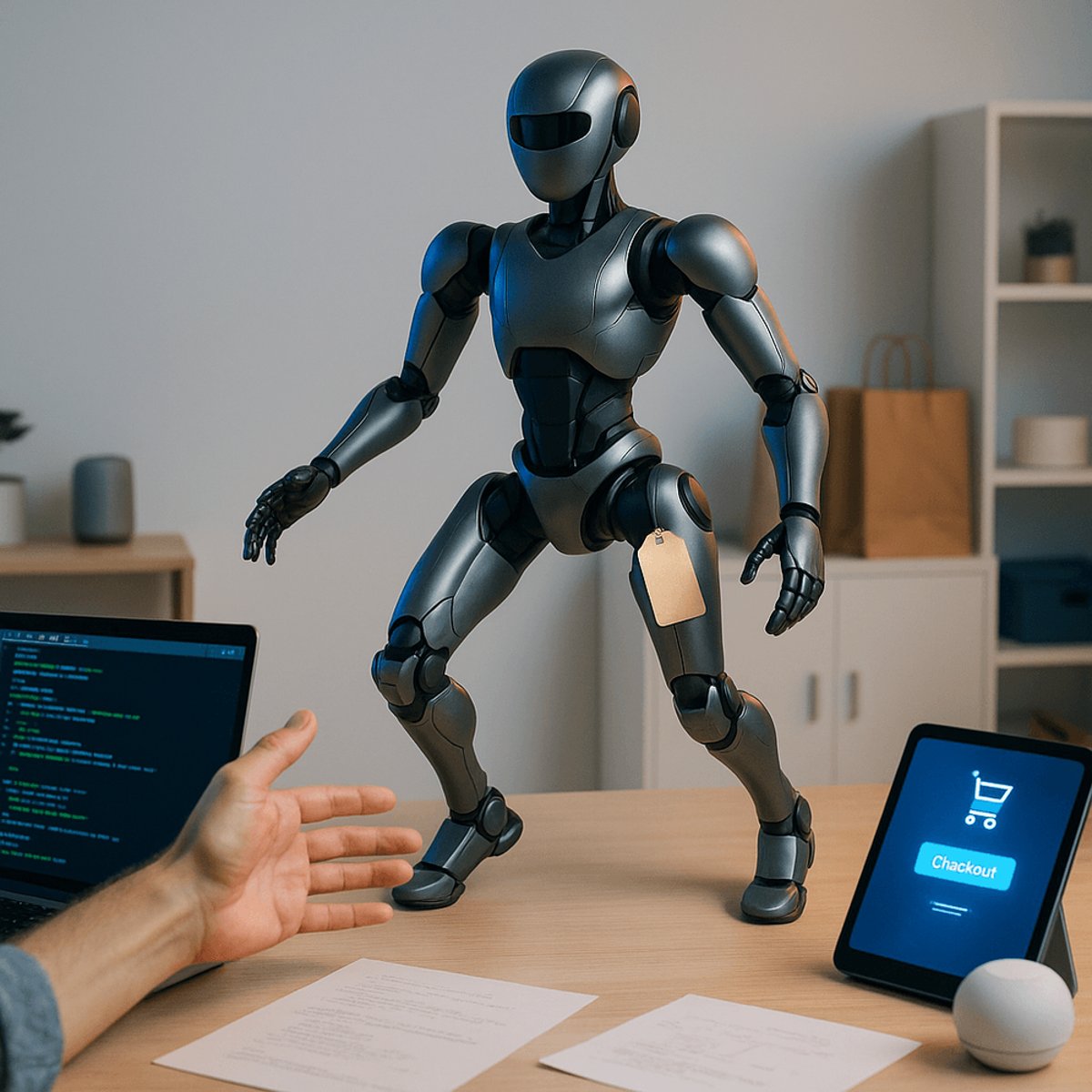
The humanoid robot revolution just got a price tag most people can stomach. Chinese robotics company Unitree is bringing its R1 humanoid to international markets via AliExpress for $4,370, slashing the barrier to entry for advanced robotics by more than 90% compared to competitors like Boston Dynamics' Atlas or Tesla's Optimus prototypes. The move marks a watershed moment in making AI-powered humanoid robots accessible to consumers, researchers, and small businesses - even if nobody's quite figured out what to do with them yet.
Unitree, the Chinese robotics firm that's been nipping at Boston Dynamics' heels with increasingly capable quadruped robots, just dropped a bombshell on the humanoid market. The company's R1 humanoid robot is now available for international pre-order on AliExpress at $4,370, a price point that fundamentally reshapes who gets to play in the robotics sandbox.
To put that in perspective, Tesla's Optimus remains a prototype with no confirmed consumer pricing, while Boston Dynamics' latest Atlas iteration isn't even for sale. Industry estimates peg commercial humanoid platforms between $50,000 and $150,000. Unitree just undercut the entire market by an order of magnitude.
The R1 arrives with specs that would've seemed science fiction a decade ago. According to Wired's coverage, the bot packs aerobatic capabilities - think backflips and dynamic balancing maneuvers that showcase sophisticated motor control and real-time stabilization algorithms. It's the kind of mobility that took Boston Dynamics years and millions in DARPA funding to achieve, now available for less than a used Honda Civic.
But here's where things get interesting. Unitree isn't positioning this as a household helper or industrial worker. The company's marketing materials lean heavy on developer potential and research applications, essentially admitting what the entire humanoid robotics industry is quietly grappling with - nobody's cracked the killer use case yet.
"The question of what you'd actually do with it remains open," as Wired's Marco Trabucchi puts it, and that's not just journalistic skepticism. It's the fundamental challenge facing consumer robotics in 2026. We've got the hardware, the AI, the mobility stack. What we don't have is a compelling answer to 'why does a household need a humanoid robot?'
The timing matters. China's robotics push, backed by state subsidies and aggressive R&D investment, is flooding the market with capable hardware before Western competitors finish their safety reviews and regulatory compliance checks. Unitree's move to AliExpress - bypassing traditional distribution channels entirely - accelerates that strategy. You can buy a humanoid robot as easily as ordering a smartphone case.
For developers and researchers, this represents a genuine breakthrough. University robotics labs that previously shared a single $100,000 platform can now outfit entire teams. Startups building AI applications for embodied systems suddenly have affordable test beds. The democratization isn't just about price - it's about iteration speed. More robots in more hands means faster software development, more edge case discovery, more creative applications.
The aerobatic capabilities hint at Unitree's long game. Dynamic mobility isn't about parlor tricks - it's about navigating real-world environments that weren't designed for robots. Stairs, uneven terrain, recovering from collisions. These are the baseline requirements for any practical deployment, whether that's warehouse work, elderly care, or disaster response. Unitree's betting that demonstrating superior mobility at consumer prices forces competitors to either match the cost or explain why their robots justify 10x premiums.
There's also a subtle AI angle here. The R1 likely runs Unitree's latest control algorithms, which increasingly incorporate machine learning for adaptive movement and task planning. At this price point, it becomes a platform for training embodied AI models at scale - something OpenAI and Google have discussed but haven't shipped consumer hardware for. The robot becomes the training ground.
The AliExpress distribution strategy deserves scrutiny too. It bypasses traditional robotics sales channels - no enterprise contracts, no B2B negotiations, just add to cart and wait for shipping. That's either brilliant market expansion or a sign that Unitree couldn't crack traditional distribution. Either way, it puts humanoid robots in the same browsing category as drones and 3D printers - consumer electronics, not specialized equipment.
What happens when several thousand R1 units hit living rooms, garages, and university labs over the next year will tell us a lot about the humanoid robotics market's real maturity. Will developers build that killer app? Will safety concerns emerge at scale? Will users find creative applications Unitree never imagined? Or will $4,370 humanoids join hoverboards and VR headsets in the closet of overhyped tech?
The hardware is clearly ready. The price is right. The distribution exists. Now it's on the robotics community - and curious consumers with disposable income - to figure out what these machines are actually for. Unitree just removed the biggest excuse for not trying.
Unitree's $4,370 R1 isn't just a product launch - it's a challenge to the entire robotics industry's assumptions about pricing, distribution, and market readiness. By making humanoid robots as accessible as high-end consumer electronics, the company is forcing the question: if cost isn't the barrier anymore, what is? The answer will define whether 2026 marks the beginning of the humanoid robot era or just another round of hardware waiting for software to catch up. Either way, thousands of developers now have affordable access to find out.