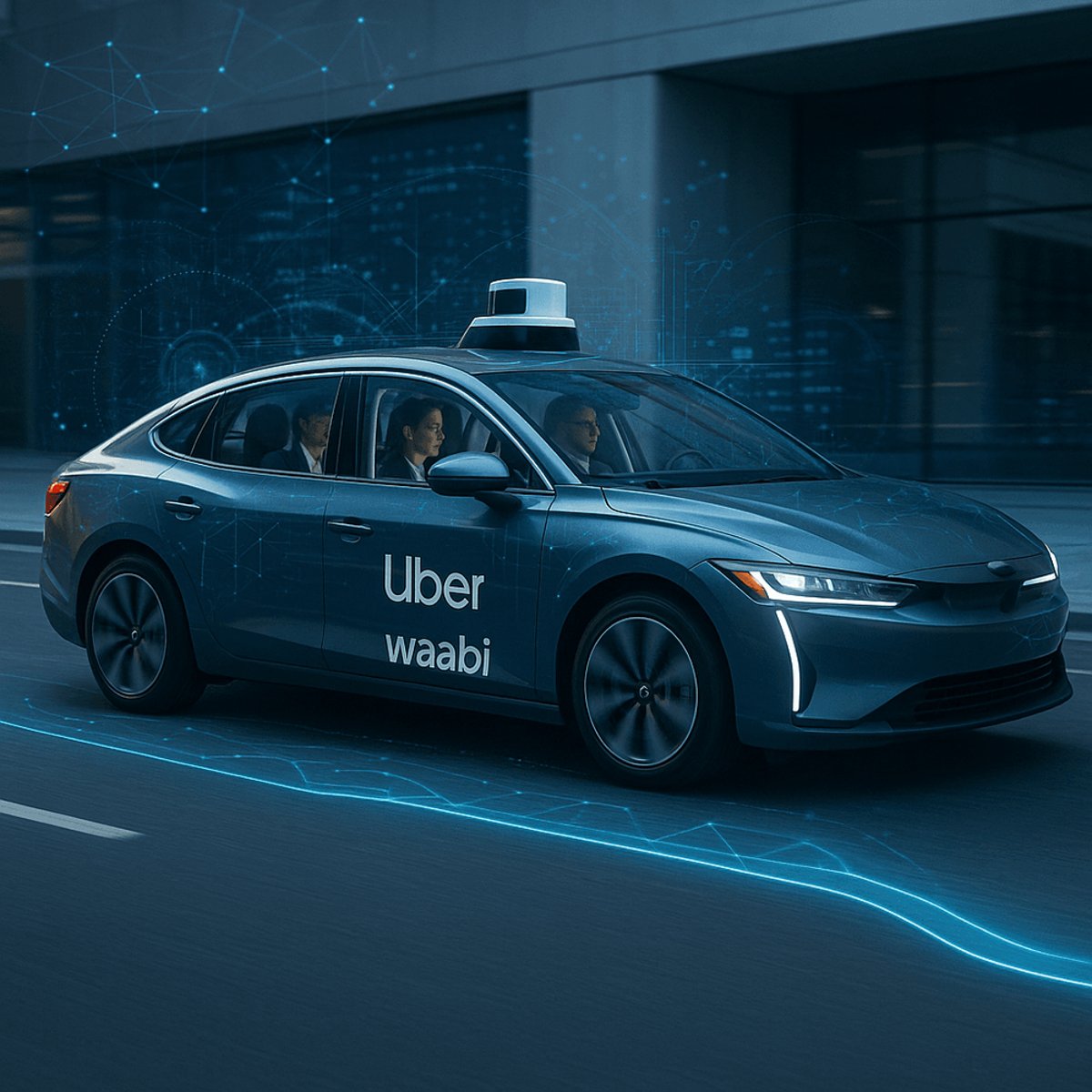
Autonomous vehicle startup Waabi just pulled off one of the biggest funding deals in self-driving history - a combined $1 billion that pairs a $750 million Series C with a $250 million commitment from Uber to deploy 25,000 robotaxis exclusively on its platform. The move marks Waabi's first expansion beyond autonomous trucking and reunites founder Raquel Urtasun with her former employer, where she once served as chief scientist of Uber's now-defunct ATG division.
Waabi just rewrote the playbook for autonomous vehicle funding. The Toronto-based startup closed a monster $1 billion deal that combines traditional venture capital with a strategic deployment partnership, signaling that the self-driving industry is entering a new phase where technology providers and platform operators are betting big together.
The funding breaks down into two pieces: an oversubscribed $750 million Series C co-led by Khosla Ventures and G2 Venture Partners, plus roughly $250 million in milestone-based capital from Uber to support deploying 25,000 or more robotaxis exclusively on its ride-hailing platform. Other backers include Nvidia's NVentures, Volvo Group Venture Capital, Porsche Automobil Holding SE, BlackRock, and BDC Capital's Thrive Venture Fund.
The deal reunites Waabi founder and CEO Raquel Urtasun with Uber, where she previously served as chief scientist at Uber ATG before that division was sold to Aurora Innovation in 2020. "Our incredible core technology really enables, for the first time, a single solution that can do multiple verticals, and they can do them at scale," Urtasun told TechCrunch. "It's not about two programs, two stacks."
That claim puts Waabi on a collision course with industry giants like Waymo, which previously attempted both robotaxis and trucking before shutting down its freight program. The difference, according to Urtasun, is Waabi's capital-efficient AI architecture that can generalize across vehicle types without requiring separate development efforts.
At the heart of Waabi's strategy is something called Waabi World, a closed-loop simulator that automatically builds digital twins from real-world data, performs real-time sensor simulation, and stress-tests the Waabi Driver in manufactured scenarios. The system teaches itself to learn from mistakes without human intervention, allowing it to reason about surroundings and choose optimal maneuvers with far fewer training examples than traditional autonomous systems.
"We don't need the gazillion humans to develop the technology and the large fleets that AV 1.0 needs," Urtasun said in the interview. "We don't need the massive data centers, energy consumption, or a gazillion latest chips."
The timing is strategic. The partnership announcement comes just one day after Uber launched Uber AV Labs, a new division that will use its fleet to collect driving data for autonomous vehicle partners. Waabi joins a growing roster of AV companies deploying on Uber's platform globally, including Waymo, Nuro, Avride, Wayve, WeRide, and Momenta.
But Waabi's approach differs from data-hungry competitors. From day one, the company has collected and simulated passenger car data alongside its trucking work - a signal that robotaxis were always part of the long-term plan. Urtasun says the Waabi Brain already generalizes to different vehicle form factors, and she's even hinted that robotics could be the company's next vertical.
The $1 billion infusion brings Waabi's total funding to roughly $1.28 billion after it closed a $200 million Series B in June 2024. That's still well below competitors like Aurora Innovation, which has raised $3.46 billion through venture capital and public markets, and Kodiak Robotics at $448 million. Urtasun argues Waabi's simulation-first approach makes it far more capital efficient.
On the trucking front, Waabi has launched several commercial pilots with safety drivers in Texas and is working with Volvo to build purpose-built autonomous trucks, which the company revealed last October at TechCrunch Disrupt. The company had planned to launch a fully driverless truck on public highways by the end of 2025, but that rollout has been delayed until sometime in the next few quarters as the trucks undergo final validation.
Urtasun says the delay isn't about technology readiness - the Waabi Driver is good to go - but about validating the physical trucks themselves. She's not concerned about demand, pointing to Waabi's direct-to-consumer model that lets shippers buy outfitted trucks directly rather than contracting with a fleet operator.
For the Uber robotaxi deployment, Urtasun wouldn't share specifics like which automaker Waabi would partner with or when the first vehicles might hit the road. The companies provided no timeline for the ambitious 25,000-vehicle target. She did confirm Waabi would take a similar approach to trucking by integrating its sensors and technology at the factory level.
"We believe in vertically integrating with a fully redundant platform from the OEM," she said. "That is how you really build safe and truly scalable technology."
The announcement builds on Waabi's existing partnership with Uber Freight, creating a comprehensive relationship across Uber's mobility and logistics businesses. It also positions Waabi as one of the few companies attempting to crack both the long-haul trucking and urban robotaxi markets simultaneously.
Whether Waabi's AI-first approach can deliver on its promises remains to be seen. The company has operated in relative stealth compared to competitors, with limited public demonstrations of its technology. But the backing from Uber and a roster of heavyweight investors suggests confidence that Urtasun's team can execute on its ambitious dual-market strategy.
Waabi's billion-dollar bet represents a pivotal moment for the autonomous vehicle industry - one where simulation and AI architecture might matter more than miles driven. If Urtasun's team can deliver on its promise of a single technology stack that works across trucking and robotaxis, it could reshape how the industry thinks about scaling self-driving systems. But the real test comes next: proving that capital efficiency and generative AI can overcome the brutal physics of deploying 25,000 robotaxis on public roads. The timeline remains conspicuously absent, and Waabi still needs to launch its first fully driverless truck. For now, the company has the capital and the partner to make a serious run at both markets.