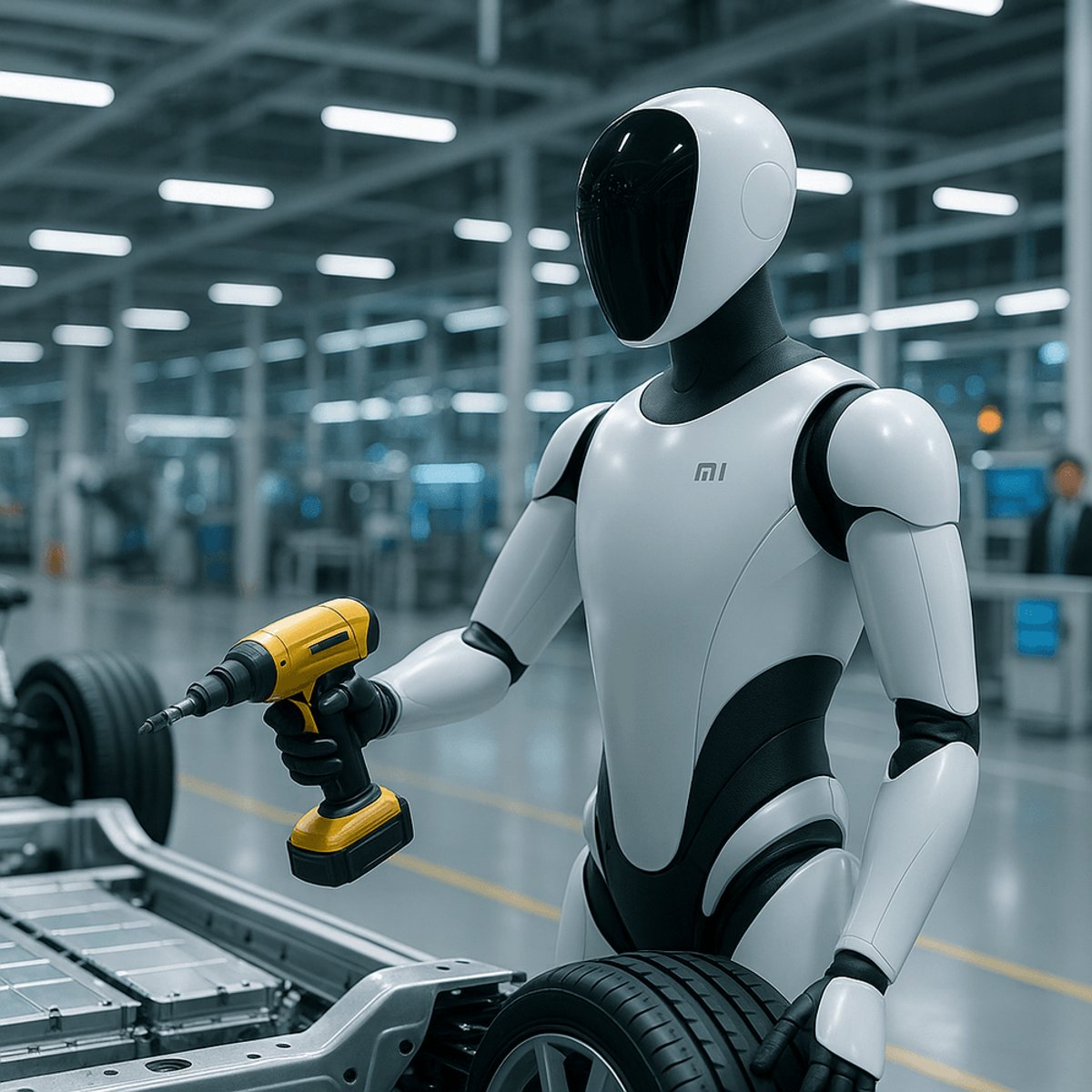
Xiaomi is putting humanoid robots to work on its EV production lines, and the company's president says they're performing like promising interns. In an interview with CNBC, Xiaomi President Lu Weibing revealed that two humanoid robots can complete 90% of assigned work in just three hours—a striking benchmark as manufacturers race to automate increasingly complex assembly tasks. The deployment marks another step in China's aggressive push to dominate both electric vehicles and robotics, two sectors where the country is betting billions.
Xiaomi is quietly turning its electric vehicle factory into a testing ground for humanoid robots, and the early results suggest the machines are learning fast. The Chinese electronics giant has deployed humanoid robots on its EV production lines, where they're tackling manufacturing tasks that typically require human dexterity and judgment.
The performance metrics are eye-catching. Two humanoid robots can complete 90% of their assigned work in just three hours, according to Xiaomi President Lu Weibing, who shared the update in an interview with CNBC. That's a remarkably high completion rate for machines that are essentially learning on the job—which is exactly how Xiaomi's leadership sees them. Lu described the robots as being like "interns," a telling analogy that suggests they're capable but still developing their skills.
The comparison to human workers isn't just colorful language. It signals how Xiaomi is thinking about integrating humanoid robots into complex manufacturing environments. Unlike fixed industrial robots that repeat the same motions endlessly, humanoid robots are designed to navigate spaces built for people, use tools designed for human hands, and adapt to varied tasks. That flexibility comes with a learning curve, but Xiaomi's data suggests the curve is steep in the right direction.
Xiaomi entered the EV market in 2024 with its SU7 sedan, joining a brutally competitive landscape where more than 100 electric vehicle brands are fighting for market share in China. The company has been leveraging its consumer electronics expertise—particularly in software and supply chain management—to carve out a position. Now it's adding robotics to that mix, potentially creating a manufacturing advantage as it scales production.
The timing is strategic. China's robotics industry is exploding, with companies like Unitree and Fourier Intelligence shipping increasingly capable humanoid robots at price points that would have seemed impossible two years ago. Meanwhile, Tesla has been developing its Optimus humanoid robot explicitly for factory work, and other EV makers are watching closely. The manufacturing floor is becoming the proving ground for general-purpose robots.
What Xiaomi is testing goes beyond simple automation. Traditional industrial robots excel at repetitive tasks in controlled environments, but humanoid robots promise something different: the ability to handle varied tasks in spaces designed for humans, without requiring extensive facility redesign. If they can prove their worth in the demanding environment of automotive assembly, the economics of manufacturing could shift dramatically.
The 90% completion rate in three hours raises questions about what constitutes the full scope of work, and what happens with the remaining 10%. Those details matter enormously for understanding whether humanoid robots are months or years away from being truly practical at scale. But Xiaomi's willingness to deploy them on actual production lines—not just lab demos—suggests the company sees a clear path forward.
China's manufacturing sector is under pressure to automate. Rising labor costs, an aging workforce, and intense competition are all pushing companies to find alternatives to human workers for routine tasks. Humanoid robots, if they can deliver on their promise, offer a solution that's more flexible than fixed automation and potentially more cost-effective than expanding human headcount.
For Xiaomi, the robot deployment serves multiple purposes. It addresses immediate manufacturing needs as the company ramps EV production. It generates valuable data about how humanoid robots perform in real-world conditions. And it positions Xiaomi as an innovator in both vehicles and robotics—two sectors where brand perception matters enormously to Chinese consumers.
The "intern" framing is revealing in another way. It suggests Xiaomi expects the robots to improve over time, learning from experience and possibly from human supervisors. That implies an investment in the technology that goes beyond simply buying machines and putting them to work. Xiaomi is betting that these robots will get better, faster, and more capable as the company accumulates experience.
Other manufacturers are watching. If Xiaomi can demonstrate genuine productivity gains from humanoid robots—especially at competitive costs—expect a wave of similar deployments across Chinese factories. The country's manufacturing sector moves fast when proven technologies emerge, and humanoid robots are approaching that threshold.
Xiaomi's humanoid robot deployment is more than a factory experiment—it's a signal of how quickly advanced robotics are moving from research labs to production floors. The 90% completion rate Lu cited suggests these machines are already useful, not just promising. As Chinese manufacturers battle for EV market share while managing labor costs, humanoid robots are becoming a practical option rather than a futuristic concept. The question isn't whether they'll transform manufacturing, but how fast that transformation happens and which companies move first. Xiaomi just made its bet.