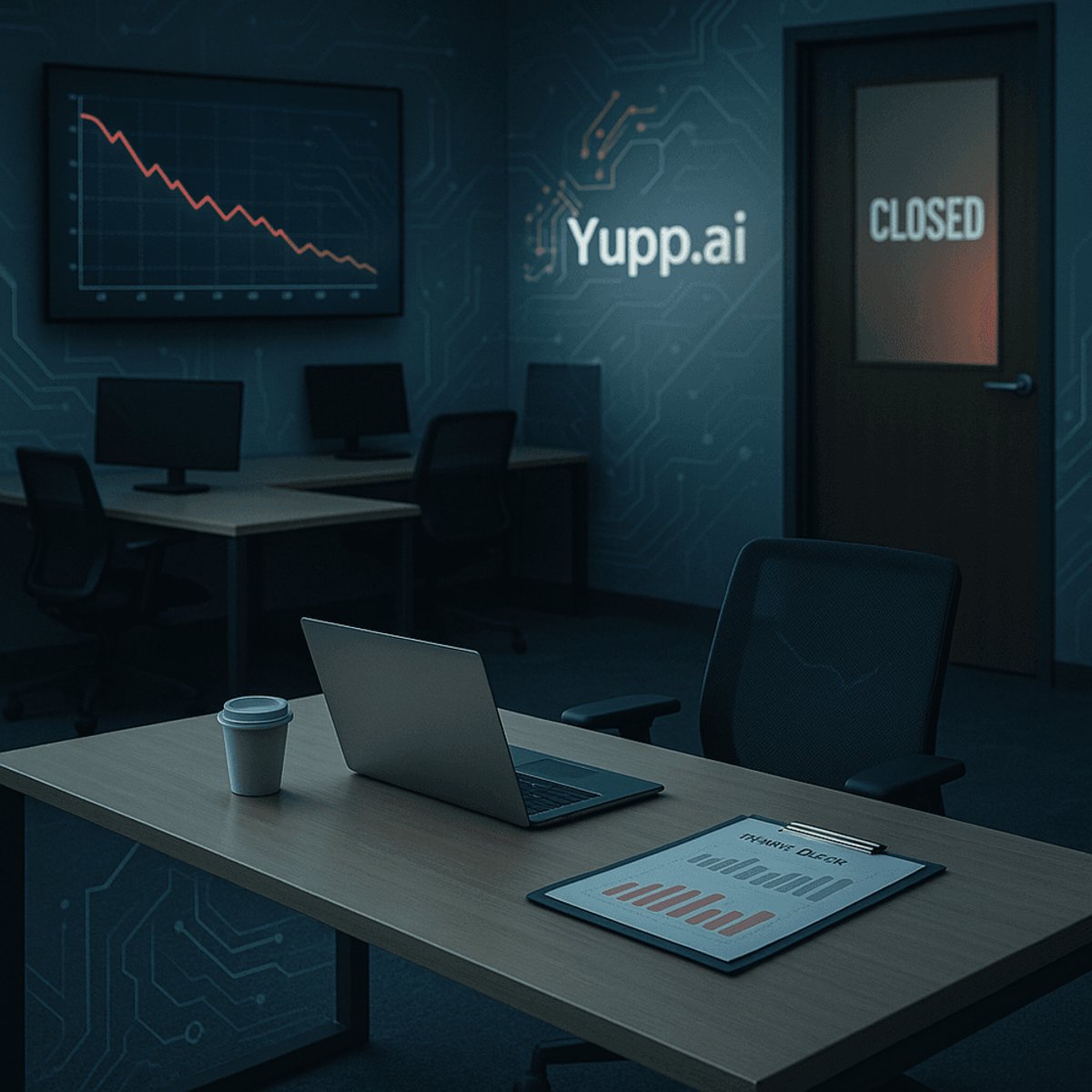
Yupp.ai is shutting down less than a year after launch, the company announced Tuesday, marking one of the most high-profile AI startup failures of 2026. The crowdsourced AI model feedback platform raised $33 million from a16z crypto's Chris Dixon and other top-tier Silicon Valley investors, but couldn't find sustainable footing in an increasingly competitive AI tooling market. The rapid collapse raises fresh questions about investor thesis validation and the viability of consumer-facing AI feedback models.
Yupp.ai is closing its doors, the company confirmed Tuesday, becoming the latest casualty in an AI market that's proving far more unforgiving than many anticipated. The shutdown comes barely 10 months after the startup emerged from stealth with $33 million in backing from a16z crypto's Chris Dixon and a roster of prominent Silicon Valley investors.
The collapse is particularly striking given the pedigree behind it. Dixon, who led Andreessen Horowitz's push into crypto and web3, personally championed Yupp.ai's vision of using crowdsourced human feedback to improve AI model outputs. The startup positioned itself as critical infrastructure for the AI era, promising to help companies fine-tune large language models through distributed human evaluation.
But that vision never translated into sustainable traction. According to TechCrunch, Yupp.ai struggled to differentiate itself in a market where OpenAI, Anthropic, and other major AI labs were building similar feedback mechanisms in-house. The startup's crowdsourced approach faced quality control challenges and couldn't match the scale or integration of enterprise solutions from established players.
The timing reveals how quickly the AI investment landscape has shifted. When Yupp.ai raised its funding round last year, investors were still writing massive checks for anything AI-adjacent. Now, with several high-profile AI startups burning through capital without clear paths to profitability, VCs are demanding proof of product-market fit and revenue traction far earlier than they did 12 months ago.
Yupp.ai's business model faced fundamental headwinds. Crowdsourcing human feedback sounds appealing in theory, but execution proved brutal. The company needed to recruit, train, and retain thousands of evaluators while maintaining quality standards. Meanwhile, potential enterprise customers were already locked into feedback loops with their model providers or building proprietary systems internally.
The competitive landscape crushed any hope of a pivot. OpenAI's reinforcement learning from human feedback (RLHF) pipelines are now industry standard, while companies like Scale AI have sewn up the data labeling and model evaluation market. Yupp.ai entered a space where the incumbents had years of head start and relationships with every major AI lab.
Dixon's involvement makes this shutdown particularly noteworthy. The a16z crypto partner built his reputation spotting early-stage opportunities, from Coinbase to OpenSea. His backing typically signals serious validation, which is why Yupp.ai's $33 million raise turned heads. The rapid failure suggests even top-tier investors are misjudging how quickly AI market dynamics are consolidating around a handful of winners.
For the broader AI ecosystem, Yupp.ai's closure is a canary in the coal mine. Dozens of AI infrastructure startups raised substantial rounds in 2025 on similar premises - that human-in-the-loop systems would be essential for AI development. Many are now facing the same brutal realities: enterprise customers want proven solutions, not experiments, and the window for scrappy startups to establish themselves is shrinking fast.
The shutdown also raises questions about what happens to Yupp.ai's technology and team. In typical Silicon Valley fashion, there's speculation about potential acqui-hires, with larger AI companies potentially scooping up the engineering talent. The intellectual property around crowdsourced feedback mechanisms could have value, even if the standalone business model didn't work.
What's clear is that the AI startup mortality rate is accelerating. After years of frothy funding and sky-high valuations, the market is demanding real businesses with defensible moats and actual revenue. Yupp.ai had the backing, the timing, and the investor validation - but in 2026's AI market, that's no longer enough to survive.
Yupp.ai's swift demise after raising $33 million from one of Silicon Valley's most respected investors sends a stark message to the AI startup ecosystem. Having the right backers and a compelling pitch isn't enough anymore - you need defensible technology, clear product-market fit, and a path to revenue that doesn't depend on outcompeting OpenAI or Anthropic at their own game. As the AI market matures, expect more well-funded startups to meet similar fates, especially those caught between scrappy newcomers and deep-pocketed incumbents with years of head start. The question now is whether this marks the beginning of a broader shakeout in AI infrastructure, or just an isolated case of a startup that couldn't execute on its promise.