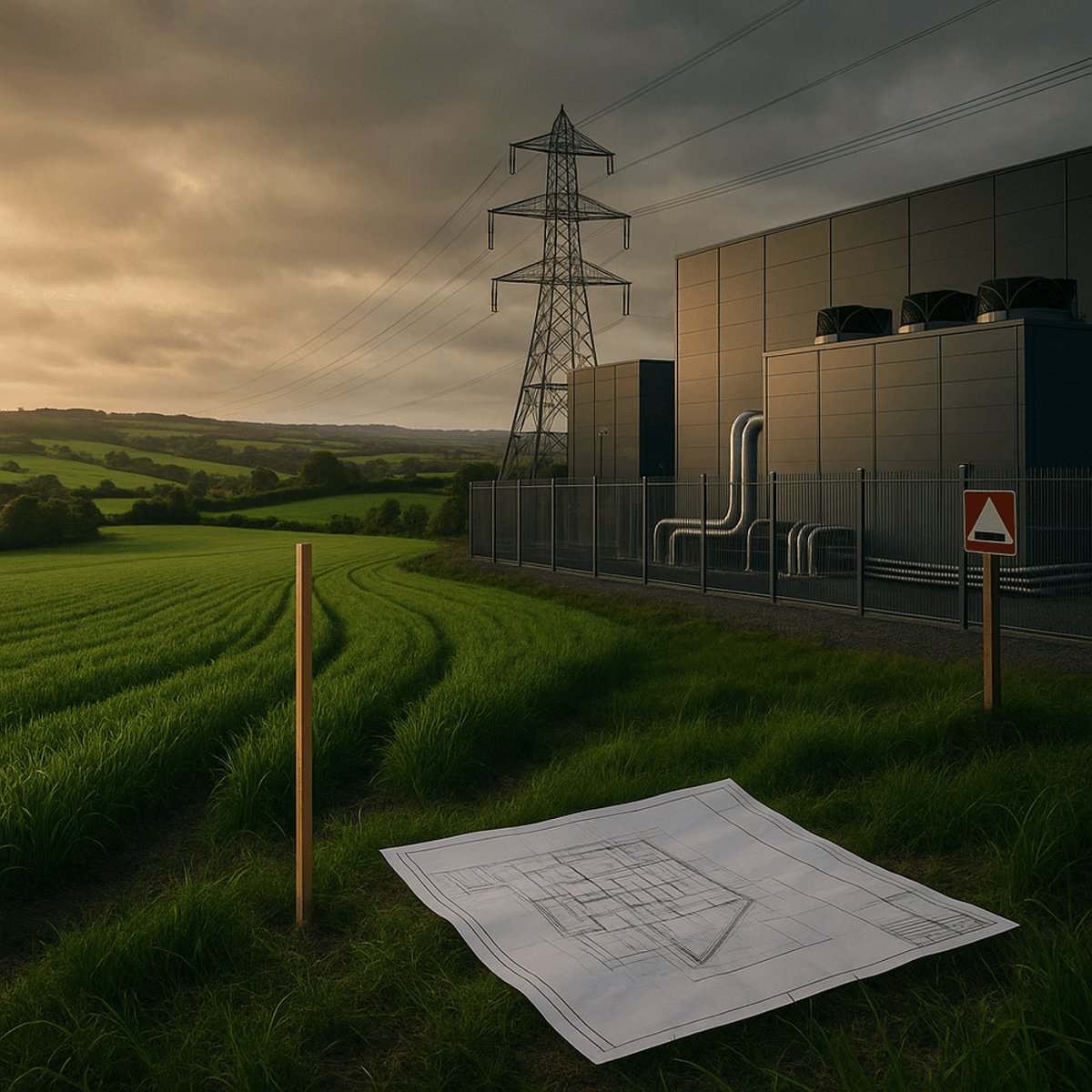
The global AI boom is colliding with small-town England. Residents of Potters Bar, a quiet commuter town north of London, are mounting resistance against plans to convert protected green belt land into sprawling data centers needed to power artificial intelligence systems. The clash highlights a growing tension as tech companies race to build AI infrastructure while communities push back against the environmental and social costs of that expansion.
A quiet English town has become an unlikely frontline in the global AI arms race. Potters Bar, a sleepy commuter community of about 23,000 people sitting just outside London's northern edge, is now ground zero for a battle that's playing out across the developed world - what happens when AI's massive infrastructure needs slam into protected environmental zones.
The conflict centers on London's green belt, the ring of farms, forests, and meadows that's been protected since 1935 to prevent urban sprawl. Now that protected land is being eyed by developers looking to meet the exploding demand for data centers capable of training and running increasingly powerful AI models. According to Wired, local residents are organizing to block proposals that would transform agricultural land into industrial-scale computing facilities.
The timing couldn't be more critical. AI models like those powering OpenAI's ChatGPT and Google's Gemini require enormous data centers packed with specialized chips and cooling systems. Each new generation demands exponentially more computing power, and tech companies are scrambling to secure locations near major population centers where they can access both power grids and network connectivity.
Potters Bar's location makes it particularly attractive. It sits along major transport corridors connecting to London, with relatively easy access to power infrastructure and fiber networks. But it's also surrounded by exactly the kind of green space that UK planning policy was designed to protect - a protection that's now being tested by the AI industry's voracious land appetite.
The UK isn't alone in facing this pressure. Similar conflicts are erupting across Europe and North America as data center developers target sites within reasonable distance of major cities. Ireland recently paused new data center approvals in Dublin due to power grid concerns, while Virginia's Loudoun County - already the world's largest data center hub - faces growing resident backlash over noise, water usage, and land conversion.
What makes the Potters Bar case particularly significant is how it exposes the hidden costs of AI development. While tech executives tout AI's potential to solve climate change and boost productivity, the physical infrastructure required to make those systems work is anything but virtual. Modern data centers consume massive amounts of electricity - often equivalent to small cities - and require extensive cooling systems that can strain local water supplies.
The UK government faces a difficult balancing act. Prime Minister's office has made AI development a cornerstone of economic policy, promising to make Britain a global leader in the technology. But that ambition runs headlong into equally firm commitments to protect the green belt and meet climate targets. Planning rules that were designed to preserve countryside from suburban sprawl never anticipated the unique demands of AI infrastructure.
Local planning authorities find themselves caught in the middle. They face intense pressure from national government to approve developments that promise jobs and tax revenue, while residents mobilize to protect the character and environment of their communities. The green belt designation, once considered nearly sacrosanct in UK planning law, is increasingly viewed by developers as outdated regulation standing in the way of technological progress.
Environmental groups are watching closely. If green belt protections can be overridden for data centers in Potters Bar, it could set precedent for similar developments across the protected ring around London. The concern goes beyond just this one site - it's about whether the AI boom will trigger a broader weakening of environmental safeguards that have stood for nearly a century.
The infrastructure challenge extends beyond just land use. Data centers require enormous amounts of reliable power, and Britain's electrical grid is already strained by the transition away from fossil fuels. Adding major new loads from AI computing facilities could delay climate goals or force continued reliance on gas-fired power plants - ironic outcomes for a technology often positioned as enabling sustainability.
Tech companies argue they're being responsible, pointing to commitments to renewable energy and efficient cooling systems. But those promises ring hollow to residents who see their communities transformed by industrial development regardless of how it's powered. The noise from cooling fans, light pollution from 24/7 operations, and truck traffic from maintenance and equipment delivery all degrade quality of life in ways that spreadsheets measuring carbon offsets don't capture.
What's unfolding in Potters Bar represents more than just local planning disputes. It's a fundamental question about who benefits from AI development and who bears the costs. Silicon Valley executives and venture capitalists reap the financial rewards while small-town residents deal with transformed landscapes, strained infrastructure, and disrupted communities. That tension isn't going away - it's likely to intensify as AI models continue to grow and demand even more computing power.
The fight in Potters Bar is just beginning, but it's already revealing uncomfortable truths about AI development. The technology requires massive physical infrastructure that must go somewhere, and that somewhere increasingly means converting protected or agricultural land near cities. How governments resolve these conflicts will shape not just the AI industry's growth trajectory but also determine whether environmental protections can withstand pressure from powerful economic interests. For now, residents are organized and fighting back, but they're up against forces that view their green fields as obstacles to inevitable progress. The outcome could set the template for similar battles across the developed world.