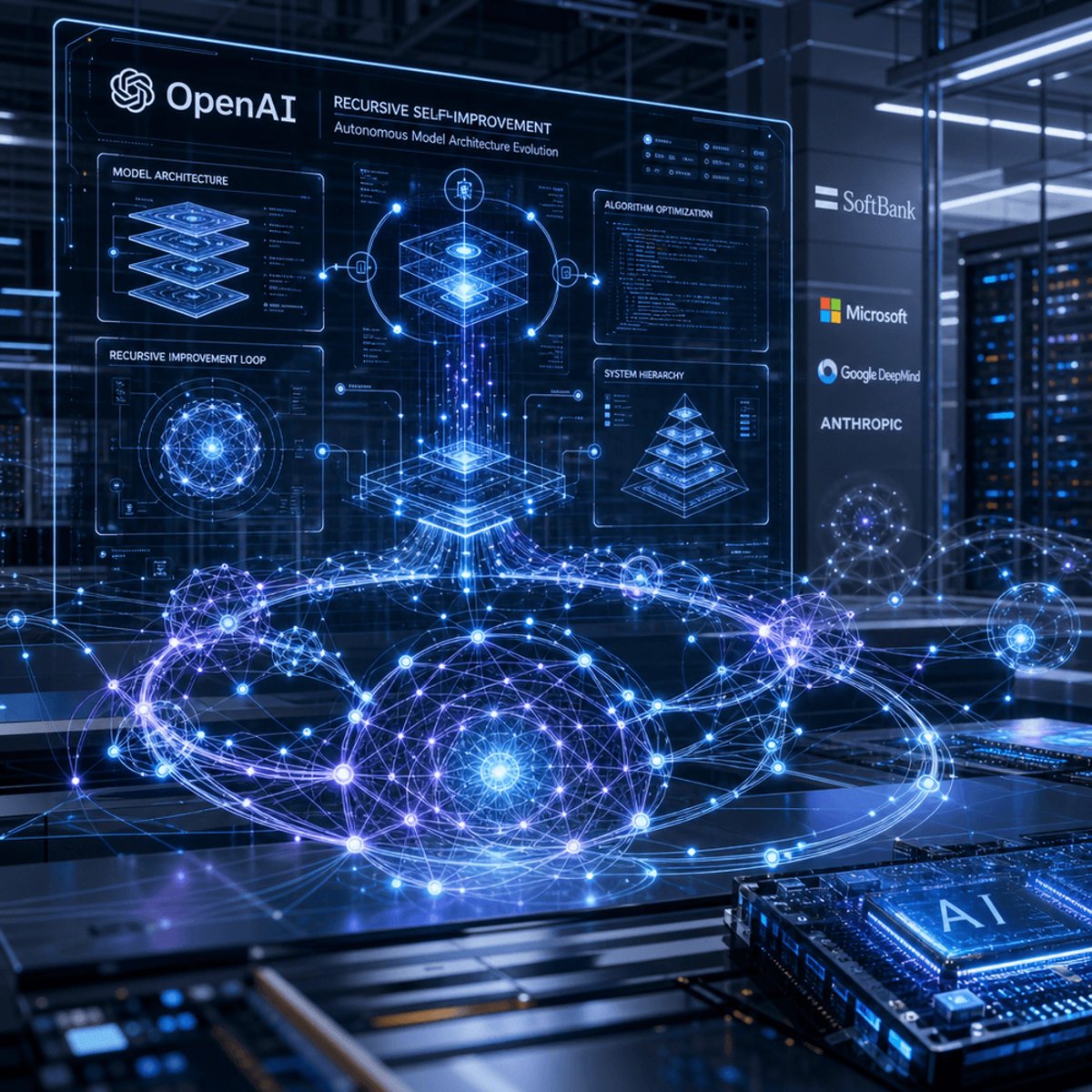
SoftBank CEO Masayoshi Son just dropped a bombshell that's reshaping the artificial general intelligence timeline. In an interview with CNBC, Son revealed that AI is now designing OpenAI's next model—a development he's calling an early sign of artificial super intelligence. The claim marks a dramatic acceleration from his previous ten-year AGI forecast, which he now considers "conservative." For investors and technologists watching the AI race, this suggests we've crossed into recursive self-improvement territory faster than anyone predicted.
SoftBank CEO Masayoshi Son just confirmed what many AI researchers have been quietly predicting but few wanted to say out loud: artificial intelligence has started designing the next generation of AI systems. Speaking to CNBC, Son revealed that AI is currently working on OpenAI's next model, a milestone he's interpreting as an early indicator of artificial super intelligence arriving ahead of schedule.
The announcement carries weight beyond typical executive hype. Son, whose SoftBank Vision Fund has deployed billions across the AI landscape, previously forecast that ASI would arrive within ten years. Now he's walking that back, calling the timeline "conservative" and suggesting the breakthrough could come significantly sooner. The shift reflects what's happening behind closed doors at leading AI labs, where the line between human-guided development and AI-assisted architecture is blurring fast.
What Son's describing is recursive self-improvement, the theoretical inflection point where AI systems become capable enough to enhance their own designs. It's been a staple of AGI timelines since the early 2000s, but most researchers treated it as a distant milestone. If OpenAI is genuinely using AI to architect its next model—not just optimize hyperparameters or suggest code improvements, but actually design system architecture—that's a fundamental shift in how quickly capabilities could compound.
The timing aligns with whispers from inside OpenAI about their post-GPT-4 roadmap. The company's been notably quiet about GPT-5 details, fueling speculation that they're taking a different architectural approach. If AI systems are contributing to that design process, it would explain both the secrecy and the confidence. It also raises questions about how OpenAI validates and tests models that weren't primarily designed by human engineers.
For SoftBank, this isn't just philosophical musing. The firm's made massive bets on AI infrastructure and application companies, from chip designers to enterprise software. Son's public statements often serve as market signals for where he's deploying capital next. His emphasis on accelerated ASI timelines suggests SoftBank is positioning for a world where AI capabilities compound faster than linear development curves predicted.
The claim also intensifies pressure on OpenAI's competitors. Google DeepMind, Anthropic, and Meta have all been racing to match or exceed GPT-4's capabilities. If OpenAI has successfully incorporated AI into its own development pipeline, that's not just a technical advantage—it's a velocity multiplier that could widen the gap between leaders and followers in the foundation model race.
But Son's framing as "super intelligence" deserves scrutiny. AI designing AI doesn't automatically equal ASI, which typically refers to systems that surpass human intelligence across virtually all domains. What OpenAI appears to have achieved is narrow recursive improvement in a specific domain: model architecture and training. That's significant, but it's not the same as general superintelligence that can outthink humans in physics, strategy, creativity, and social reasoning simultaneously.
The safety implications are already triggering debate. If AI systems are designing their successors, traditional red-teaming and alignment approaches may need radical updates. You can't audit what you didn't build, and understanding emergent behaviors becomes exponentially harder when the design process itself involves non-human intelligence. OpenAI's superalignment team, already tasked with ensuring advanced AI remains controllable, just got a much harder job.
Investors are watching these developments closely. Microsoft, which has invested over $13 billion in OpenAI, stands to benefit enormously if recursive AI development proves out. But the accelerated timeline also compresses the window for competitors to catch up and for regulators to establish guardrails. The EU's AI Act and various U.S. proposals were written assuming a more gradual capability curve.
Son's comments arrive as AI investment continues at breakneck pace despite broader tech market volatility. His willingness to publicly revise AGI timelines upward suggests confidence that current architectures and training approaches have more headroom than skeptics believed. Whether that confidence proves prescient or premature will likely become clear in the next 12-18 months as OpenAI and rivals ship their next generation of models.
Son's revelation that AI is designing OpenAI's next model represents either a genuine inflection point in AI development or a significant overstatement of current capabilities. Either way, the claim from one of tech's most influential investors will accelerate both funding and scrutiny around AGI timelines. For the industry, this means compressed development cycles, intensified competition, and urgent questions about how to govern systems that increasingly build themselves. The next few product cycles will reveal whether we've truly entered the recursive improvement era or if we're still in the hype phase of a longer journey to artificial super intelligence.