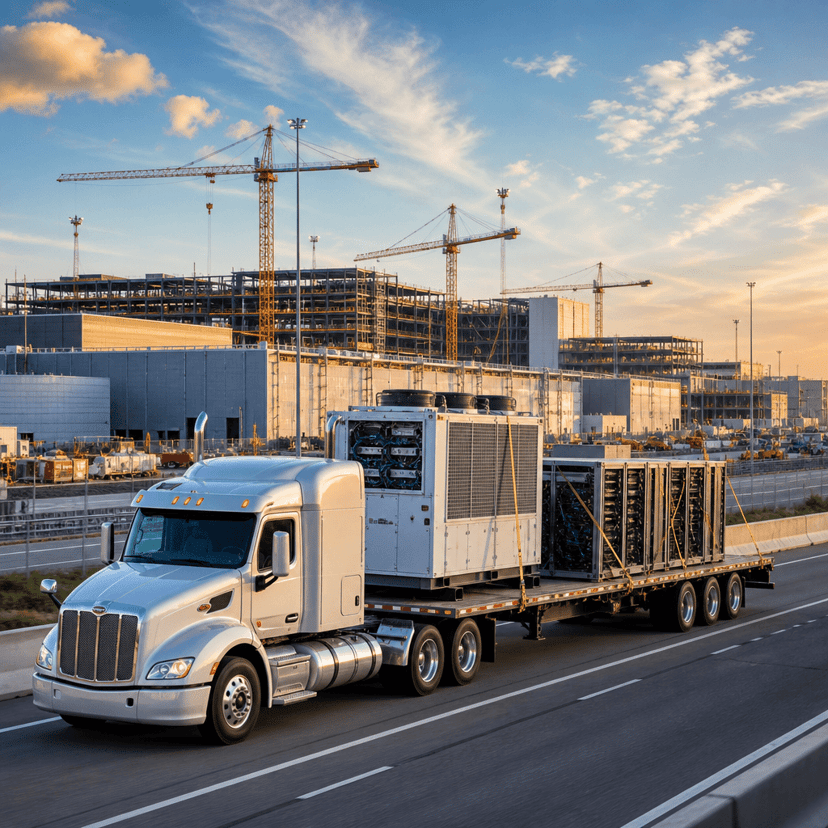
Australian data center operator AirTrunk just announced a staggering $30 billion commitment to build 5 gigawatts of AI-focused data center capacity across India, marking one of the largest infrastructure investments in the country's tech sector. The move positions India as a critical battleground for AI computing infrastructure as global demand for training and inference capacity continues to outpace supply. For context, 5GW could power AI workloads equivalent to training hundreds of frontier models simultaneously, reshaping the Asia-Pacific cloud landscape.
AirTrunk is placing a massive bet on India's AI future. The Sydney-based data center operator announced Friday it's committing $30 billion to build out 5 gigawatts of capacity across the country, in what industry analysts are calling a watershed moment for Asia-Pacific cloud infrastructure. The investment dwarfs most recent data center commitments in emerging markets and signals that India has become ground zero for the next phase of AI infrastructure expansion.
The timing couldn't be more critical. Global AI companies are scrambling to secure compute capacity as training runs for frontier models balloon in complexity and cost. Microsoft, Google, and Amazon Web Services have all faced capacity constraints in established markets like the US and Europe, pushing them to seek alternatives in regions with available power, land, and increasingly favorable regulatory environments. India checks all those boxes, with the added advantage of a massive domestic tech workforce and growing enterprise cloud adoption.
AirTrunk's 5GW commitment is staggering in scale. To put that in perspective, a single gigawatt can support approximately 10,000 to 15,000 high-density GPU racks optimized for AI training. That means AirTrunk's facilities could theoretically house enough computing power to simultaneously train dozens of GPT-4 scale models or run inference for hundreds of millions of users. The announcement positions India alongside established data center hubs like Northern Virginia and Singapore, but with significantly more room for growth.
The company hasn't disclosed specific locations yet, but industry insiders expect facilities to cluster around Mumbai, Bangalore, and Hyderabad - India's three largest tech hubs with existing fiber infrastructure and proximity to hyperscale customers. Power availability will be the biggest constraint. India's grid has historically struggled with reliability, but recent investments in renewable energy and dedicated industrial power zones have made large-scale data center operations increasingly viable.
This investment also validates Blackstone's $16 billion acquisition of AirTrunk earlier this year, one of the largest infrastructure deals in recent memory. The private equity giant clearly saw what others missed - that the next wave of AI infrastructure wouldn't just happen in established Western markets. Blackstone's deep pockets and infrastructure expertise now enable AirTrunk to move aggressively into emerging markets while competitors remain cautious.
The India expansion comes as AirTrunk operates major facilities across Asia-Pacific, including Sydney, Melbourne, Singapore, Tokyo, Osaka, Hong Kong, and Kuala Lumpur. But India represents a fundamentally different opportunity - a greenfield market with over a billion potential cloud users and a government actively courting foreign tech investment through initiatives like Digital India and production-linked incentive schemes for electronics manufacturing.
Competitors are watching closely. CtrlS Datacenters, India's largest domestic operator, and global players like Digital Realty and Equinix have announced expansions, but nothing approaching AirTrunk's scale. The land rush is reminiscent of the data center boom that transformed Northern Virginia into "Data Center Alley" over the past decade, turning rural farmland into the internet's backbone.
The $30 billion will likely deploy over 5-7 years in phases, with initial facilities coming online as early as 2027. Build timelines for hyperscale data centers typically run 18-24 months from groundbreaking to operational, meaning we could see the first racks powered up by late 2027 if permitting and construction move smoothly. But India's bureaucratic processes and infrastructure coordination challenges could extend those timelines.
What makes this particularly significant for AI companies is the power density. Modern AI training clusters require 50-100 kilowatts per rack, compared to 5-10 kilowatts for traditional enterprise workloads. AirTrunk's facilities will need to be engineered from the ground up for these extreme thermal and electrical loads, with liquid cooling, redundant power systems, and high-speed networking. That level of specialization is why hyperscalers are willing to pay premium colocation rates - they simply can't build fast enough themselves.
The announcement also has major implications for India's broader tech ambitions. Prime Minister Modi's government has been trying to position India as a manufacturing and innovation hub, not just a services outsourcing destination. Large-scale AI infrastructure investments like this enable domestic AI startups and enterprises to compete globally without depending on US or Chinese cloud providers. It's digital sovereignty meets economic development.
For Nvidia, which supplies the vast majority of AI training chips, AirTrunk's buildout represents another massive customer. The company will likely need tens of thousands of H100s and next-generation Blackwell GPUs to fill 5GW of AI-optimized capacity. Those chips are currently backordered for months, creating a chicken-and-egg problem where data center operators need GPUs to fill racks, but can't secure allocation without confirmed customer demand.
AirTrunk's $30 billion commitment isn't just about building data centers - it's a bet that the next decade of AI development will be geographically distributed in ways the industry hasn't seen before. As Western markets face power constraints, land scarcity, and increasingly complex permitting, emerging economies with available resources and pro-business policies become strategic assets. India's combination of technical talent, growing domestic demand, and infrastructure ambitions makes it the obvious choice. The real question now is whether AirTrunk can execute at this scale while competitors scramble to catch up. If they succeed, we might look back at this moment as when India became the AI infrastructure capital of Asia-Pacific.