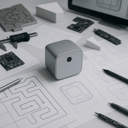
Anker just crammed OpenAI's GPT-4o into a device smaller than a quarter. The company's new Soundcore Work AI recorder measures just 0.91 inches across but delivers 8-hour battery life and real-time transcription in 100+ languages, directly challenging established players like Plaud and setting a new benchmark for wearable AI hardware at $99.99.
Anker just fired the latest shot in the AI wearables race, and it's smaller than anyone expected. The company's new Soundcore Work recorder shrinks OpenAI's GPT-4o transcription engine into a coin-sized device that makes existing competitors look bulky by comparison.
Launching this September for $99.99, the Work measures just 0.91 inches across – smaller than a quarter's diameter, though slightly thicker. That's a significant size reduction from rivals like the Plaud NotePin and Bee, both of which have gained traction in the growing market for AI-powered meeting transcription tools.
"The coin-sized Work is designed to be discreet but includes LEDs that indicate when it's recording," according to Anker's official announcement, addressing privacy concerns that have dogged the wearable recording category since its emergence.
Despite its tiny footprint, the Work doesn't compromise on functionality. The device packs dual microphones, 8 hours of battery life, and most impressively, on-device GPT-4o processing that can transcribe audio in more than 100 languages without requiring a cloud connection. When the built-in battery runs low, Anker's proprietary charging case extends usage up to 32 total hours.
The device takes a privacy-first approach that could differentiate it in a market where data security concerns run high. "Recordings are encrypted and processed locally for privacy reasons but can be bounced through the cloud if you desire to share them with someone," Anker explains, giving users control over where their sensitive meeting data gets processed.
Unlike always-on recording devices that have raised workplace surveillance concerns, the Work requires manual activation through a single tap, with a double-tap feature to mark important conversation moments for later highlighting in transcripts. This deliberate interaction model addresses one of the biggest friction points in the AI wearables category.
The timing couldn't be better for Anker. Enterprise demand for AI transcription tools surged following remote work adoption, while consumer interest in wearable AI devices has exploded after OpenAI's GPT-4o demonstrated real-time conversation capabilities. Market research firm Gartner predicts the AI wearables segment will reach $2.4 billion by 2026.
Anker plans to monetize beyond the hardware through a $15.99 monthly subscription that unlocks additional features not yet revealed. This recurring revenue model mirrors strategies from Plaud and other AI hardware startups looking to build sustainable businesses beyond one-time device sales.
The device connects to Anker's Soundcore mobile app, where transcripts can be searched, edited, and exported to various formats. The magnetic clip and lanyard attachments make it versatile for different wearing preferences, whether clipped to clothing or worn as a pendant.
What makes this launch particularly significant is Anker's established retail presence and manufacturing scale compared to smaller startups in the space. The company's existing relationships with retailers like Best Buy and Amazon could accelerate market penetration for AI wearables beyond early adopters.
The September launch will start in select markets before expanding globally later this year, suggesting Anker is taking a measured approach to production scaling and market feedback integration.
For professionals juggling back-to-back meetings, journalists conducting interviews, or students attending lectures, the Work promises to eliminate the friction of manual note-taking while maintaining the discretion that larger recording devices lack. The combination of OpenAI's industry-leading language model with Anker's hardware reliability could establish new standards for what AI wearables can achieve.
Anker's Soundcore Work represents the next evolution in AI wearables – powerful enough to challenge established players yet small enough to disappear into daily workflows. With GPT-4o processing, competitive pricing, and Anker's retail reach, this could be the device that brings AI transcription from early adopters to mainstream professionals. The real test will be whether consumers embrace yet another wearable device, even one this capable.