Naveen Rao just fired the opening shot in Silicon Valley's next big chip war. The former Databricks AI chief is raising $1 billion at a $5 billion valuation for Unconventional Inc., a stealth startup building what he calls a 'new substrate for intelligence' designed to take on Nvidia's AI chip dominance. With Andreessen Horowitz leading and heavyweights like Lightspeed and Lux backing the play, this marks one of 2025's most ambitious AI hardware bets.
The AI chip wars just got their most credentialed challenger yet. Naveen Rao, the mastermind behind Databricks' AI strategy, is betting $1 billion that he can crack the code Nvidia has dominated for years. His new startup, Unconventional Inc., is already in advanced talks for what would be one of the largest AI hardware funding rounds in history.
Andreessen Horowitz has agreed to lead the massive investment, with Lightspeed Venture Partners and Lux Capital joining the round, according to four sources familiar with the discussions. The deal values Unconventional at $5 billion before it's even shipped a single chip - a valuation that signals just how desperate investors are for viable alternatives to Nvidia's stranglehold on AI computing.
Rao isn't waiting around either. Sources tell us he's already raised hundreds of millions and plans to start building without the full $1 billion closing. The rest will come through a tranched approach - allowing him to hit development milestones while maintaining that sky-high valuation. It's a smart play in today's cautious funding environment.
The timing couldn't be more perfect. Nvidia's H100 chips remain backordered for months, creating opening after opening for competitors. But Rao isn't just building another GPU competitor - he's rethinking the entire computing stack. 'Rethinking the foundations of a computer to build a new substrate for intelligence that is as efficient as biology,' he posted on X last week, confirming Unconventional's existence. 'Brain Scale Efficiency without the biological baggage!'
This isn't Rao's first rodeo challenging tech giants. Databricks acquired his previous startup MosaicML for $1.3 billion just two years ago, after the company proved it could train large language models more efficiently than competitors. Before that, Intel snapped up his machine learning platform Nervana Systems for over $400 million in 2016.
The pattern is clear - Rao spots inefficiencies in how the industry approaches AI computing, builds a better mousetrap, then gets acquired by companies desperate to catch up. This time feels different though. With Databricks now valued at $100 billion and generating $4 billion in annual recurring revenue, Rao had a front-row seat to see just how much companies are willing to pay for AI infrastructure that actually works.
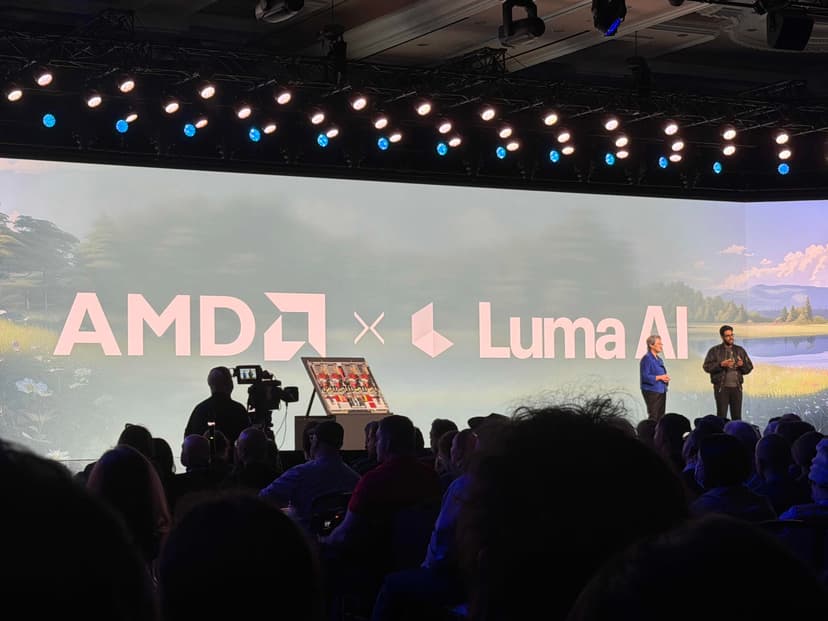
The competitive landscape has never been more intense. AMD continues pushing its MI300X chips as Nvidia alternatives. Startups like Cerebras and Groq are gaining traction with novel architectures. Even Google and Amazon are designing their own custom silicon to reduce dependence on Nvidia.
But Unconventional's approach sounds fundamentally different. Rather than just building faster chips, Rao appears focused on the entire computing paradigm - combining custom silicon with server infrastructure in ways that mirror biological neural networks. It's exactly the kind of moonshot thinking that attracts Andreessen Horowitz, which has been betting heavily on AI infrastructure plays.
The funding structure also reveals Silicon Valley's new reality. Even with a proven track record and blue-chip backing, Rao chose a tranched approach rather than raising the full billion upfront. It protects investors while allowing the company to prove technical milestones before unlocking more capital - a hedge against the growing skepticism around AI hardware valuations.
What makes this particularly intriguing is Databricks' reported participation as an investor. Having Rao's former employer back his new venture suggests serious confidence in both the technology and the market opportunity. It also gives Unconventional a potential path to early customers, always crucial for hardware startups burning through development cash.
Unconventional represents more than just another Nvidia challenger - it's a bet on fundamentally reimagining how AI systems compute. With Rao's proven track record of building and selling AI companies, plus backing from Silicon Valley's top VCs, this startup enters the market with both the resources and credibility to make waves. Whether 'brain scale efficiency' can actually dethrone Nvidia remains to be seen, but with $1 billion in funding and some of tech's smartest money betting on him, Rao has everything he needs to find out. The AI chip wars just got a lot more interesting.