AMD at CES 2026: Helios Signals a Full-Stack AI Push
At CES 2026, AMD used its session to focus squarely on AI infrastructure, open software, and world-scale modeling. The headline announcement was Helios, AMD’s next-generation AI platform built for extreme performance and density.
This was a clear signal that AMD is accelerating its challenge in the AI data center and developer stack.
Helios is designed as a rack-scale AI system, weighing over 7,000 pounds and fully liquid cooled to push performance limits.
AMD emphasized that cooling is central to the design. Liquid cooling allows higher sustained throughput, tighter chip packing, and more predictable performance under heavy AI workloads.
“This is a monstrous rack,” was the phrase used on stage, and the scale backs it up.
MI455X and Venice Take Center Stage
At the core of Helios are AMD’s new Instinct GPUs, led by MI455X and the Venice platform.
Key details shared on stage:
-
MI455X features 320B transistors, around 70% more than MI355
-
Built using 12 compute and IO chiplets on 2nm and 3nm process nodes
-
Includes 432GB of HBM4 memory
-
Uses next-generation 3D chip stacking technology
AMD called MI455X the most advanced chip it has ever built, designed specifically for large AI training and inference workloads.
Open Stack and ROCm Momentum
AMD reinforced its commitment to an open AI stack, with ROCm positioned as the software foundation for Helios and Instinct GPUs.
This open approach is aimed at developers and enterprises that want flexibility across models, frameworks, and infrastructure without being locked into a closed ecosystem.
OpenAI Joins the Stage
One of the most notable moments came when Greg Brockman from OpenAI joined AMD on stage.
The appearance highlighted collaboration around open systems, large-scale AI training, and the future of model deployment across different hardware platforms.
Luma and World Generation
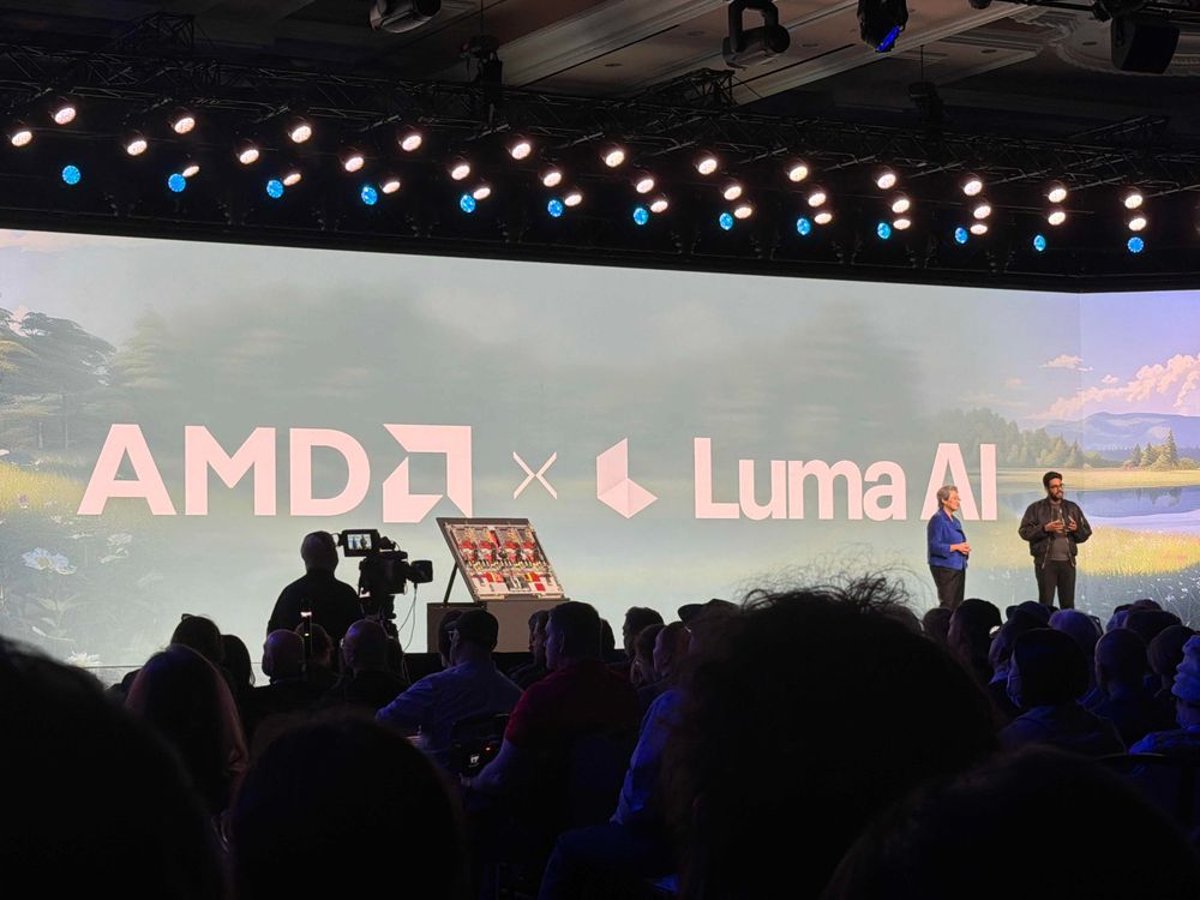
AMD also highlighted progress with Luma, focusing on modeling and generating worlds.
The message was direct. AI video and world generation are advancing fast, with Luma positioned as a tool that lowers the barrier to high-end visual creation. AMD framed this shift as changing how large-scale visual content is produced, including work traditionally handled by major studios.
Updated Luma video models are now available for download.
Looking Ahead: MI500 and the Roadmap
AMD previewed what comes next.
While details were limited, the roadmap signals aggressive long-term scaling in AI compute.
AI Comes to the PC
AMD confirmed that new AI chips are launching this quarter across its PC lineup.
The company also announced:
This ties AMD’s data center strategy directly to edge and personal computing.
Why the AMD Session Matters
The CES 2026 AMD session focused on three priorities:
-
High-density AI infrastructure with Helios and MI455X
-
Open software and developer access through ROCm
-
World-scale AI generation spanning data centers to PCs
AMD’s message was consistent. AI performance, openness, and scale are moving together, and Helios is designed to sit at the center of that shift.