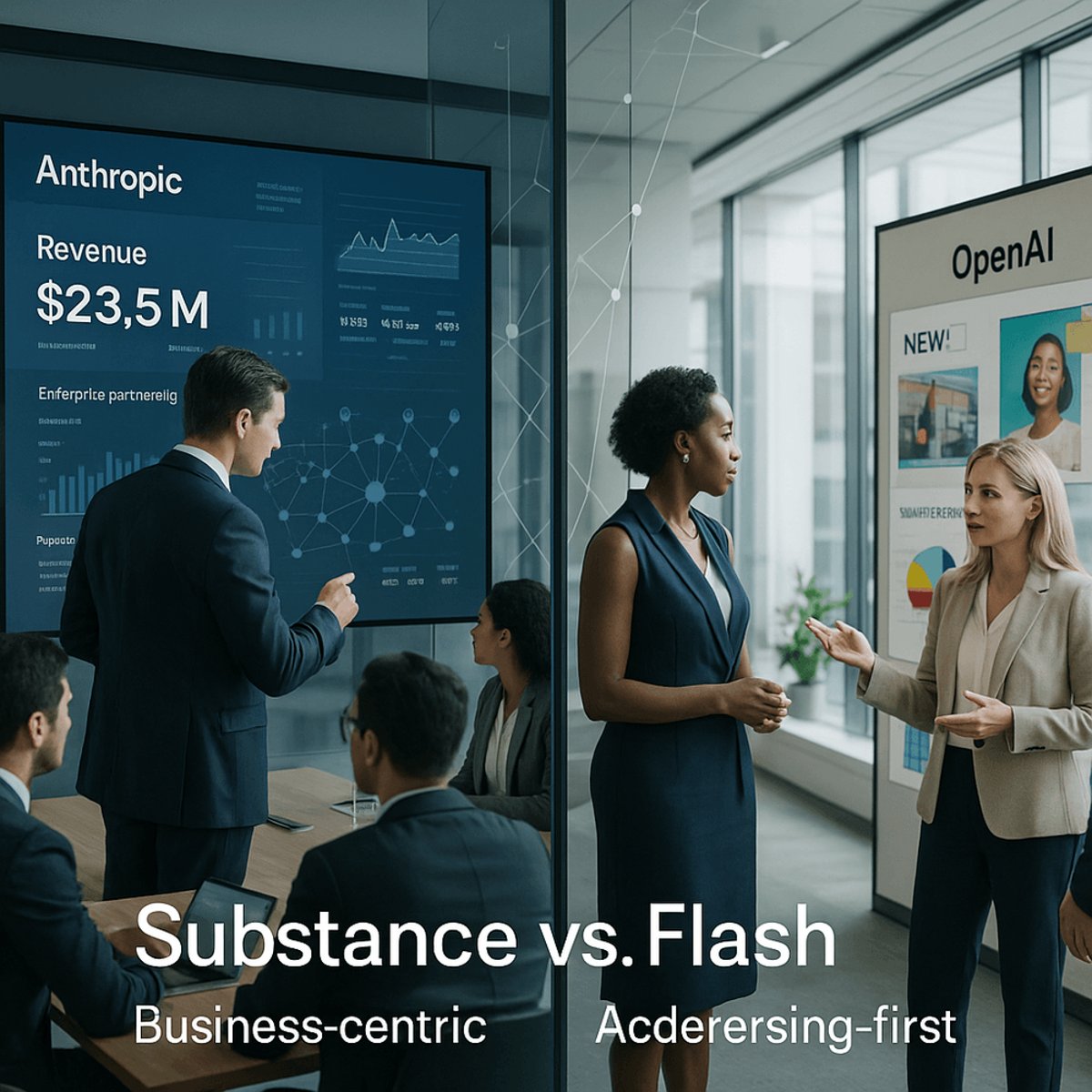
The AI wars just got personal. Anthropic's chief commercial officer fired a thinly-veiled critique at OpenAI today, contrasting his company's revenue-focused approach with rivals who chase "flashy headlines." Speaking to CNBC, the executive positioned Anthropic as the serious business alternative in an industry increasingly defined by splashy marketing campaigns and eye-popping spending. The public swipe marks a rare moment of direct competitive positioning between two of AI's most prominent players, signaling growing tension as the race for enterprise dollars intensifies.
Anthropic just threw down the gauntlet in the AI industry's quietest rivalry. The company's chief commercial officer told CNBC that while competitors chase headlines, Anthropic has been laser-focused on "growing revenue and winning business." The target of that criticism wasn't named, but the implication was crystal clear - this was about OpenAI.
"We've made less flashy headlines than some," the executive said, drawing a clear line between Anthropic's approach and rivals who've dominated news cycles with product launches, celebrity partnerships, and massive advertising campaigns. It's a positioning play that frames Anthropic as the enterprise-friendly alternative, the steady hand in an industry known for hype.
The timing of this public critique isn't accidental. OpenAI has recently ramped up consumer-facing marketing efforts, including high-profile ad campaigns and partnerships that have kept the company in the spotlight. Meanwhile, Anthropic has quietly built relationships with enterprise customers, positioning its Claude AI assistant as a safer, more transparent option for businesses wary of AI's risks.
But the revenue focus claim cuts both ways. While Anthropic has secured major partnerships with companies like Amazon - which invested up to $4 billion in the startup - OpenAI has built a consumer subscription base that reportedly generates over $2 billion in annual recurring revenue. Both companies are racing to prove their business models work at scale, even as they burn through billions in compute costs.
The competitive dynamics between these two AI heavyweights reflect deeper strategic divides. Anthropic was founded by former OpenAI researchers who left over disagreements about safety and commercialization. That origin story has shaped Anthropic's identity as the more cautious, research-oriented alternative. The company has emphasized constitutional AI and transparency in its models, appealing to enterprises nervous about AI governance.
OpenAI, by contrast, has embraced a consumer-first strategy with ChatGPT while simultaneously courting enterprise customers through its API and Microsoft partnership. The company's willingness to spend heavily on marketing and infrastructure reflects a bet that brand recognition and first-mover advantage will translate into long-term market dominance.
The chief commercial officer's comments also hint at concerns about burn rates in the AI industry. Multiple reports have suggested that leading AI companies are spending billions on compute infrastructure and talent, raising questions about path to profitability. By emphasizing revenue growth, Anthropic is signaling to investors and customers that it's building a sustainable business, not just chasing valuation.
But public jabs between AI companies remain relatively rare. Most executives have stuck to emphasizing their own strengths rather than directly criticizing competitors. This departure from that playbook suggests Anthropic feels confident enough in its position to take shots, or concerned enough about OpenAI's momentum to try differentiating more aggressively.
The enterprise AI market is expected to reach hundreds of billions in annual revenue over the next decade, and the companies that secure early enterprise relationships will have a massive advantage. Anthropic's emphasis on being the "serious business" option is a direct play for that market, positioning the company as the alternative for CIOs and CTOs who find OpenAI's consumer focus concerning.
Still, the strategy carries risks. While Anthropic touts its revenue focus, OpenAI has built massive brand recognition that translates into consumer adoption and, increasingly, enterprise interest. Companies often want the AI tools their employees are already using at home, which gives OpenAI a built-in advantage in bottom-up enterprise adoption.
This rare public critique reveals how the AI industry's competitive dynamics are shifting from pure technical capabilities to business strategy and market positioning. As the initial hype around generative AI matures into actual enterprise adoption, companies like Anthropic and OpenAI are staking out distinct territories - one emphasizing steady revenue growth and safety, the other betting on brand dominance and consumer-first expansion. The winner will likely be determined not by who makes the flashiest headlines, but by who can actually prove their models generate sustainable business value at scale. For now, the gloves are starting to come off, and the AI wars are getting personal.