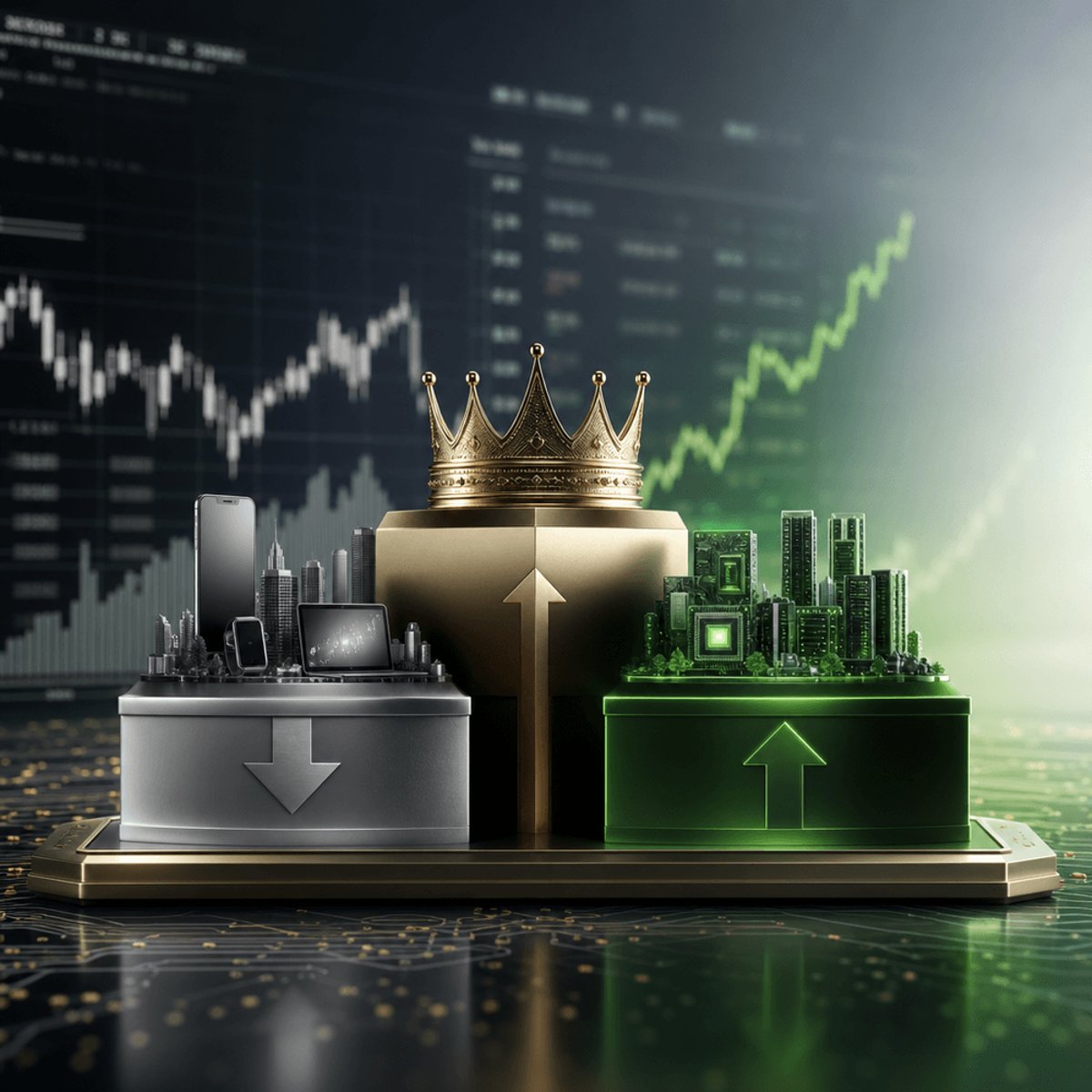
Apple just snatched back its throne. The Cupertino giant closed Monday as the world's most valuable company, dethroning Nvidia after the chipmaker's 13-month run at the top. The shift marks a pivotal moment in markets that have been obsessed with AI infrastructure plays, signaling investors might be rotating back toward diversified tech giants with proven consumer businesses and emerging AI strategies.
The changing of the guard happened quietly during Monday's trading session, but the implications are anything but subtle. Apple closed the day with a market capitalization that edged past Nvidia, reclaiming a title it lost over a year ago when AI mania sent the chipmaker's stock into orbit.
Nvidia has been the poster child for the AI revolution since early 2023, riding unprecedented demand for its H100 and H200 data center GPUs. The company took the world's most valuable crown from Microsoft in June 2025, a symbolic moment that seemed to validate the narrative that AI infrastructure would dominate tech for years to come. For 13 months, Nvidia held that position even as its stock experienced wild swings tied to semiconductor export restrictions, competitive threats from custom AI chips, and questions about sustainability of its gross margins.
But Monday's reversal tells a different story. Apple's return to the top suggests the market is reassessing what matters in the AI era. While Nvidia sells the picks and shovels, Apple is building the entire mining operation - from custom silicon like its M-series and A-series chips to on-device AI features that don't require constant cloud connectivity. The company's pivot toward edge AI, particularly with features rolling out across iOS and macOS, positions it as both a chip designer and the platform where AI directly touches billions of consumers.
The timing is notable. Apple's resurgence comes as questions mount about whether Nvidia's extraordinary growth can continue. Hyperscalers like Microsoft, Google, and Amazon have all announced custom AI chip initiatives, potentially reducing their dependence on Nvidia's GPUs. Meanwhile, Apple's Services business continues generating massive recurring revenue, providing a financial cushion that pure hardware or semiconductor plays can't match.
There's also a macro element at play. When markets get nervous, diversification matters. Apple generates revenue from iPhones, Macs, iPads, wearables, services, and increasingly from AI-enhanced features across its ecosystem. Nvidia, for all its dominance, remains heavily concentrated in data center GPU sales. That concentration has been a blessing during the AI buildout, but it's also a vulnerability if spending patterns shift.
The market cap race between these tech titans has become a real-time referendum on where the AI economy is headed. Is value concentrated in the infrastructure layer where Nvidia dominates? Or does it flow to platforms that package AI into consumer and enterprise experiences where Apple excels? Monday's trading suggests investors are hedging their bets, shifting capital back toward companies with multiple growth engines.
What's fascinating is how quickly leadership has rotated. Microsoft held the crown before Nvidia, and before that, Apple and Microsoft traded places several times. The velocity of these changes reflects genuine uncertainty about which business model will capture the most value as AI matures from infrastructure buildout to mainstream adoption.
For Apple, this isn't just about bragging rights. Reclaiming the top valuation strengthens its hand in negotiations with suppliers, boosts employee morale through stock-based compensation gains, and sends a signal to developers that its platforms remain the most valuable real estate in tech. For Nvidia, losing the spot doesn't diminish its fundamental business strength, but it does puncture the narrative of invincibility that had surrounded the stock.
The next catalyst to watch is earnings season. Both companies report quarterly results in the coming weeks, and investors will be parsing every data point about iPhone sales trajectories, AI feature adoption rates, data center GPU demand, and forward guidance. Those numbers will either validate Monday's rotation or set up another reversal.
What's clear is that the battle for most valuable company has become a proxy war for the future of AI itself - infrastructure versus platforms, specialized chips versus integrated ecosystems, enterprise spending versus consumer adoption. And as Monday proved, that war is far from over.
Apple's return to the top of the valuation charts isn't just a milestone - it's a signal that the market is rethinking how AI value gets distributed. While Nvidia powered the first wave of AI infrastructure, Apple's bet on edge computing, integrated ecosystems, and consumer AI experiences is gaining credibility with investors. The question now isn't whether AI will transform technology, but which layer of the stack captures the most value. If Monday's action is any indication, the answer might be the companies that can play at multiple levels simultaneously. Expect this crown to change hands several more times before the AI economy settles into a stable hierarchy.