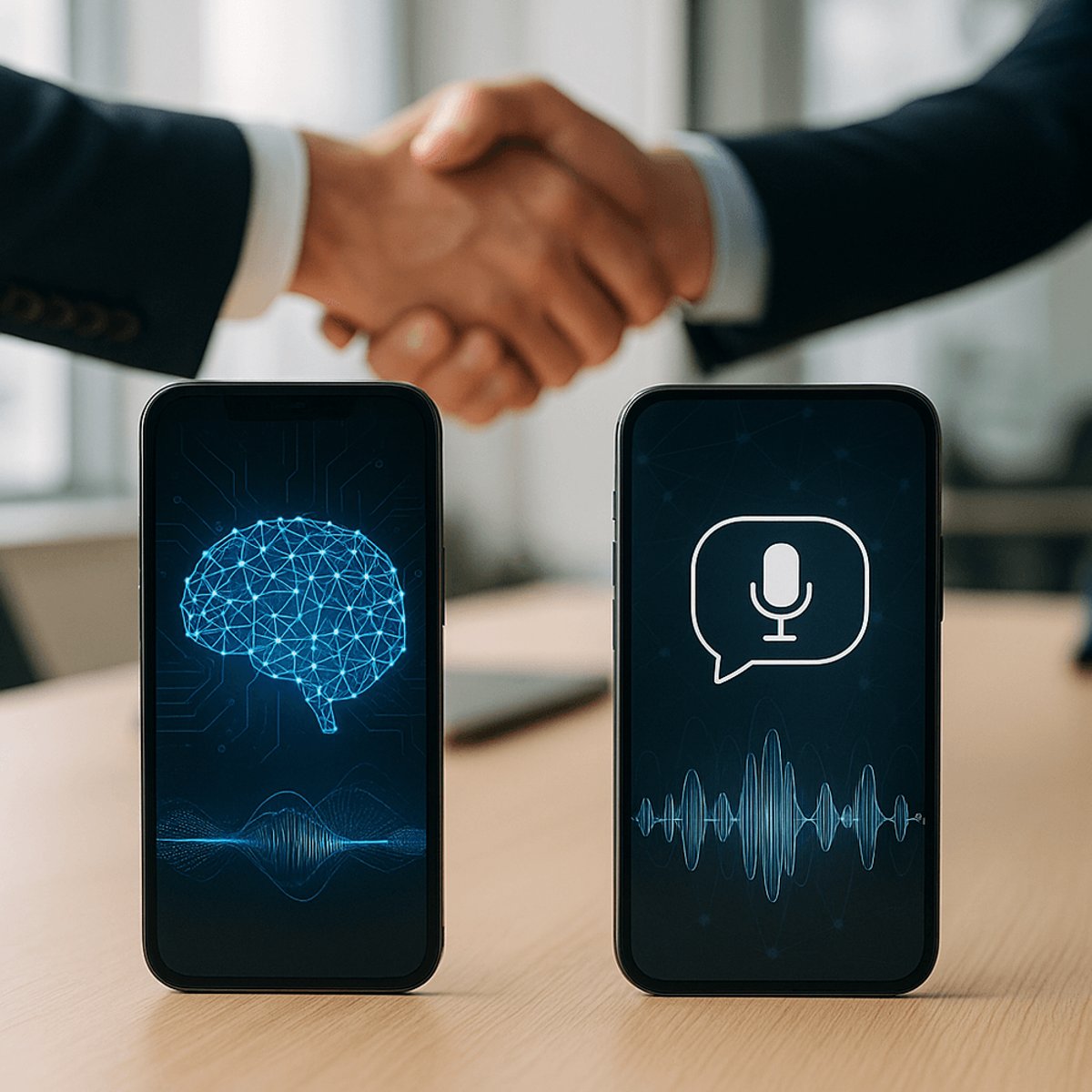
Apple is exploring a partnership with Google to power a long-promised Siri overhaul using Gemini AI, according to Bloomberg's Mark Gurman. The move signals Apple's acknowledgment that its internal AI capabilities are falling critically behind competitors, forcing the iPhone maker to consider working with its biggest smartphone rival to salvage its voice assistant.
Apple just made its most surprising strategic pivot yet. The company is exploring a partnership with Google to power its long-delayed Siri overhaul using Gemini AI, according to Bloomberg's Mark Gurman, who broke the story Thursday evening. The development marks a stunning reversal for Apple, which has spent years positioning itself as the privacy-focused alternative to Google's data-hungry ecosystem.
The talks reveal just how far behind Apple has fallen in the AI assistant race. While OpenAI's ChatGPT and Google's Bard have transformed user expectations around conversational AI, Siri remains largely the same voice assistant Apple launched over a decade ago. Consumer frustration has reached a tipping point, forcing Apple to consider what was once unthinkable: partnering with its biggest smartphone competitor.
According to Gurman's reporting, Google has already begun training a specialized version of Gemini that could run on Apple's servers, addressing some of the privacy concerns that would inevitably arise from such a partnership. This server-side approach mirrors the strategy Apple has used with other third-party integrations, maintaining some control over user data while leveraging external AI capabilities.
The Google discussions aren't Apple's first attempt to find an AI lifeline. The company previously approached both OpenAI and Anthropic about similar partnerships, suggesting a systematic evaluation of the AI landscape rather than a hasty decision. Anthropic, makers of Claude AI, and OpenAI represent different philosophical approaches to AI development, but Apple's willingness to court all three major players underscores the urgency of its situation.
The timing couldn't be more critical. Apple promised a major Siri revamp at its Worldwide Developers Conference earlier this year, but has consistently fallen short of delivery. Meanwhile, competitors have raced ahead. Microsoft has integrated ChatGPT across its entire ecosystem, Amazon is overhauling Alexa with generative AI, and Meta has launched AI assistants across its social platforms.
For Google, a partnership with Apple would represent a massive validation of Gemini and potentially billions in licensing revenue. The search giant has been aggressively pushing Gemini across its product suite, but landing Apple's massive user base would instantly make it the most widely deployed AI assistant in the world. Industry analysts estimate Apple's active device ecosystem at over 2 billion users globally.
The partnership discussions also highlight the broader consolidation happening in the AI industry. As development costs soar and technical barriers increase, even tech giants like Apple are finding it challenging to compete independently. The resource requirements for training state-of-the-art language models now exceed tens of billions of dollars, making partnerships increasingly attractive even for cash-rich companies.
Apple's consideration of the Google partnership signals a potential shift in its traditionally closed ecosystem approach. The company has historically preferred developing technologies in-house, from its custom silicon to its operating systems. Outsourcing a core feature like Siri's AI brain would represent one of the most significant strategic departures in the company's modern history.
Apple's exploration of a Google partnership for Siri represents more than just a tech deal—it's an admission that the AI revolution has fundamentally changed the rules of competition. With a decision expected within weeks, Apple faces a choice between maintaining its independence while falling further behind, or embracing an unlikely alliance that could instantly catapult Siri back into relevance. Either way, the smartphone industry is about to witness one of its most consequential strategic shifts.