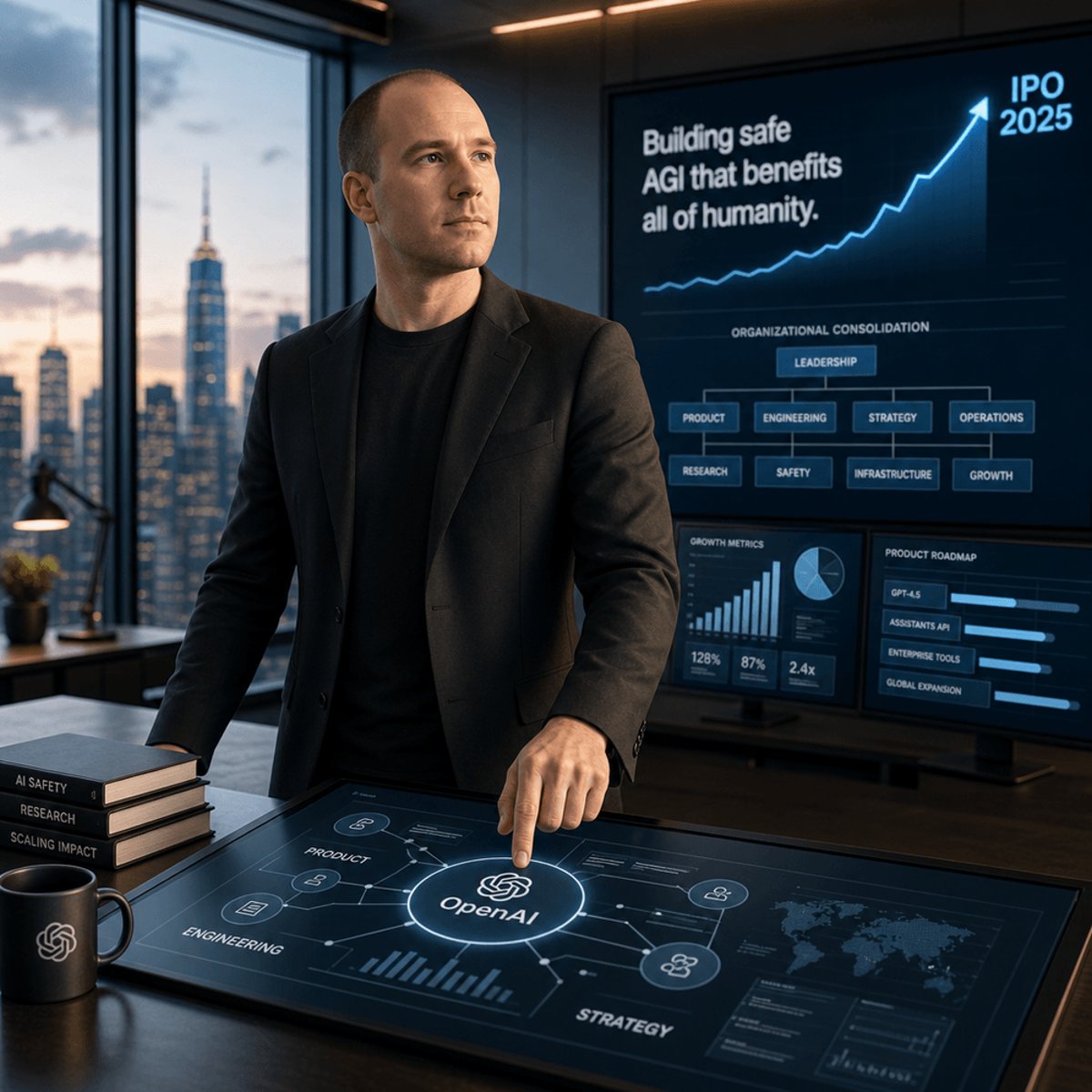
Power is consolidating fast at OpenAI. Co-founder Greg Brockman is quietly cementing his control over the AI giant's operations following the abrupt departure of CEO Fidji Simo, who stepped down citing chronic health issues. The leadership shakeup comes at a critical moment - OpenAI is laying groundwork for what could be the decade's biggest tech IPO, and Brockman's expanded role signals the company is streamlining decision-making ahead of public market scrutiny. According to CNBC, Brockman's influence now extends across product, engineering, and strategic planning.
OpenAI just handed the keys to one of its founding architects. Greg Brockman, the company's president and co-founder, is now the undisputed operational leader following Fidji Simo's departure announced earlier this week. Simo, who took the CEO role less than a year ago, cited ongoing health complications that made continuing in the position untenable.
But Brockman's ascent isn't just about filling a vacuum. Sources familiar with the company's internal dynamics say the move has been brewing for months, with board members increasingly viewing Brockman as the steady hand needed to navigate an IPO process that could kick off as early as 2027. According to CNBC's reporting, Brockman now oversees product roadmaps, engineering priorities, and strategic partnerships - essentially everything that matters operationally.
The timing couldn't be more critical. OpenAI is sitting on a private valuation north of $150 billion following its latest funding round, and investor appetite for an IPO remains strong despite broader market volatility. Wall Street banks have been circling for months, with Goldman Sachs and Morgan Stanley reportedly competing to lead the offering. But going public means opening the books to regulatory scrutiny, and that requires bulletproof governance.
That's where Brockman's expanded role gets interesting. Unlike Simo, who came from Meta with consumer product expertise but limited AI background, Brockman has been embedded in OpenAI's DNA since 2015. He was there when the company pivoted from nonprofit to capped-profit structure. He weathered the storm when Sam Altman was briefly ousted by the board in November 2023, even threatening to walk alongside Altman before the board reversed course.
Insiders describe Brockman as OpenAI's institutional memory and technical conscience. While Altman plays visionary-in-chief and handles external relations, Brockman translates that vision into shipping products. He was instrumental in the architecture behind GPT-4 and reportedly led the internal push to accelerate GPT-5 development despite safety concerns from the company's disbanded superalignment team.
The leadership consolidation also reflects OpenAI's maturation from research lab to commercial juggernaut. The company now generates over $3 billion in annual recurring revenue, primarily from ChatGPT subscriptions and enterprise API deals. Microsoft, which has invested more than $13 billion into OpenAI, continues to deepen its Azure integration, effectively making OpenAI's models the default AI infrastructure for enterprise customers.
But competitors aren't standing still. Anthropic just closed a $7 billion round led by Amazon, while Google is pushing Gemini aggressively into workspace products. Meta continues releasing open-source Llama models that undercut OpenAI's pricing. The IPO window might be open now, but it won't stay that way forever if OpenAI's margins compress or growth slows.
There's also the governance question that refuses to die. OpenAI's unusual structure - a nonprofit board controlling a capped-profit subsidiary - has been a source of tension since the Altman firing saga. Investors want clarity on who actually controls the company, especially if they're buying shares in a public offering. Brockman's consolidation might be a precursor to broader governance reforms designed to reassure institutional investors.
The departure of Simo, while attributed to health issues, also removes a potential point of friction. According to people familiar with internal discussions, Simo and Brockman occasionally clashed over product priorities, with Simo pushing for faster consumer feature releases while Brockman advocated for technical robustness. With Simo out, that tension evaporates.
What happens next will define OpenAI's trajectory for the next decade. If Brockman can maintain product velocity while demonstrating disciplined financial management, the IPO could value OpenAI at $200 billion or more. That would make it one of the most valuable public tech companies on earth, trailing only Apple, Microsoft, Nvidia, and Alphabet.
But the pressure is immense. Public market investors won't tolerate the internal drama that's characterized OpenAI's recent history. They'll demand predictable execution, transparent governance, and a clear path to profitability without the nonprofit complications. Brockman now owns that delivery.
Brockman's consolidation marks a pivotal moment in OpenAI's evolution from chaotic startup to IPO-ready enterprise. Whether this centralization of power brings the stability investors demand or simply concentrates risk remains to be seen. But one thing is clear - the company that unleashed ChatGPT on the world is betting its public market future on the technical co-founder who helped build it from day one. Wall Street will be watching closely to see if Brockman can deliver the disciplined execution that Simo's brief tenure promised but never fully realized.