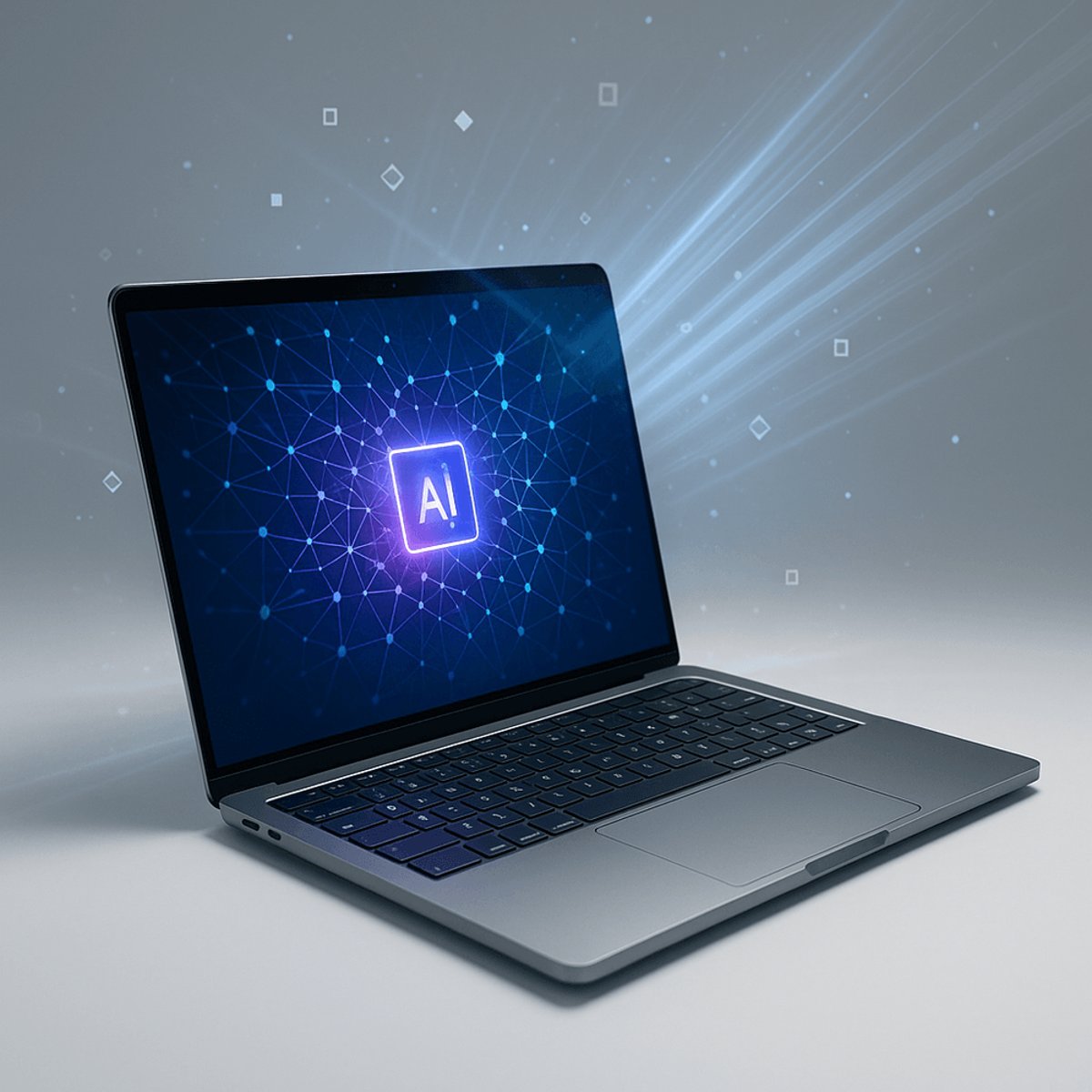
Apple just dropped its most significant MacBook Pro update in years. The new 14-inch model packs the breakthrough M5 chip, delivering up to 3.5x faster AI performance than M4 and maintaining the same $1,599 starting price. Pre-orders begin today with availability starting October 22.
Apple just rewrote the rules for professional laptops. The company's surprise Tuesday announcement of the M5-powered MacBook Pro delivers the kind of performance leap that sends competitors scrambling to rewrite their roadmaps. With up to 3.5x faster AI performance than its predecessor and the same $1,599 starting price, this isn't just an incremental update - it's a statement.
The M5 chip represents Apple's most aggressive push into AI-powered computing yet. Each of the 10 GPU cores now includes a dedicated Neural Accelerator, creating what Apple calls "the next big leap in AI for the Mac." According to internal benchmarks released today, users running diffusion models in Draw Things will see dramatically faster text-to-image generation, while large language models in LM Studio execute with unprecedented speed.
"M5 marks the next big leap in AI for the Mac and delivers a huge boost in graphics performance," Apple senior VP of Hardware Engineering John Ternus told reporters during the announcement. The timing feels deliberate - just as competitors like Microsoft and Google push their own AI hardware initiatives, Apple's doubling down on local processing power.
The performance numbers tell a compelling story for upgraders. Intel-based MacBook users will see up to 86x faster AI performance - a staggering leap that effectively transforms workflows overnight. Even M1 users, who've enjoyed Apple silicon's benefits for years, get up to 6x faster AI performance and 6.8x faster GPU performance with ray tracing. It's the kind of generational jump that makes old hardware feel ancient.
But Apple's real masterstroke lies in the details. The M5's enhanced Neural Engine now packs 16 cores, accelerating the on-device AI tasks that power Apple Intelligence features. Combined with up to 2x faster SSD performance, users can load local LLMs faster than ever - a crucial advantage as AI workloads shift toward edge computing. The company's also bumping storage options up to 4TB, recognizing that AI models demand serious disk space.
Battery life remains Apple's secret weapon. The M5 MacBook Pro delivers up to 24 hours of use - 14 additional hours compared to Intel systems and four more than M1 models. Unlike Windows laptops that throttle performance on battery, this MacBook maintains full speed whether plugged in or portable. It's a reminder why Apple silicon fundamentally changed the laptop game.
The competitive implications extend far beyond Apple's ecosystem. Nvidia's dominance in AI computing suddenly faces a consumer-focused challenger, while traditional laptop makers must explain why their AI features require cloud connectivity when Apple processes everything locally. The 14-inch form factor, previously Apple's "entry-level" Pro option, now outperforms many desktop workstations.
Pricing strategy reveals Apple's confidence. Keeping the $1,599 starting price while upgrading to 16GB unified memory as standard sends a clear message to competitors racing to match Apple's value proposition. Educational customers get an even better deal at $1,499, making this a compelling upgrade for students entering AI-heavy fields.
The environmental story matters too. Apple's pushing toward its 2030 carbon neutral goal with 45% recycled content by weight, including 100% recycled aluminum in the enclosure and 100% recycled cobalt in the battery. Manufacturing uses 55% renewable electricity, while packaging remains 100% fiber-based. It's sustainable computing without performance compromise.
For developers and creatives, this represents a watershed moment. Video editors using Topaz Video see up to 7.7x faster AI enhancement compared to M1 systems. Blender users get 6.8x faster 3D rendering. Game frame rates jump 3.2x over M1. Even Xcode compilation speeds increase 2.1x. These aren't marginal improvements - they're workflow transformations.
Apple's M5 MacBook Pro isn't just another chip upgrade - it's a strategic repositioning for the AI era. By maintaining the $1,599 price point while delivering transformative performance gains, Apple's forcing the entire industry to reconsider what's possible in a laptop. For anyone still running Intel-based systems or even M1 hardware, this represents a compelling reason to upgrade. The real question isn't whether this MacBook Pro is worth buying, but whether competitors can match this combination of performance, efficiency, and local AI processing power. Pre-orders start today, but based on these specs, availability might be limited once word spreads.