Qualcomm just made its boldest move yet in the wearables race, backing Indian health-tech startup Ultrahuman in a $70 million round that values the smart ring maker as more than just a sleep tracker. The bet: turn a piece of jewelry into a legitimate computer. With a Qualcomm-powered chip reportedly in the works, Ultrahuman is targeting a $200 million annual revenue run rate by January 2027, according to TechCrunch.
Qualcomm just placed a very specific bet on the future of wearables, and it's shaped like a ring. The chipmaker's investment arm, Qualcomm Ventures, has led a $70 million funding round into Ultrahuman, the Bengaluru-based startup that's been quietly building one of the more credible challengers to Oura in the smart ring category. According to TechCrunch, the round also pulled in returning investors Nexus Venture Partners and Blume Ventures, both of whom have backed Ultrahuman through earlier stages.
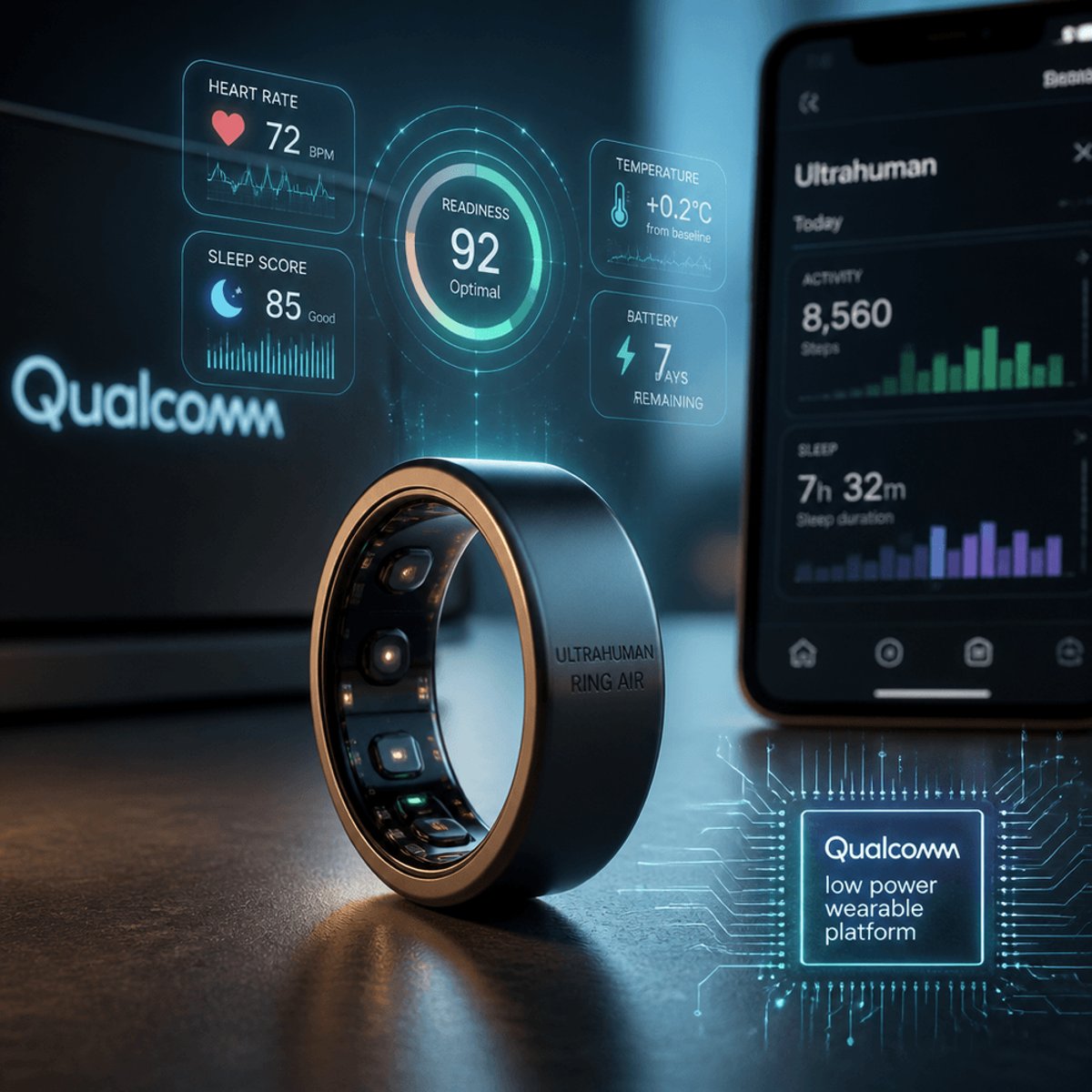
What makes this round notable isn't just the check size, it's who wrote it. Qualcomm doesn't typically write checks into consumer hardware startups unless there's a chip story attached, and this one has a big one. The plan, per the report, is to build a new Ultrahuman ring powered by a Qualcomm processor, effectively upgrading the device from a glorified sensor package into something that starts to resemble a genuine computing platform. That's a meaningful shift for a product category that's largely been defined by passive tracking: sleep scores, heart rate variability, temperature trends, the kind of data that sits in an app rather than does anything on its own.
[Image: Ultrahuman Ring AIR product shot]
Ultrahuman's ambitions are not modest. The company is targeting a $200 million annual revenue run rate by January 2027, a figure that would represent a dramatic acceleration from where most smart ring makers currently sit. For context, the entire smart ring market has been a fraction of the smartwatch business, dominated by Apple Watch and Samsung Galaxy Watch on one side and Oura's more focused wellness play on the other. Ultrahuman has tried to carve a niche by leaning hard into metabolic health, partnering with lab testing giant Labcorp to fold blood biomarker data directly into its app, giving users a fuller picture that goes beyond what a ring's sensors alone can capture.
The timing matters too. Wearables have been stuck in something of an innovation plateau, with most players iterating on battery life and sensor accuracy rather than rethinking what the device actually does. A Qualcomm-powered chip opens the door to on-device processing that wasn't previously feasible in a ring form factor, things like local AI inference, more sophisticated on-ring interactions, or tighter integration with phones and other Qualcomm-powered devices in a user's ecosystem. It's the same playbook Qualcomm has run with smartwatches and, more recently, AI glasses, positioning its silicon as the connective tissue across an expanding universe of wearable form factors.
For Qualcomm, the strategic logic is straightforward even if the ring category remains niche. The company has been aggressively diversifying beyond smartphone chips for years, chasing automotive, XR, and wearable silicon as smartphone growth flattens out globally. Backing Ultrahuman gives Qualcomm both an equity stake in a fast-growing wearable brand and a design win for its chips, a two-for-one that's become a familiar move in its venture strategy.
Competitively, this puts pressure on Oura, which has raised its own war chest and pushed into new categories like blood pressure insights and women's health tracking, but hasn't publicly signaled a similar leap toward on-device computing. It also raises the stakes for other health wearable makers watching from the sidelines, since a genuinely more capable ring could reset expectations for what the category is supposed to deliver.
Whether Ultrahuman can actually hit that $200 million run rate target by early 2027 is the open question. Hardware timelines slip, chip integration is never as fast as roadmaps suggest, and consumer wearables live and die on trust in their health data. But with Qualcomm now financially and technically invested in the outcome, Ultrahuman has more resources and more credibility behind its next move than it's had at any previous point in its roughly six-year history.
This deal is less about $70 million and more about what it signals: chipmakers now see enough future in wearable health tech to bet on the category's next generation of hardware. If Ultrahuman pulls off its computing-ring pivot and hits its revenue targets, it could force every other player in the space, from Oura to Samsung, to rethink what a ring is actually supposed to do. For now, it's a bet worth watching closely as the wearable health market matures past step counts and sleep scores into something more ambitious.