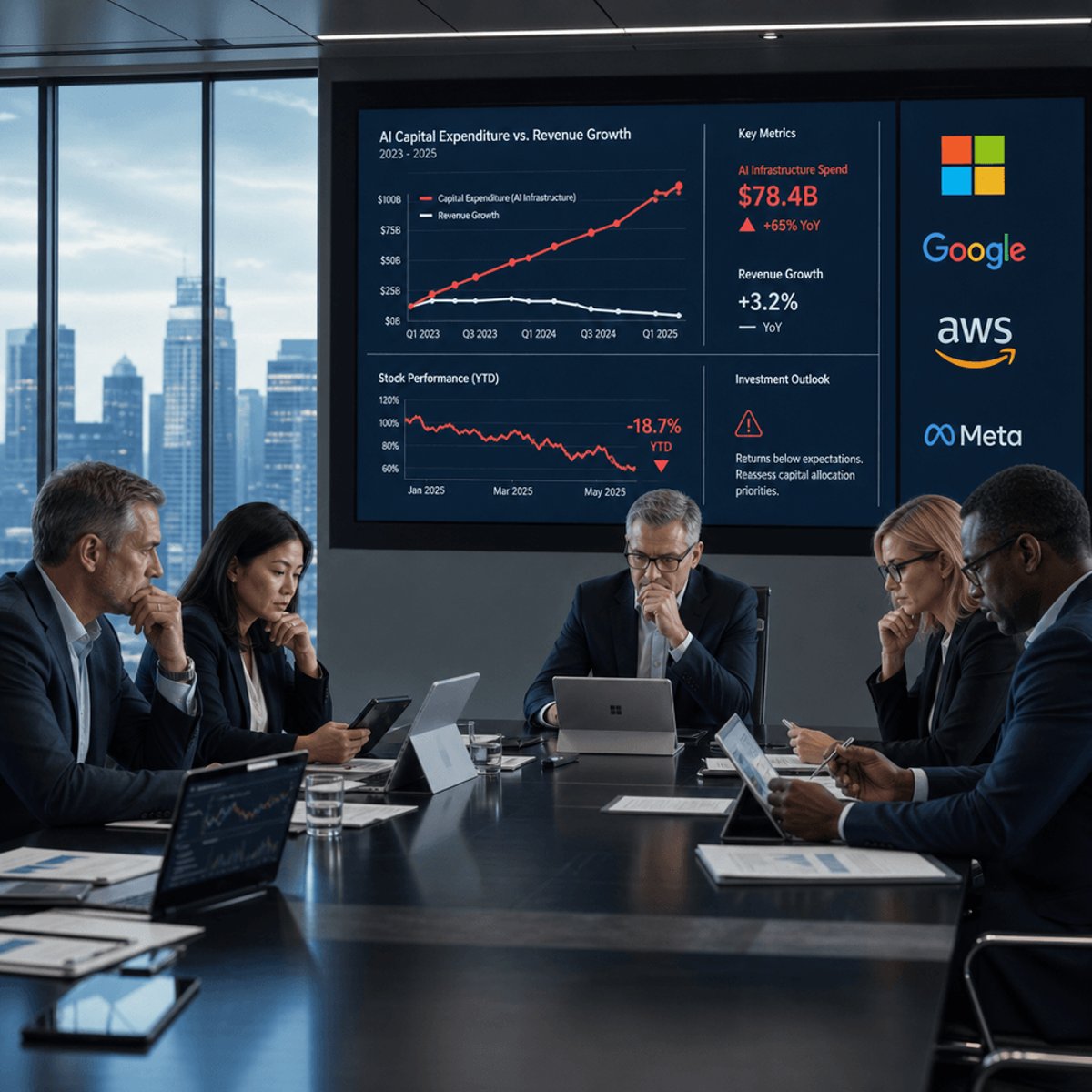
Wall Street's patience with Big Tech's AI gold rush just ran out. Google's parent company Alphabet sent shockwaves through markets this week after reporting negative free cash flow for the first time in years and simultaneously raising its capital spending forecast. Now Amazon, Meta, and Microsoft face a reckoning as they prepare to report earnings to investors suddenly skeptical that billions in AI infrastructure will ever pay off.
Google's earnings report landed like a bomb on Wall Street. For the first time in recent memory, Alphabet posted negative free cash flow while simultaneously announcing it's doubling down on capital expenditures. The combination sent the stock tumbling and dragged every other hyperscaler down with it.
The timing couldn't be worse for Amazon, Meta, and Microsoft. All three report earnings this week, and they're walking into a completely different investor climate than existed just days ago. The market's message is clear: show us the money, or the spending spree stops here.
For months, Big Tech CEOs have been selling the same story. Pour billions into GPUs, data centers, and AI infrastructure now, and the revenue will follow. Investors bought it, sending these stocks to record highs despite capital spending that would've triggered alarm bells in any other era. Microsoft has been particularly aggressive, positioning itself as the AI leader through its partnership with OpenAI and Azure's enterprise offerings.
But Google's numbers revealed the uncomfortable truth hiding beneath the hype. You can spend unlimited amounts on AI infrastructure, but if the revenue doesn't materialize fast enough, you burn through cash. And once free cash flow goes negative, investors start asking hard questions about return on investment.
The sell-off hit the slower-growing cloud providers especially hard. While Google Cloud has been gaining share, it still trails Amazon Web Services and Microsoft Azure significantly. If the market leader is struggling to generate returns on AI spending, what hope do the followers have?
Amazon faces unique pressure because AWS has been the company's profit engine for years. Any sign that cloud growth is slowing while capex accelerates could trigger a major revaluation. The company's reportedly spent tens of billions on AI infrastructure, betting that enterprise customers will migrate to AWS for AI workloads. That bet needs to start paying off visibly, or investors will revolt.
Meta has perhaps the hardest story to sell. Unlike Microsoft and Amazon, it doesn't have a massive cloud business generating revenue from AI services. CEO Mark Zuckerberg has justified enormous AI spending by pointing to improved ad targeting and content recommendations. But those benefits are harder to quantify than direct cloud revenue, and investors are running out of patience with vague promises.
The infrastructure build-out has been staggering across the industry. Nvidia can barely keep up with demand for its H100 and upcoming Blackwell GPUs. Data center construction has accelerated globally. Power consumption concerns are mounting. And all of it is predicated on the assumption that AI will generate enough revenue to justify the investment.
Microsoft has the strongest case to make. The company's been successfully monetizing AI through Copilot subscriptions and Azure AI services. But even Microsoft needs to show that the revenue is scaling fast enough to justify continued capex increases. Investors want to see the path to profitability, not just top-line growth.
The market's shift in sentiment represents a fundamental change in how Big Tech's AI investments will be evaluated going forward. For the past year, spending more on AI was seen as visionary. Now it's seen as risky unless accompanied by clear revenue growth. That's a huge psychological shift that could reshape strategic decisions across the industry.
Analysts are already adjusting their models and questions for this week's earnings calls. Instead of asking about AI capabilities and future plans, they'll be pressing for specifics on ROI, payback periods, and when free cash flow will turn positive again. The companies that can't provide satisfying answers will see their stocks hammered.
What happens next depends entirely on what Amazon, Meta, and Microsoft reveal this week. If they show strong AI revenue growth that justifies their spending, markets could stabilize. If they echo Google's pattern of rising costs without proportional revenue gains, the sell-off could accelerate into a full-blown correction.
The AI infrastructure boom just hit its first major speed bump, and the ripple effects will define Big Tech's trajectory for the rest of the year. Investors are done accepting promises and projections - they want proof that the billions being poured into GPUs and data centers will actually generate returns. How Amazon, Meta, and Microsoft answer that challenge this week will determine whether this is just a temporary correction or the start of a major reckoning for the entire hyperscaler business model. The era of unlimited AI spending just ended, and the era of accountability has begun.