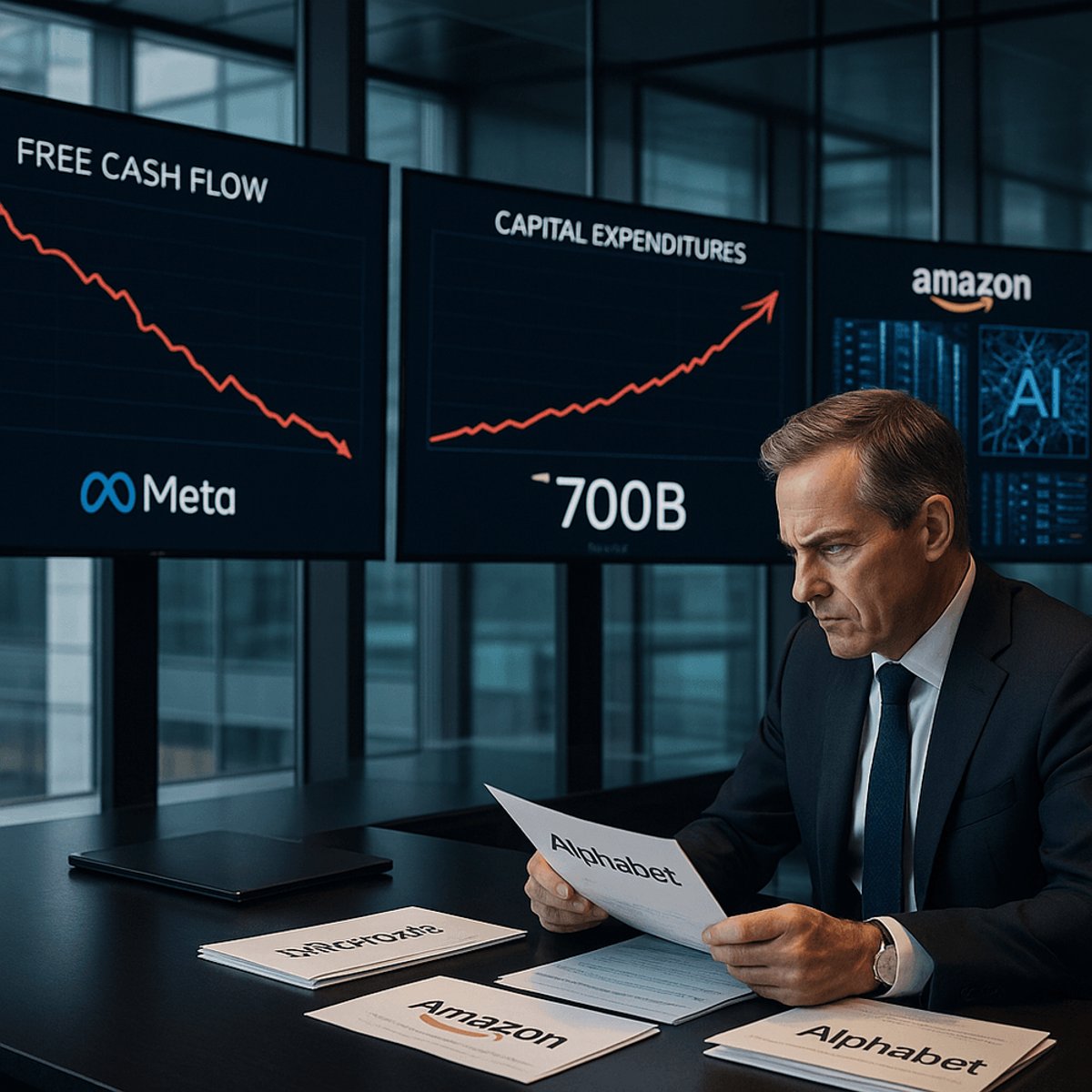
The AI arms race just got a price tag that's making Wall Street nervous. Alphabet, Microsoft, Meta and Amazon are projected to blow nearly $700 billion this year on AI infrastructure - a 60% jump from 2025's already historic levels. But there's a catch that's sending shockwaves through investor circles: free cash flow is about to take a nosedive, with some companies staring down negative territory for the first time in years.
Wall Street's love affair with tech's cash-generating machines just hit a major speed bump. As earnings season wraps up, the numbers tell a sobering story about what it really costs to win the AI race - and investors aren't sure they like the answer.
Amazon dropped the biggest bombshell Thursday, announcing plans to spend $200 billion this year on AI infrastructure. Morgan Stanley analysts now project the e-commerce giant will burn through $17 billion in negative free cash flow in 2026, while Bank of America sees a deficit hitting $28 billion. In a quiet SEC filing Friday, Amazon signaled it may tap equity and debt markets to fuel the buildout. The stock immediately sank 6%, extending its 2026 losses to 9%.
But Amazon's not alone in the spending frenzy. Alphabet is projecting up to $185 billion in capex this year, with Morgan Stanley managing director Brian Nowak telling CNBC's Power Lunch he expects that figure to balloon to $250 billion by 2027. Pivotal Research projects Alphabet's free cash flow will crater 90% to just $8.2 billion from $73.3 billion in 2025. The company already held a $25 billion bond sale in November, and its long-term debt quadrupled last year to $46.5 billion.
Meta might be facing the most dramatic shift. Barclays analysts are now modeling negative free cash flow for 2027 and 2028 after the social media giant announced capex could reach $135 billion this year. "We are now modeling negative FCF for '27 and '28, which is somewhat shocking to us but likely what we eventually see for all companies in the AI infrastructure arms race," the analysts wrote. When CFO Susan Li fielded questions about capital allocation on the earnings call, her message was clear: "The highest order priority is investing our resources to position ourselves as a leader in AI."
The collective numbers are staggering. Combined, the four hyperscalers generated $200 billion in free cash flow last year, down from $237 billion in 2024. But that decline looks modest compared to what's coming. The companies are loading up on high-priced chips, constructing massive data centers, and buying networking technology to connect it all - with much of the payoff years away.
"If you're going to pour all this money into AI, it's going to reduce your free cash flow," Longbow Asset Management CEO Jake Dollarhide, who counts Amazon as his biggest holding, told CNBC. "Do they have to go to the debt markets or short-term financing to find the optimal mix of equity and debt? Yeah. That's why CEOs and CFOs are paid what they're paid."
Not everyone's convinced the pain is worth it. Microsoft, where capex is rising at a slower clip than its peers, still faces a projected 28% slide in free cash flow this year according to Barclays. The stock has tumbled 17% in 2026, the worst performance among the megacaps. Mizuho analysts warned that bearish investors may view the doubling of capex as "leaving limited FCF in 2026 with uncertain" return on investment.
Yet bulls argue the four tech giants have advantages that justify the spending spree. They're sitting on over $420 billion in cash and equivalents as of the latest quarter, giving them firepower that AI upstarts like OpenAI and Anthropic can only dream of. Deutsche Bank wrote that Alphabet's infrastructure buildout is creating a "meaningful moat" - a view echoed by executives betting AI represents a generational opportunity with revenue eventually reaching into the trillions.
The companies insist demand is there. Amazon CEO Andy Jassy said growth at Amazon Web Services hit "the fastest we've seen in 13 quarters." Morgan Stanley's Nowak pointed to Alphabet "seeing a lot of signal on return when it comes to Google Cloud, return on Google search, and YouTube." Businesses are racing to build AI agents that handle everything from customer service to application development, all requiring massive amounts of compute power.
But skeptics worry about what happens if the AI boom stumbles. OpenAI has announced over $1.4 trillion in AI deals, and some analysts fear a slip-up at the ChatGPT creator could trigger market contagion given how much of the industry's growth is tied to its success. "The truth is, we're at the dawn of a new technology shift and it's really hard to know the sustainability of top line," Michael Nathanson, co-founder of MoffettNathanson, told CNBC. "We're entering new times and predicting the top line has gotten a lot harder."
For now, Wall Street analysts are maintaining their buy ratings even as they slash cash flow projections. Futurum Group CEO Daniel Newman argues the megacaps remain "core technologies" as enterprises build on their platforms. But with Amazon potentially going cash-flow negative, Alphabet's free cash flow vanishing, and Meta projecting years of cash burn ahead, investors face a uncomfortable question: how long can tech's biggest names sacrifice profitability before they need to show AI can actually pay the bills?
The $700 billion question facing tech investors isn't whether AI will transform business - it's whether these companies can afford to wait for the payoff. With free cash flow evaporating across the board and Amazon potentially going negative for the first time, Wall Street's patience is being tested. The megacaps have the cash reserves and market dominance to sustain years of heavy spending, but as earnings pressure mounts and stock prices stumble, they'll need to start showing returns sooner rather than later. For now, the message from Silicon Valley is clear: the AI infrastructure race is winner-take-all, and sitting out isn't an option - even if it means burning through cash at unprecedented rates.