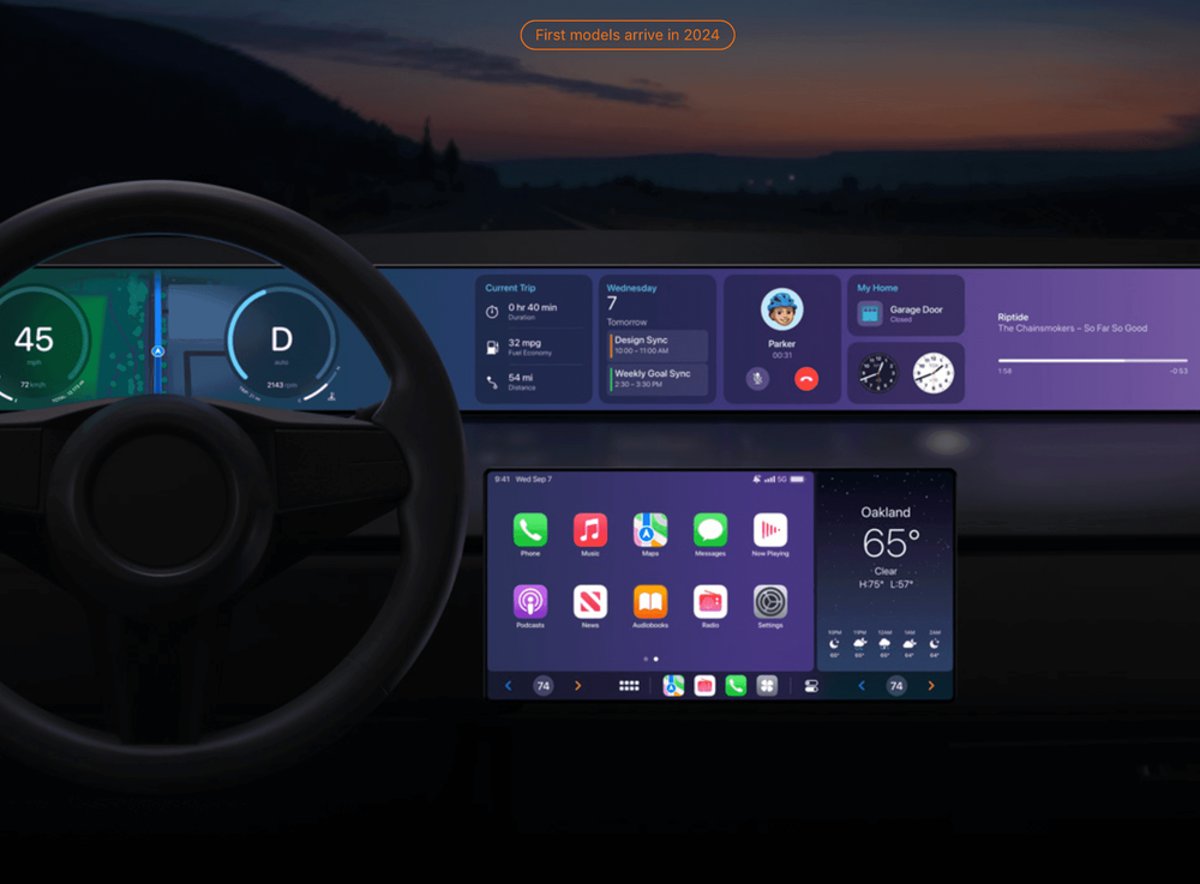
Apple is preparing to crack open CarPlay's voice assistant ecosystem to rival AI chatbots, according to a Bloomberg report. The move would let drivers interact with ChatGPT, Claude, or Gemini directly through their car's dashboard instead of fumbling with their iPhone. It's a quiet but significant retreat from Apple's typical walled-garden approach, signaling the company recognizes Siri alone won't cut it in the AI arms race that's now reaching into automobiles.
Apple is about to make driving with AI a whole lot more flexible. The company is quietly developing support for third-party voice-controlled chatbots in CarPlay, letting users choose between ChatGPT, Anthropic's Claude, Google Gemini, and potentially others instead of relying solely on Siri, according to Bloomberg's Mark Gurman.
Right now, CarPlay users who want to access these more capable AI assistants need to reach for their iPhone, navigate to the app, and hope they're not already on the highway. The upcoming integration would eliminate that friction, bringing voice-controlled AI directly to the car's dashboard interface where drivers can safely interact with it hands-free.
But Apple isn't surrendering complete control. The company reportedly won't let users replace the Siri button on CarPlay or change the wake word that summons Apple's assistant. Instead, drivers will need to manually open their preferred chatbot's app before they can start talking. It's a compromise that keeps Siri front and center while acknowledging that users increasingly want access to more advanced AI capabilities.
Developers will get a workaround, though. They'll be able to configure their apps to automatically launch into voice mode when opened in CarPlay, which could make the experience feel nearly as seamless as invoking Siri directly. For OpenAI, Google, and Anthropic, it's a valuable foothold in the automotive interface - a space where Apple has historically maintained iron-fisted control.
The timing is notable. Just last month, Apple announced that Google Gemini would power an updated version of Siri expected later this year. That partnership already signaled Apple's recognition that its own AI capabilities lag behind competitors. Now, extending that openness to CarPlay suggests the company is playing defense across multiple fronts.
CarPlay has become crucial infrastructure for Apple. The system is available in over 800 car models and used by millions of drivers daily. It's also a sticky ecosystem play - once users get comfortable with CarPlay, they're less likely to switch to Android. Opening it to third-party AI could actually strengthen that lock-in by making the platform more versatile and useful.
For the AI companies, automotive integration represents a massive opportunity. Drivers spend an average of 51 minutes per day in their cars, according to AAA data. That's 51 minutes of potential AI interaction for navigation help, restaurant recommendations, message dictation, and countless other tasks. OpenAI, Google, and Anthropic have been racing to embed their assistants into every possible surface, and the car dashboard is prime real estate.
According to Bloomberg, the feature could roll out "within the coming months," though Apple hasn't officially announced anything yet. That timeline would put it somewhere in the spring or early summer, possibly coinciding with iOS updates that typically arrive around WWDC in June.
The move also raises questions about Apple's broader AI strategy. The company has been methodical about AI integration, favoring privacy-focused, on-device processing over the cloud-dependent approaches favored by competitors. But that caution has left Siri visibly behind ChatGPT, Gemini, and Claude in capabilities. By opening CarPlay to these assistants, Apple is essentially admitting users need access to more powerful AI, even if it means sending data to third-party servers.
What we don't know yet is how deep the integration will go. Will these chatbots be able to control CarPlay functions like changing music or adjusting navigation? Or will they remain siloed, useful for conversation and information but unable to tap into the car's systems? The answers will determine whether this is a meaningful expansion or just a cosmetic addition.
Apple's decision to open CarPlay to third-party AI assistants is less about altruism and more about pragmatism. The company knows Siri can't compete with ChatGPT's conversational abilities or Gemini's information retrieval, and users are already finding workarounds to access those tools while driving. By bringing them directly into CarPlay - with guardrails firmly in place - Apple gets to look flexible and user-focused while maintaining control over the core interface. For drivers, it means better AI is coming to the dashboard. For the AI companies, it's another battleground in the fight to become the default assistant in every part of our lives.