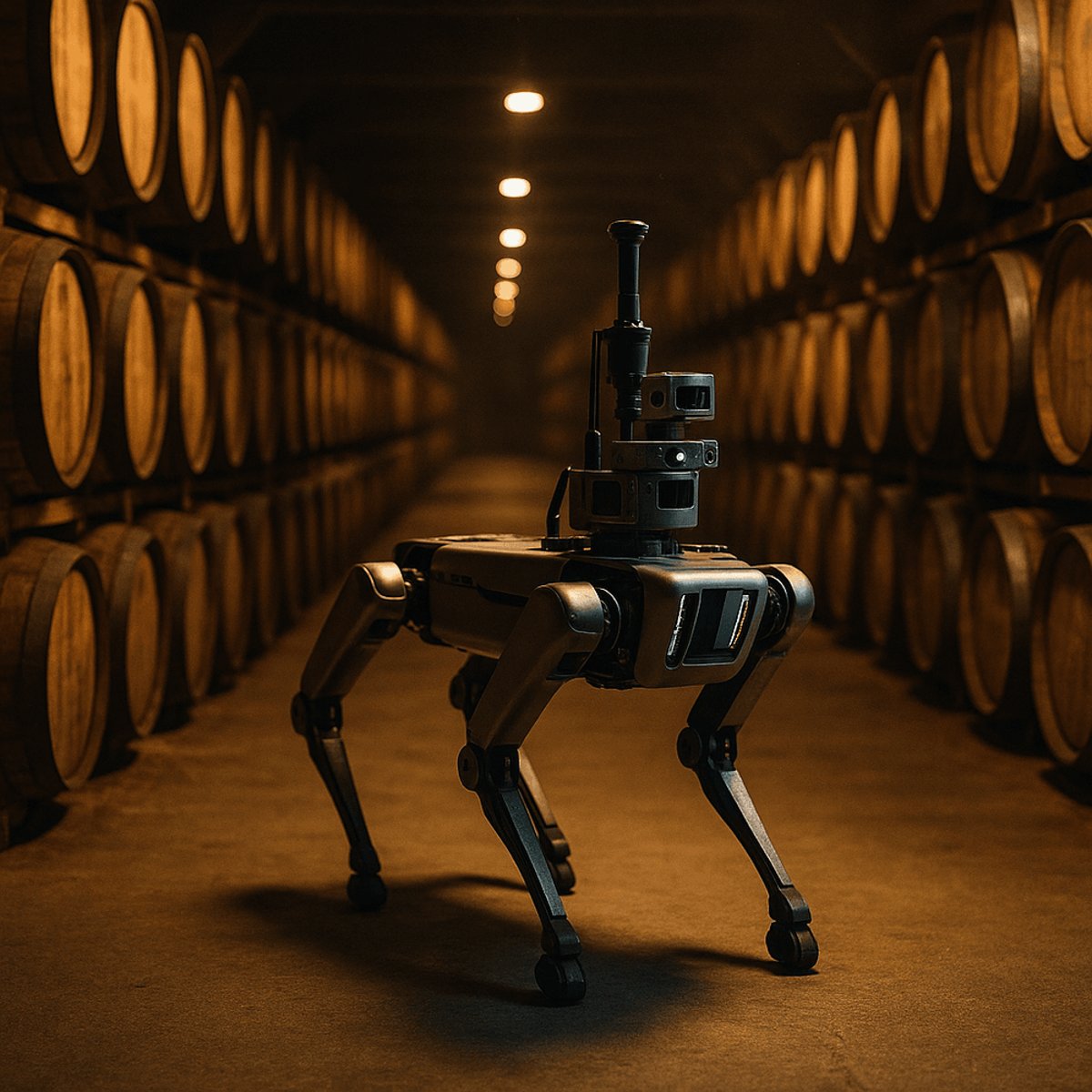
Inside Dewar's sprawling Scottish whisky warehouses, a four-legged robot is prowling between aging barrels with a mission: sniff out leaks before they waste precious spirits. The distillery has deployed a Boston Dynamics Spot robot dog equipped with ethanol sensors to patrol its cavernous storage facilities, marking one of the more unusual applications of industrial robotics in traditional manufacturing. It's a glimpse at how even centuries-old industries are turning to automation to solve age-old problems.
Boston Dynamics' Spot robot just landed its most Scottish job yet. Inside the cavernous warehouses of Dewar's, the four-legged machine is padding between rows of aging whisky casks with an ethanol sensor mounted where a nose would be, hunting for leaks that could cost the distillery thousands in lost spirits.
The deployment represents a practical application of industrial robotics in an environment humans find tedious and potentially hazardous. Whisky warehouses are massive, dimly lit facilities where thousands of barrels age for years, and leaks can go undetected until significant product is lost. The traditional method involves human workers walking miles of warehouse aisles, visually inspecting barrels and occasionally relying on smell to catch problems.
Enter Spot, the quadruped robot that's become Boston Dynamics' most commercially successful product since the company started selling it to enterprises in 2020. Equipped with an ethanol detection sensor, the robot can autonomously navigate warehouse layouts, systematically checking each barrel row for telltale signs of alcohol vapor that indicate a leak. The sensor acts like a mechanical bloodhound, capable of detecting ethanol concentrations that might escape human notice until a leak becomes obvious.
For Dewar's, owned by spirits giant Bacardi, the economics make sense. Whisky evaporation during aging - known romantically as the 'angel's share' - is expected and factored into production. But unexpected leaks from damaged barrels represent pure loss. A single leaking cask can waste hundreds of liters of aged whisky worth thousands of dollars. Catching these leaks early, before significant product escapes, directly impacts the bottom line.
The robot's deployment also addresses a labor challenge. Walking warehouse floors is physically demanding work, and distilleries compete for workers in rural Scottish regions where unemployment is low. Spot can patrol 24/7 without fatigue, covering more ground more consistently than human teams while freeing workers for tasks that require human judgment and skill.
Boston Dynamics has been aggressively pushing Spot into new industrial verticals since Hyundai acquired the company for $1.1 billion in 2021. The robot's already inspecting oil rigs, monitoring construction sites, and conducting safety patrols at nuclear facilities. This whisky warehouse application demonstrates how robotics companies are finding revenue in niche manufacturing sectors that seem low-tech on the surface but have specific pain points automation can address.
The technology integration is relatively straightforward. Spot's existing autonomous navigation system handles the warehouse layout, using LIDAR and cameras to avoid obstacles. The ethanol sensor - essentially a modified industrial gas detector - mounts on Spot's body and feeds data to monitoring software. When the sensor detects elevated ethanol levels, it flags the location for human inspection. Workers then examine the flagged barrels and take corrective action, whether that means transferring the whisky to a new cask or repairing minor damage.
What's notable is how this fits into broader automation trends in food and beverage manufacturing. While cutting-edge AI and machine learning grab headlines, many manufacturers are seeing immediate ROI from simpler robotic applications focused on monitoring and inspection. You don't need computer vision models or predictive analytics when a well-placed sensor and a mobile platform solve the problem.
The deployment also highlights how industrial robotics is maturing beyond the factory floor. Early commercial robots were stationary machines bolted in place on assembly lines. Mobile robots like Spot represent a second wave - machines that move through human-designed spaces and handle tasks that require navigation and adaptability rather than precision repetition.
For Boston Dynamics, every unusual Spot deployment builds the case that mobile robots can justify their cost across diverse industries. The company reportedly sells Spot for around $75,000 per unit, a significant investment that requires clear operational benefits. Warehouse monitoring applications like this one offer compelling payback periods when the alternative is lost inventory or expanded human labor costs.
Dewar's whisky-sniffing robot dog might seem like a novelty, but it's actually a template for how industrial robotics finds commercial traction. Companies like Boston Dynamics aren't winning by building general-purpose humanoid robots that can do everything - they're succeeding by deploying specialized mobile platforms that solve specific, expensive problems in environments humans find tedious or hazardous. Whether it's inspecting oil pipelines, monitoring construction zones, or prowling whisky warehouses for leaks, the path to robotics adoption runs through unglamorous but profitable niche applications. And if that robot happens to look like a mechanical dog, so much the better for the marketing.