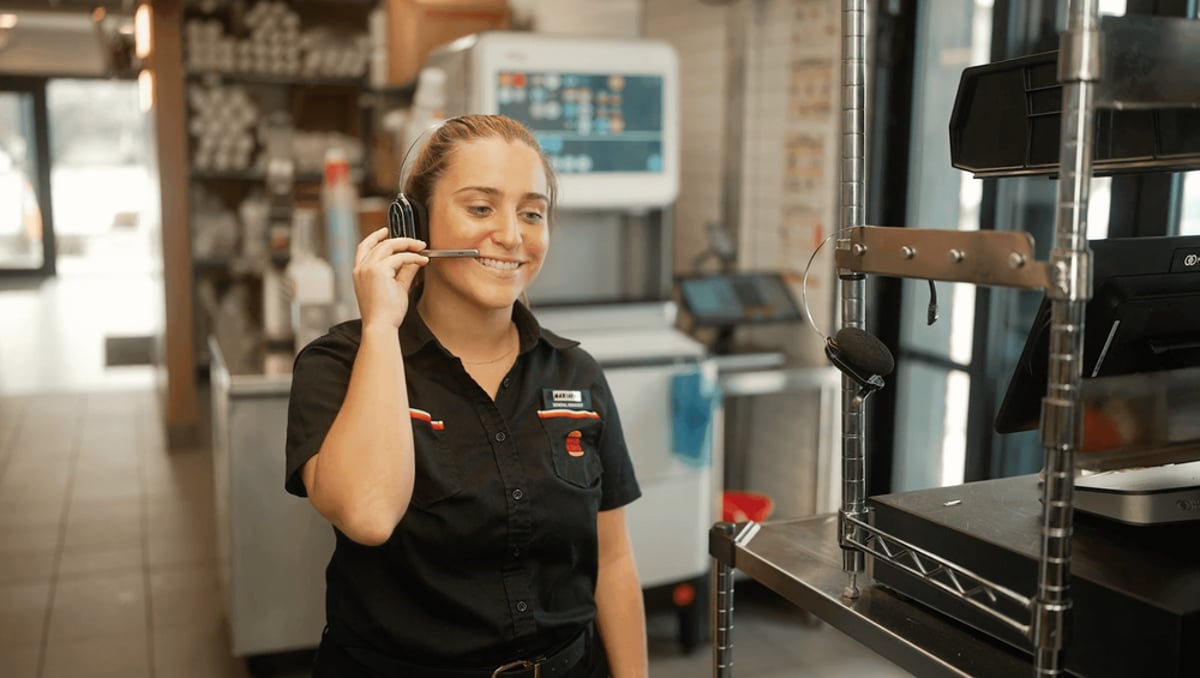
Burger King is putting AI in employee headsets to monitor how polite workers are to customers. The fast food giant's new voice assistant, dubbed "Patty," doesn't just help with meal prep - it actively listens to every drive-thru interaction and scores employees on friendliness metrics like whether they say "please," "thank you," and "welcome to Burger King." The move signals a new frontier in workplace surveillance, where AI doesn't just automate tasks but actively evaluates human behavior in real-time.
Burger King just turned every drive-thru headset into a listening device. The fast food chain is rolling out an AI assistant called "Patty" that lives inside employee headsets, and it's not just there to help - it's actively grading workers on how nice they sound to customers.
The voice-enabled chatbot is part of what Burger King calls the BK Assistant platform, and it's designed to do two things simultaneously: help employees prepare orders and evaluate whether they're being friendly enough. Thibault Roux, Burger King's chief digital officer, told The Verge that the company worked with franchisees and customers to define what "friendliness" actually means in measurable terms.
The result? An AI system trained to recognize specific words and phrases. "Welcome to Burger King," "please," and "thank you" are apparently the magic words that trigger positive scores. Managers can then review these friendliness metrics alongside whatever other performance data they're already tracking. It's workplace surveillance dressed up as customer service optimization.
This isn't just about automation anymore - it's about AI evaluating the emotional labor that service workers perform dozens or hundreds of times per shift. The technology represents a significant shift in how AI gets deployed in retail and quick-service environments. Where previous generations of restaurant tech focused on order accuracy or kitchen efficiency, Patty is explicitly designed to monitor the tone and content of human interactions.
The dual-purpose design is noteworthy. By combining meal preparation assistance with conversation monitoring, Burger King is essentially making the surveillance layer feel like a helpful tool rather than pure oversight. Employees get AI support with their tasks, but that support comes with a listening ear that's always on and always evaluating.
For the broader AI industry, this deployment signals where voice AI is headed in enterprise settings. We've seen chatbots in customer service and voice assistants in warehouses, but embedding AI directly into employee communication tools for real-time behavioral analysis is relatively new territory. The technology required to parse natural speech, identify specific phrases, and generate meaningful metrics from thousands of daily interactions represents a practical application of natural language processing that goes beyond simple transcription.
The privacy and labor implications are substantial. Fast food workers already operate under intense productivity pressures and constant oversight. Adding an AI layer that literally scores every interaction with customers creates a new category of performance anxiety. Will employees start over-using programmed phrases to game the system? Will managers rely too heavily on algorithmic friendliness scores instead of their own judgment? These aren't hypothetical concerns - they're inevitable outcomes when you quantify something as subjective and human as politeness.
Burger King isn't alone in exploring AI-powered employee monitoring. Retailers and restaurants across the industry are experimenting with similar technologies, from AI-powered cameras that track worker movements to sentiment analysis tools that evaluate customer service calls. But putting the technology directly into the communication device that workers rely on to do their jobs feels like a particularly intimate form of surveillance.
The timing is significant too. As labor markets remain tight and minimum wage debates continue, fast food chains are increasingly turning to technology not just to replace workers but to extract more measurable value from the workers they keep. Patty represents the next evolution of that strategy - not replacing the human entirely, but augmenting them with AI that ensures they perform their emotional labor according to corporate specifications.
What happens when the AI decides an employee isn't friendly enough? That's the question Burger King and its franchisees will need to answer as this system rolls out. The technology might be sophisticated enough to recognize words and phrases, but it's not sophisticated enough to understand context, genuine human connection, or the difference between scripted politeness and actual customer service.
Burger King's Patty system represents a turning point in workplace AI - the moment when automation stopped being just about efficiency and started being about behavioral control. By embedding monitoring directly into the tools employees use to communicate, the fast food giant is normalizing a level of workplace surveillance that would have seemed dystopian just a few years ago. Whether this becomes an industry standard or a cautionary tale will depend largely on how workers, franchisees, and customers respond to the reality of AI-scored politeness. One thing is certain: the line between helpful AI assistant and omnipresent overseer has never been thinner.