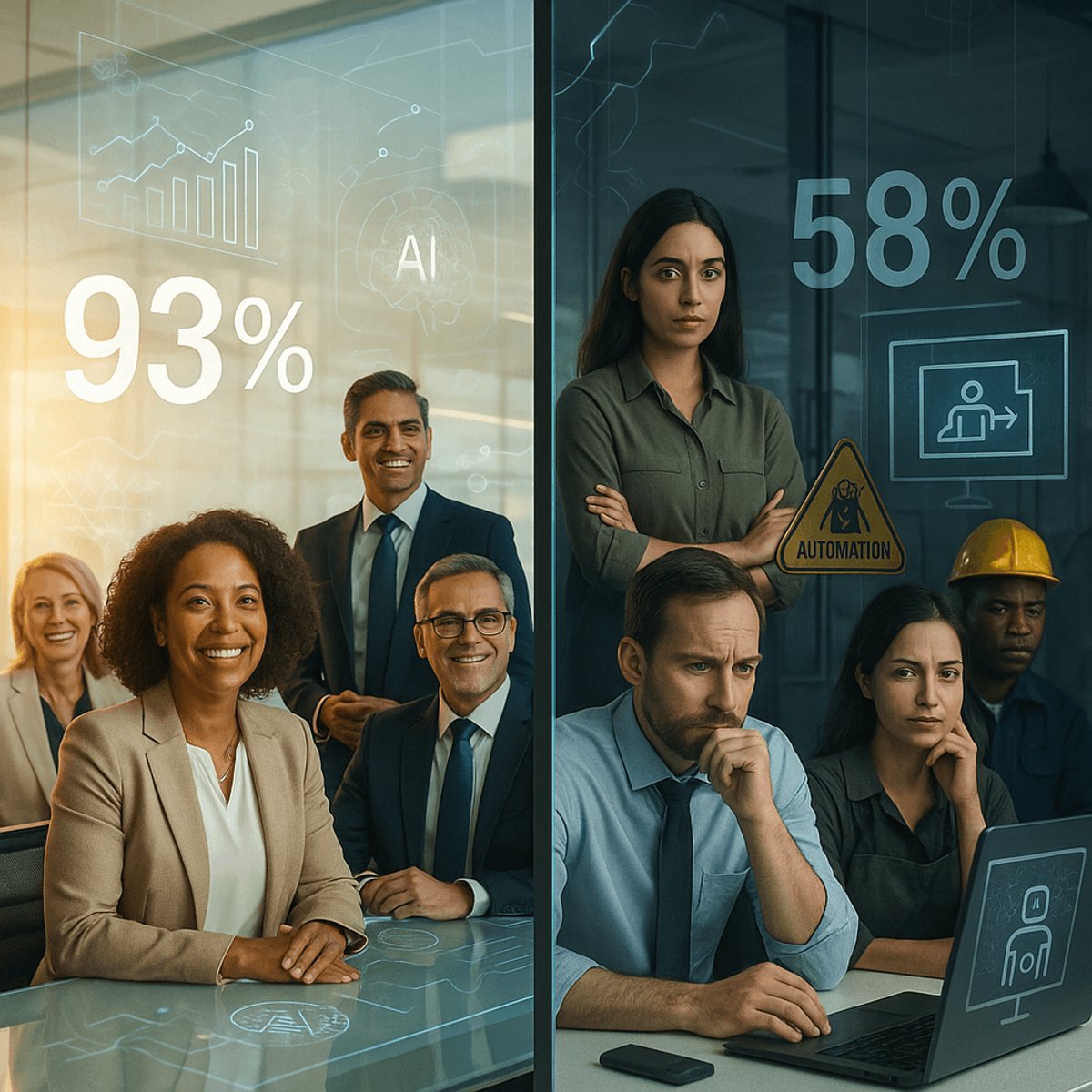
Three years after ChatGPT's debut, the AI revolution has created a stunning perception gap. While 93% of corporate executives believe AI will benefit society, only 58% of Americans agree - and nearly half expect widespread job losses, according to new survey data from Just Capital that exposes the widening disconnect between boardrooms and Main Street.
The numbers tell a stark story of two Americas viewing the same technological revolution. OpenAI's ChatGPT launch three years ago didn't just spark an AI boom - it created a perception chasm that's widening by the quarter.
Just Capital's latest survey, conducted between September and November, reveals corporate executives living in a fundamentally different reality than the workers whose jobs they're reshaping. The nonprofit polled institutional investors, corporate executives, and everyday Americans, uncovering divisions that go far beyond typical tech adoption curves.
The workplace productivity question exposes the deepest fault lines. A staggering 98% of corporate leaders believe AI will boost worker productivity, compared to a mere 47% of the general public. It's not just skepticism - it's fear. Nearly half of Americans expect AI to replace workers and eliminate jobs outright, while only 20% of executives see that same threat.
"The survey findings reveal widespread public concern that companies' growing adoption of AI will have swift, direct consequences for workers through job cuts," Just Capital noted in their report. The data suggests executives either aren't communicating their AI strategies effectively or aren't being honest about the human cost of automation.
The timing couldn't be more critical. Analysts are forecasting AI spending will reach into the trillions by decade's end, with companies from Microsoft to Meta pouring billions into infrastructure and capabilities. BlackRock recently signaled it's betting big on the "pick and shovel" trade around AI infrastructure, while corporate earnings calls consistently highlight AI investments as key growth drivers.
But the public isn't buying the productivity narrative. Only 23% believe AI will help workers be more productive in their current jobs, compared to 64% of executives who see that same potential. This disconnect suggests either a massive communication failure or executives genuinely don't grasp how their AI rollouts appear to workers on the ground.
Investors occupy a middle ground in this perception war. Roughly 80% believe AI will positively impact society - more optimistic than the public but less bullish than the C-suite executives driving these investments. It's a telling position for the money managers who ultimately fund these AI transformations.
Safety concerns unite all three groups, though their priorities differ sharply. Corporate leaders and investors worry most about disinformation and malicious use of AI technology. The public shares those fears but adds two critical concerns that executives seem to dismiss: loss of control and environmental impact.
The environmental angle reveals another blind spot in corporate AI strategy. More than 40% of corporate leaders admitted environmental issues aren't factored into their AI deployment plans, even as data centers consume increasingly massive amounts of energy to power large language models and training runs.
Spending priorities show similar misalignment. Roughly 60% of investors and half the public believe companies should dedicate more than 5% of their total AI investment to safety measures. Corporate leaders? Just 59% think safety deserves up to 5% of AI budgets - not more than that threshold.
These aren't just survey numbers - they're warning signs for an industry racing toward a multitrillion-dollar transformation without public buy-in. The disconnect between executive optimism and worker anxiety could fuel regulatory backlash, talent shortages, or consumer resistance that slows AI adoption regardless of technological capabilities.
Just Capital plans quarterly tracking of these sentiment gaps, creating a real-time barometer of how the AI revolution is being received across different stakeholder groups. The data suggests companies need to invest as much in change management and communication as they do in GPU clusters and model training.
This perception gap isn't just a PR problem - it's a strategic risk that could derail the AI revolution before it fully takes hold. Companies investing trillions in AI capabilities need to invest equally in winning hearts and minds, or risk facing the kind of public and regulatory backlash that has slowed other transformative technologies. The survey data suggests we're not just building AI systems, we're building toward a reckoning between corporate optimism and worker anxiety.