Last year's TechCrunch Disrupt runner-up geCKo Materials just dropped four new commercial products on stage Wednesday, riding high on an $8 million fundraise and contracts with tech giants like Samsung and Intel. The biomimetic adhesive startup, which mimics gecko feet to create residue-free gripping technology, is proving that sometimes nature's oldest tricks make the best business.
The gecko's evolutionary masterpiece just got a Silicon Valley upgrade. geCKo Materials, fresh off the TechCrunch Disrupt stage Wednesday, is turning lizard biology into industrial gold with four new product launches that have semiconductor giants scrambling to upgrade their manufacturing lines.
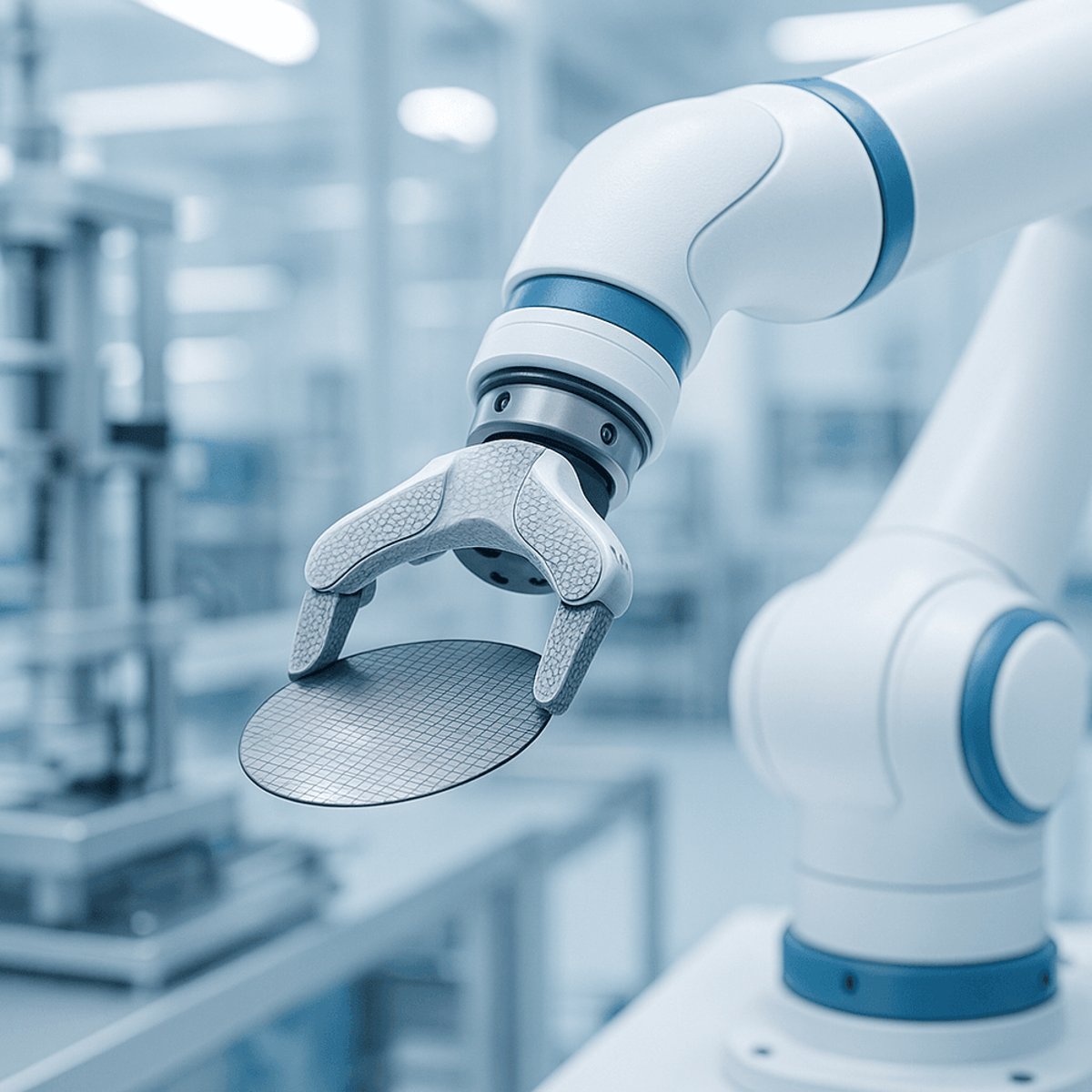
Founder Dr. Capella Kerst didn't just return to Disrupt for a victory lap - she came armed with proof that biomimetic technology can outpace traditional industrial solutions. The company's gecko-inspired dry adhesive, which requires zero electricity or suction, just demonstrated 5.4G acceleration in semiconductor wafer handling, crushing the industry's 2G standard that customers at Samsung, Intel, and TSMC thought was ambitious.
"Our customers said we have a goal to move wafers at 2Gs of acceleration," Kerst told the packed audience. "We decided to blow them out of the water and do 5.4Gs repeatedly, reliably." The demonstration wasn't just showmanship - it represents a fundamental shift in how delicate components move through manufacturing pipelines.
The four new products tackle different industrial challenges: a semiconductor wafer handling system that's already catching attention from chip manufacturers, robotic grippers designed for smooth surfaces like solar panels and glass, curved "end effectors" that adapt to irregular shapes, and general-purpose grippers for existing robotic arms. Each leverages geCKo's core technology - a dry adhesive that can attach and detach 120,000 times while holding 16 pounds per square inch.
This isn't theoretical tech anymore. Kerst revealed that her company completed an $8 million funding round while tripling team size since last year's Startup Battlefield appearance. More telling: geCKo's adhesive technology flew on six space missions in the past year, proving it works in conditions from vacuum chambers to manufacturing floors. When NASA and Ford signed on as customers before the company even competed last year, the writing was on the wall.
The semiconductor application might be the biggest breakthrough. Current wafer handling relies on suction systems that limit speed and precision, but geCKo's approach eliminates those constraints. For an industry where microseconds matter and a single dropped wafer costs thousands, that performance leap translates to serious competitive advantage. TSMC and other foundries are already testing the technology in production environments.
What makes geCKo's approach clever is how it solves multiple industrial pain points simultaneously. Traditional adhesives leave residue, mechanical grippers can damage surfaces, and suction systems fail in certain environments. The gecko-inspired solution works in vacuum, leaves no trace, and adapts to virtually any surface texture - from mirror-smooth semiconductor wafers to textured solar panel backing.
The Pacific Gas & Electric partnership hints at where this technology heads next. As renewable energy installations scale up, the ability to handle large glass surfaces quickly and safely becomes more valuable. Solar panel manufacturing and installation could see similar speed improvements to what geCKo demonstrated in semiconductors.
Kerst's timing looks prescient. As manufacturing automation accelerates and materials become more delicate, the demand for precise, adaptable handling solutions grows. The company's biomimetic approach sidesteps traditional engineering constraints by borrowing from millions of years of gecko evolution - a strategy that's proving both technically superior and economically viable.
The real test comes as these products hit commercial production. Early customer adoption suggests strong market validation, but scaling manufacturing while maintaining the precision that makes the technology valuable presents new challenges. Kerst's team expansion and funding round position the company for that next phase, but execution will determine whether geCKo Materials becomes the next Velcro or remains a niche industrial solution.
geCKo Materials just proved that sometimes the best industrial solutions come from studying nature's oldest problems. With major semiconductor and aerospace customers already on board and $8 million in fresh funding, the company is positioning itself at the intersection of two massive trends: manufacturing automation and biomimetic engineering. As production lines get faster and components get more delicate, gecko-inspired gripping might just become as ubiquitous as the Velcro that inspired Kerst's pitch. The question isn't whether this technology will find its market - it's how quickly industries will adapt to take advantage of what millions of years of gecko evolution just taught Silicon Valley.