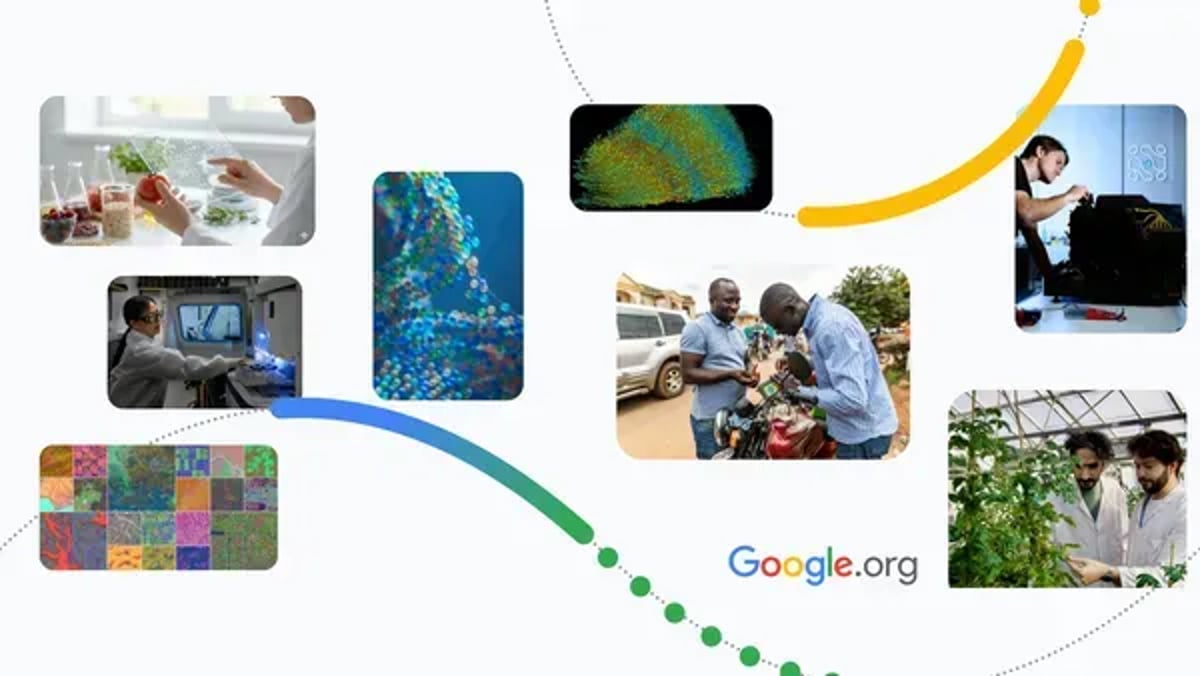
Google.org just opened its checkbook to accelerate scientific discovery in a big way. The philanthropic arm of Google announced twelve recipients of its $20 million AI for Science fund, backing organizations using artificial intelligence to crack some of humanity's toughest challenges - from decoding the 99% of the human genome we still don't understand to cutting bacteria detection time from days to under an hour. The fund targets a critical problem: while global challenges grow more complex, the pace of scientific discovery is actually slowing down.
Google.org is betting that artificial intelligence can restart the engine of scientific progress. The company's VP and Global Head Maggie Johnson announced today that twelve organizations - spanning academic institutions, nonprofits, and startups - will share a $20 million AI for Science fund designed to compress decades of research into years.
The timing isn't accidental. Scientific discovery is hitting a wall. Research shows the pace of new breakthroughs is actually slowing even as problems like climate change, drug resistance, and food security accelerate. Google is positioning AI as the solution to this paradox.
"These teams aren't just using AI to synthesize and process data," Johnson wrote in the official announcement. "They are using it to break through the most significant obstacles across scientific domains like health, agriculture and biodiversity to turn discoveries into real-world solutions."
The health-focused recipients showcase AI's potential to transform medicine from reactive to predictive. UW Medicine is deploying its breakthrough Fiber-seq technology with AI to map the 99% of the human genome that remains mysterious, hunting for the genetic roots of rare diseases. Meanwhile, Cedars-Sinai Medical Center is building BAN-map, an AI tool that analyzes neural data in real time to decode how thoughts and memories actually form.
But it's Spore.Bio, a French startup, that might deliver the most immediate clinical impact. The company is developing an AI-powered scanner that could detect life-threatening, drug-resistant bacteria in under an hour - a process that currently takes days. In hospital settings where every hour counts, that compression could save thousands of lives.
The agriculture recipients are tackling food security from multiple angles. The Sainsbury Laboratory is launching "Bifrost," which uses Google DeepMind's AlphaFold3 to predict how plant immune systems interact with pathogens based solely on genome sequences. That capability could accelerate breeding of disease-resistant crops without years of field trials.
The Periodic Table of Food Initiative is taking an even more ambitious approach - mapping what they call the "dark matter" of food. Thousands of unknown molecules define nutritional quality and flavor. PTFI's AI platform aims to catalog them all, potentially enabling scientists to design healthier diets from the molecular level up.
Climate and livestock concerns get attention too. The Innovative Genomics Institute at UC Berkeley is using AI to decode cow microbiomes, hunting for the specific bacterial interactions that could be edited to slash methane emissions from livestock - a major contributor to climate change.
On the biodiversity front, The Rockefeller University is overhauling genome sequencing pipelines with AI automation. The goal: accelerate production of high-quality genomic blueprints for Earth's 1.8 million species. Those blueprints could guide conservation decisions and unlock new medicines.
UNEP-WCMC, the UN's biodiversity monitoring center, is deploying large language models to scan millions of scientific records and create definitive distribution maps for all 350,000 known plant species. Those maps fill critical "data deserts" that currently hamper conservation efforts.
The energy and materials recipients are perhaps the most forward-looking. The Swiss Plasma Center at EPFL is standardizing global fusion energy data so AI models can learn from collective experiments worldwide, potentially accelerating the timeline to commercial fusion power.
And The University of Liverpool is pioneering what they call a "Hive Mind" approach - autonomous laboratory robots working alongside human scientists and AI agents to discover new materials for global-scale carbon capture. It's a glimpse of how scientific research itself might be reorganized around AI collaboration.
What sets this initiative apart from typical grant programs is the open science commitment. Every recipient has agreed to make their datasets and solutions publicly available. Google.org is betting that open access will multiply impact far beyond the twelve funded projects.
The Technical University of Munich exemplifies this approach. They're building a multiscale foundation model that bridges individual cells and whole organs, allowing clinicians to simulate disease progression and test treatments digitally. If that model becomes open source, it could transform how pharmaceutical companies test drugs.
The Infectious Disease Institute at Makerere University in Uganda is leveraging existing open AI tools - including the EVE framework and AlphaFold - to predict how malaria parasites evolve and develop drug resistance. That work could help African health systems stay ahead of resistance patterns that currently require expensive lab testing to detect.
The fund builds on Google's broader AI-for-science strategy. Google DeepMind has already made waves with AlphaFold, which predicted protein structures with unprecedented accuracy. Several of today's awardees are explicitly building on AlphaFold's foundation.
But this initiative marks a shift from Google developing AI tools internally to funding external researchers to apply those tools in domain-specific ways. It's a recognition that the biggest breakthroughs will come from scientists who understand both AI capabilities and the nuances of their specific fields.
The $20 million commitment is modest by Big Tech standards but strategically focused. Rather than spreading funds thin, Google.org selected twelve teams positioned to deliver measurable breakthroughs within reasonable timeframes. The fund prioritizes projects that could demonstrate AI's scientific potential and create open resources for others to build on.
Johnson signaled this is just the beginning. "We're excited to continue supporting these organizations and discovering others that are driving breakthrough science," she wrote, pointing readers to upcoming opportunities to apply for future funding.
The announcement comes as tech giants race to position AI as transformative beyond consumer applications. Microsoft has partnered with academic labs on AI drug discovery. Meta open-sourced protein folding models. But Google's approach of funding diverse external teams while requiring open science commitments could prove more catalytic than proprietary internal research.
For the scientific community, the question isn't whether AI will accelerate discovery - AlphaFold already proved that - but how quickly institutions can adapt to AI-native research workflows. These twelve awardees are now test cases for whether AI can truly compress research timelines from decades to years across diverse domains.
The stakes extend beyond individual breakthroughs. If AI can restart the engine of scientific progress, it could help humanity tackle existential challenges from pandemics to climate change. If it can't, the gap between problems and solutions will keep widening.
Google.org's $20 million bet on AI-accelerated science is a test of whether artificial intelligence can solve the innovation slowdown plaguing research. The twelve recipients span an impressive range - from decoding cow microbiomes to standardizing fusion energy experiments - but they share a common thread: using AI to compress research timelines that traditionally span decades into just years. The open science requirement means breakthroughs from any single project could cascade across the entire scientific community. If these teams deliver, they won't just solve specific problems in health, agriculture, or climate - they'll provide a blueprint for how AI can restart the engine of human progress itself. The real story here isn't the $20 million check. It's whether this marks the moment scientific discovery shifts from slowing down to speeding up.