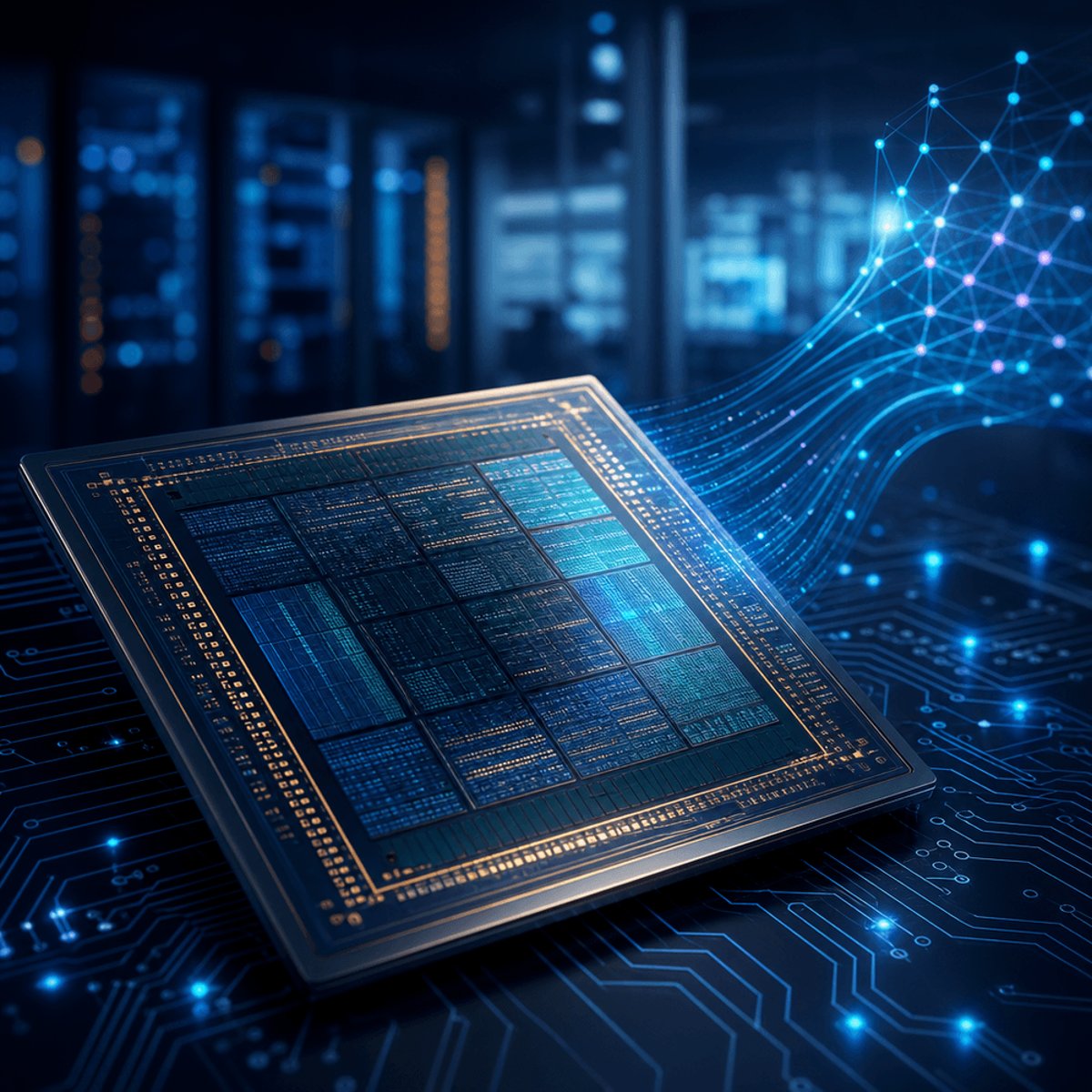
Google is developing a groundbreaking AI chip that bakes its Gemini model directly into silicon, according to reports that sent Alphabet shares climbing in Monday trading. The "Frozen v2" chip represents a bold bet that purpose-built hardware can slash the massive costs of running large language models - a move that puts Google on a collision course with Nvidia while potentially reshaping how AI gets deployed across its cloud empire. If successful, the chip could give Google a decisive edge in the infrastructure wars powering the AI boom.
Google just made its most aggressive move yet in the AI chip wars. The company is building a custom processor called Frozen v2 that embeds key components of its Gemini AI model directly into the hardware itself, according to reports first surfacing Monday. It's a radical departure from traditional chip design - and one that could fundamentally change the economics of running AI at scale.
Investors immediately saw the potential. Alphabet shares jumped in Monday afternoon trading as the news spread, with analysts noting that purpose-built AI silicon could dramatically cut the compute costs that have been eating into margins across the industry. Every query to Gemini costs money to process, and multiply that by billions of searches, emails, and cloud workloads. Custom chips optimized for those exact tasks could slash those expenses.
The technical approach is fascinating. Rather than building a general-purpose AI accelerator like Nvidia's H100, Google's engineers are reportedly hardwiring specific elements of Gemini's neural network architecture into the Frozen v2 chip itself. Think of it as the difference between a Swiss Army knife and a scalpel - the latter can't do everything, but what it does, it does brilliantly. This kind of application-specific integrated circuit (ASIC) design has worked wonders for Google before with its TPU (Tensor Processing Unit) chips, which already power much of its AI infrastructure.
But Frozen v2 takes that concept several steps further. By embedding architectural elements of Gemini - likely attention mechanisms, specific layer configurations, or activation functions - directly into silicon, Google could achieve inference speeds and power efficiency that general chips simply can't match. The trade-off? Less flexibility. These chips will excel at running Gemini workloads but might struggle with other AI models.
The timing couldn't be more strategic. Microsoft, Amazon, and even Meta are all developing custom AI chips to reduce their dependence on Nvidia's increasingly expensive and supply-constrained GPUs. Microsoft's Maia chip and Amazon's Trainium processors are already deployed in data centers. Google's been working on custom silicon longer than most - the first TPU launched back in 2016 - but Frozen v2 represents a new generation of specialization.
The competitive implications ripple outward. If Google can run Gemini queries at a fraction of the cost of competitors running on off-the-shelf Nvidia chips, that's a massive advantage in the Google Cloud Platform battle against AWS and Azure. Enterprise customers shopping for AI services care deeply about price-performance ratios. A 2x or 3x improvement in inference efficiency translates directly to lower bills.
There's also the Apple parallel here. When Apple started designing its own M-series chips, skeptics questioned whether a software company could compete with Intel and AMD. Those doubts evaporated when the M1 delivered desktop-class performance with laptop-level battery life. Google's betting it can pull off a similar feat in AI infrastructure - and it's got the engineering talent and financial resources to make it happen.
What we don't know yet is the production timeline. Custom silicon takes years to design, validate, and manufacture at scale. Google likely partnered with TSMC or Samsung for fabrication, and getting priority access to cutting-edge manufacturing nodes (probably 3nm or below) isn't trivial when everyone from Apple to Nvidia is competing for the same capacity.
There's also the question of external availability. Will Google keep Frozen v2 exclusively for its own infrastructure, or will it offer these chips through Google Cloud to enterprise customers? The TPU strategy has been hybrid - Google uses them internally but also rents them out. Given the competitive sensitivity of AI infrastructure, don't be surprised if Frozen v2 stays in-house initially.
The broader trend here is unmistakable: the era of one-size-fits-all AI chips is ending. As models mature and workloads become more predictable, custom silicon optimized for specific architectures will dominate. Nvidia's still going to print money selling general-purpose GPUs for training new models and running diverse workloads, but inference - the actual deployment of AI at scale - is increasingly moving to specialized chips.
For Google, the stakes are existential. The company's dumping billions into AI research and infrastructure, and if it can't monetize that investment efficiently, shareholders will get restless. Custom chips that improve margins while delivering better performance could be the unlock that makes Google's AI strategy financially sustainable at the scale it's operating.
Google's Frozen v2 chip isn't just another hardware announcement - it's a statement about how serious the company is about controlling its AI destiny. By embedding Gemini directly into silicon, Google's betting it can outmaneuver competitors on cost and performance while reducing dependence on external chip suppliers. If the technical execution matches the ambition, we're looking at a potential inflection point in how AI infrastructure gets built. The real test comes when these chips hit production and we see actual benchmark numbers. Until then, the market's clearly betting Google's engineers can deliver on the promise.