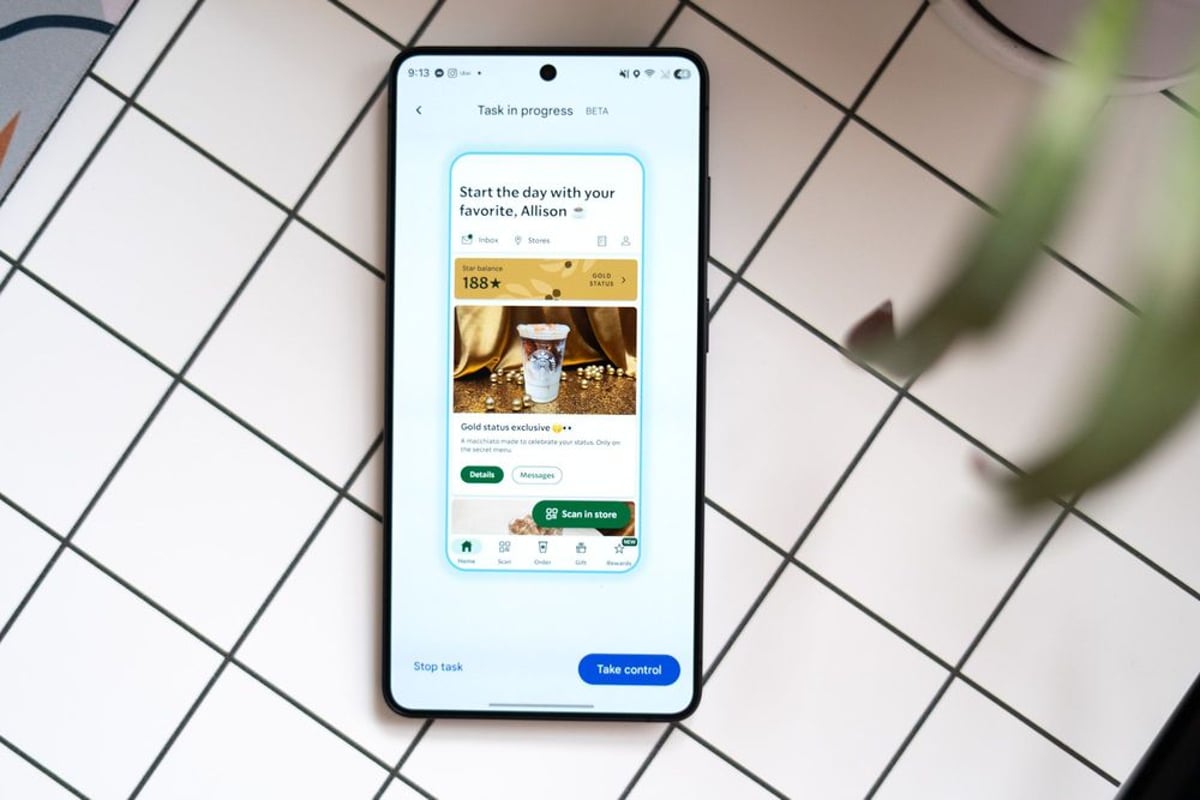
Google just crossed a threshold that's been promised for years but never quite delivered - AI that actually does things for you. The company's Gemini task automation feature went live in beta this week on Samsung Galaxy S26 Ultra and Pixel 10 devices, letting the AI assistant independently control apps like Uber Eats and rideshare services. Instead of just answering questions or setting reminders, Gemini now opens apps in a virtual window and navigates them on your behalf, ordering food or booking rides based on simple voice prompts. It's the kind of autonomous agent behavior that's been hyped endlessly but rarely shipped, and early testers report it's genuinely unsettling watching your phone operate itself.
Google just made good on years of AI assistant promises, and it's weirder than anyone expected. The company's Gemini task automation feature went live in beta this week, and for the first time, an AI assistant is actually controlling your apps without you touching the screen.
The rollout hit Samsung Galaxy S26 Ultra devices first, with Pixel 10 support arriving simultaneously. According to hands-on testing by The Verge's Allison Johnson, the experience of watching your phone navigate apps autonomously is genuinely disconcerting. "Boy is it weird watching your phone use itself," she noted after giving Gemini its first commands.
The feature works through what Google calls a "virtual window" - essentially Gemini opening and controlling apps on your behalf while you watch. Right now it's limited to food delivery and rideshare applications, but the implications are massive. You can tell Gemini to order dinner, and it'll open your preferred delivery app, browse options, add items to cart, and complete the checkout process. Same goes for booking an Uber to the airport.
This isn't the first time Google has teased autonomous AI capabilities. The company announced the feature two weeks ago alongside the Galaxy S26 launch, positioning it as the next evolution of mobile assistants. But announcements and actual deployment are different beasts entirely. What shipped this week represents a fundamental shift from reactive AI - answering questions, setting timers - to proactive agents that execute complex, multi-step tasks.
The timing puts Google ahead of Apple, which has been promising similar Siri enhancements but hasn't delivered anything close to app-level automation. While Apple Intelligence handles on-device tasks and improved natural language processing, it can't independently navigate third-party apps the way Gemini now can. That's a meaningful competitive advantage as the AI assistant wars heat up.
Under the hood, this capability relies on Gemini's vision and reasoning models understanding app interfaces the way humans do. It's essentially performing UI automation in real-time, recognizing buttons, form fields, and navigation patterns without needing custom API integrations for each app. That's technically impressive but also raises obvious questions about security, privacy, and what happens when the AI misinterprets an interface.
The beta label is doing heavy lifting here. Early adopters report the feature works but requires patience and occasional correction. Gemini might select the wrong menu item or struggle with apps that have unusual layouts. Google's limiting the initial rollout to food delivery and rideshare specifically because those apps tend to have standardized interfaces and lower-stakes outcomes. Ordering the wrong burrito is annoying; having an AI agent access your banking app is terrifying.
Samsung is betting big on this integration, making Gemini task automation a flagship feature of the S26 Ultra. The partnership with Google gives Samsung devices a software differentiation point that's actually visible to consumers, not just a spec sheet bullet point. For Google, Samsung's global reach provides massive distribution for Gemini capabilities at a moment when the company's racing to prove its AI investments translate to real-world utility.
The feature's architecture also hints at Google's longer game. By teaching Gemini to understand and manipulate app interfaces visually, the company's building toward a future where AI assistants can control any software, not just apps with formal integrations. That's the vision behind autonomous agents - AI that doesn't need permission or custom code to interact with digital systems.
But there's a friction point nobody's talking about yet: trust. Handing over app control to an AI means trusting it with payment methods, personal preferences, location data, and purchasing decisions. One misinterpreted command could mean a $200 food order or a ride to the wrong address. Google will need to nail the confirmation workflows and rollback mechanisms, or this feature risks becoming a liability instead of a selling point.
The beta availability on both Samsung and Pixel devices signals Google's committed to making this a core Android feature, not a Pixel exclusive. That's smart platform strategy but also raises the bar for execution quality. Fragmentation is Android's eternal challenge, and autonomous app control across different manufacturers, Android versions, and app ecosystems could get messy fast.
What's clear is that Google just shifted the AI assistant conversation from parlor tricks to actual utility. Whether users embrace letting AI operate their phones autonomously remains the billion-dollar question.
Google's Gemini task automation represents the first legitimate delivery of autonomous AI agent capabilities on consumer devices, not just another incremental assistant upgrade. By actually controlling apps instead of just talking about them, Google's created a tangible differentiation point in the AI wars and given Samsung a genuine software advantage over competitors. But the beta label is well-earned - trusting AI with app-level control, payment information, and purchasing decisions requires a level of reliability that's yet to be proven at scale. The next few months will determine whether this is the breakthrough that finally makes AI assistants indispensable or just another overpromised feature that users disable after the first mishap. Either way, the bar for what we expect from mobile AI just got significantly higher.