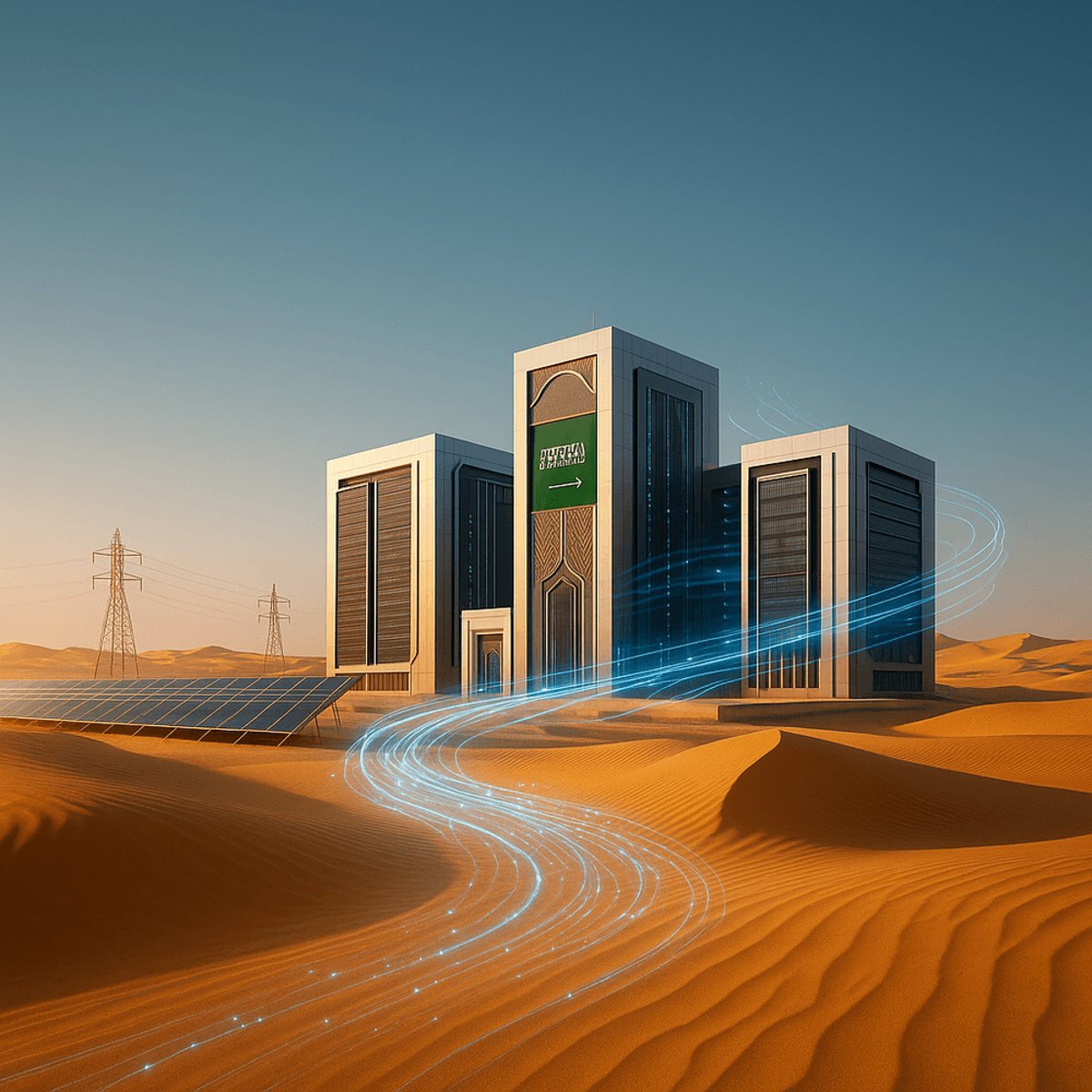
Saudi Arabia is positioning itself as the next major AI infrastructure hub, with surplus energy giving it a critical advantage over traditional data center markets. Groq CEO Jonathan Ross made the case at a major investment conference in Riyadh, arguing that the kingdom's abundant power resources could transform it into a global AI computation center that exports processed data rather than raw energy.
Saudi Arabia just got a major endorsement as the next frontier for AI infrastructure, and it's coming from someone who knows chips inside and out. Groq CEO Jonathan Ross told CNBC at the Future Investment Initiative conference in Riyadh that the Middle East represents "the ideal place" to build out massive AI data centers.
The logic is surprisingly straightforward. While everyone's been focused on the usual suspects - places like Ireland, Virginia, or Nordic countries - Ross sees an untapped opportunity in Saudi Arabia's energy abundance. "One of the things that's hard to export is energy. You have to move it, it's physical, it costs money," he explained during an exclusive interview. But data? That's a different story entirely.
"Data is very cheap to move," Ross continued. "So since there's plenty of excess energy in the Kingdom, the idea is move the data here, put the compute here, do the computation for AI here, and send the results." It's essentially flipping the traditional model - instead of shipping oil or electricity, Saudi Arabia could become a net exporter of processed intelligence.
This isn't just theoretical positioning. The numbers are starting to work in Saudi Arabia's favor. Ross revealed that operating costs for running AI chips in the kingdom are "actually cheaper than some of the Nordic countries," which have long been considered the gold standard for low-cost, renewable-powered data centers. That's a significant shift that could reshape where tech companies place their most energy-intensive AI workloads.
The timing aligns perfectly with Saudi Arabia's Vision 2030 strategy, which aims to diversify the economy beyond oil dependence. Rather than just pumping crude, the kingdom is positioning itself to pump out AI computations. Major technology firms are already taking notice, with infrastructure deals being announced across the region as companies race to secure their piece of this emerging market.
Ross's insight cuts to the heart of a fundamental challenge facing the AI industry: where to put all these power-hungry data centers. Traditional locations are getting crowded and expensive. "What you don't want to do is build a data center right next to people, where it's expensive for the land, or where the energy is already being used," he noted. "You want to build it where there isn't, where there aren't too many people, where the energy is underutilized."
For Groq, which specializes in AI inference chips designed for lightning-fast language model processing, this geographic arbitrage could be crucial. The company's chips are built for the kind of high-throughput AI workloads that consume massive amounts of power - exactly the type of computing that could benefit from Saudi Arabia's energy economics.
The broader implications extend far beyond any single company's strategy. If Saudi Arabia succeeds in becoming an AI infrastructure hub, it could fundamentally alter global data flows and challenge the dominance of traditional tech centers. Instead of data flowing primarily between Silicon Valley, Dublin, and Singapore, we might see new pathways routing through Riyadh.
What makes this particularly intriguing is how it positions energy-rich nations in the AI economy. Countries that have historically been resource exporters could leapfrog into becoming computation exporters, bypassing traditional tech development paths. It's not just about having cheap electricity anymore - it's about having surplus electricity in the right regulatory and geographic context.
Ross's comments signal a potential geographic shift in AI infrastructure that could reshape how we think about data center placement. As AI workloads continue growing exponentially, the traditional calculus of proximity to users versus energy costs is being rewritten. Saudi Arabia's bet on becoming an AI computation hub represents more than just economic diversification - it's positioning the kingdom at the center of the next phase of digital infrastructure. For tech companies facing mounting pressure to reduce AI operational costs while scaling capacity, the Middle East might just become their next essential destination.