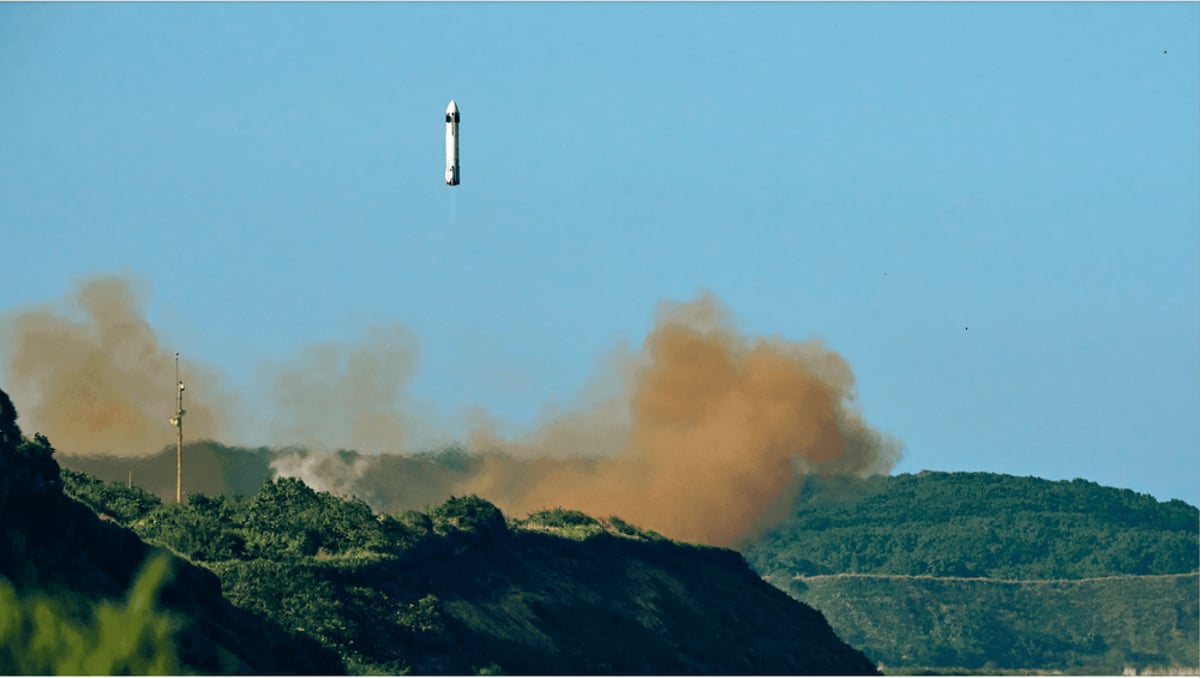
Honda just pulled off something no one saw coming - successfully launching and landing a 20-foot reusable rocket at its Japan facility. The automotive giant isn't just diversifying; it's positioning itself as a direct challenger to SpaceX with ambitious plans for satellite deployment, lunar colonies, and space robotics that could reshape the commercial space race.
Honda just became the latest company to crash SpaceX's party, and they're bringing decades of transportation expertise to the space race. In June, the Japanese automotive giant successfully launched and landed a 20-foot reusable rocket at its research facility in Hokkaido, marking a stunning pivot that few saw coming.
The move caught industry watchers off guard, but according to Kazuo Sakurahara - a former Formula One racing director who now heads Honda's space development strategy - it's actually a natural evolution. "Honda products have already expanded across land, sea, and sky," Sakurahara told The Verge in his first conversation with American press. "So, it is not surprising that space is the next field of opportunity."
But this isn't just corporate expansion for expansion's sake. Honda sees rockets as critical infrastructure for its core automotive business. The company plans to deploy satellites that support the connected features and autonomous driving systems increasingly essential to modern vehicles. "The rocket could be used to take satellites up to support mobility, energy, and communication," Sakurahara explained, referencing the wide-area communication networks that power everything from advanced driver assistance to full autonomy plans.
Sam Abuelsamid, vice president of market research for Telemetry consulting, sees the strategic logic immediately. "Honda could potentially use such satellites for its own vehicles, globally. Or it could sell this capability to other manufacturers," he says. "I could see not wanting to be reliant on a veritable monopoly like SpaceX, especially from someone who is as unstable as Elon Musk."
The timing isn't coincidental either. With geopolitical tensions rising in Asia and uncertainty around US alliances, Japan's national security considerations are driving corporate space ambitions. "These technologies could potentially provide defensive capabilities," Abuelsamid notes. "And they probably realized that they don't want to be overly dependent on the US for that at this point."
What makes Honda's approach particularly clever is how it's repurposing decades of failed or shelved research. The company's fuel cell technology, which never gained traction in ground vehicles despite 30 years of development, now forms the backbone of their lunar energy plans. Sakurahara revealed a "circulative energy system" designed to support future moon colonies - vertical solar arrays generating electricity during lunar daylight, then using that power to electrolyze water from lunar ice deposits into oxygen and hydrogen for fuel cells during the two-week lunar nights.
Even Honda's shuttered ASIMO robot program is getting new life. The company plans to create human-controlled avatar robots for space construction and repair tasks, controllable either from lunar proximity or beamed from Earth via Honda's own satellite network. "Space is a harsh environment, so if this works, it will be an incredibly useful robot for people," Sakurahara says.
This culture of creative reuse gives Honda a unique advantage over pure-play space companies. "While this might seem like a diversion for Honda, they're actually building on a lot of technologies they've been developing for ground transportation anyway - aerodynamics, fuel cells, vehicle control systems, and robots," Abuelsamid explains.
The company's timeline is ambitious but realistic. Despite only six years of development, Honda managed to launch, maneuver, and land its prototype without explosions or crashes. Compare that to SpaceX's 15-year journey to successful rocket recovery, and Honda's progress looks impressive. "I think there's a definite possibility that by the early 2030s, Honda could be launching," Abuelsamid predicts. "They're coming at Elon in a few different ways."
Still, Sakurahara tempers expectations about immediate Mars ambitions. When asked about competing with Musk's Red Planet plans, he notes the scale difference: "The Moon is 380,000 kilometers away. Mars can be over 380 million kilometers away. I think our target for now is to make sure that we hit 500 kilometers."
For now, Honda hasn't committed to commercializing its rocket system even if testing succeeds. But the company's track record of turning R&D experiments into market-leading products - from the world's first car navigation system to the first mass-produced automatic braking - suggests they're serious about space.
Honda's space ambitions represent more than corporate diversification - they signal a fundamental shift in how traditional manufacturers view their competitive landscape. By leveraging decades of transportation and robotics research, Honda is positioning itself not just as a car company that makes rockets, but as a mobility conglomerate that happens to operate across multiple dimensions. Whether they can execute on lunar colonies and satellite networks remains to be seen, but their successful prototype test proves that SpaceX's dominance isn't inevitable. The real question isn't whether Honda can reach space, but whether Elon Musk is ready for competition from a company that's been perfecting precision engineering for over 70 years.