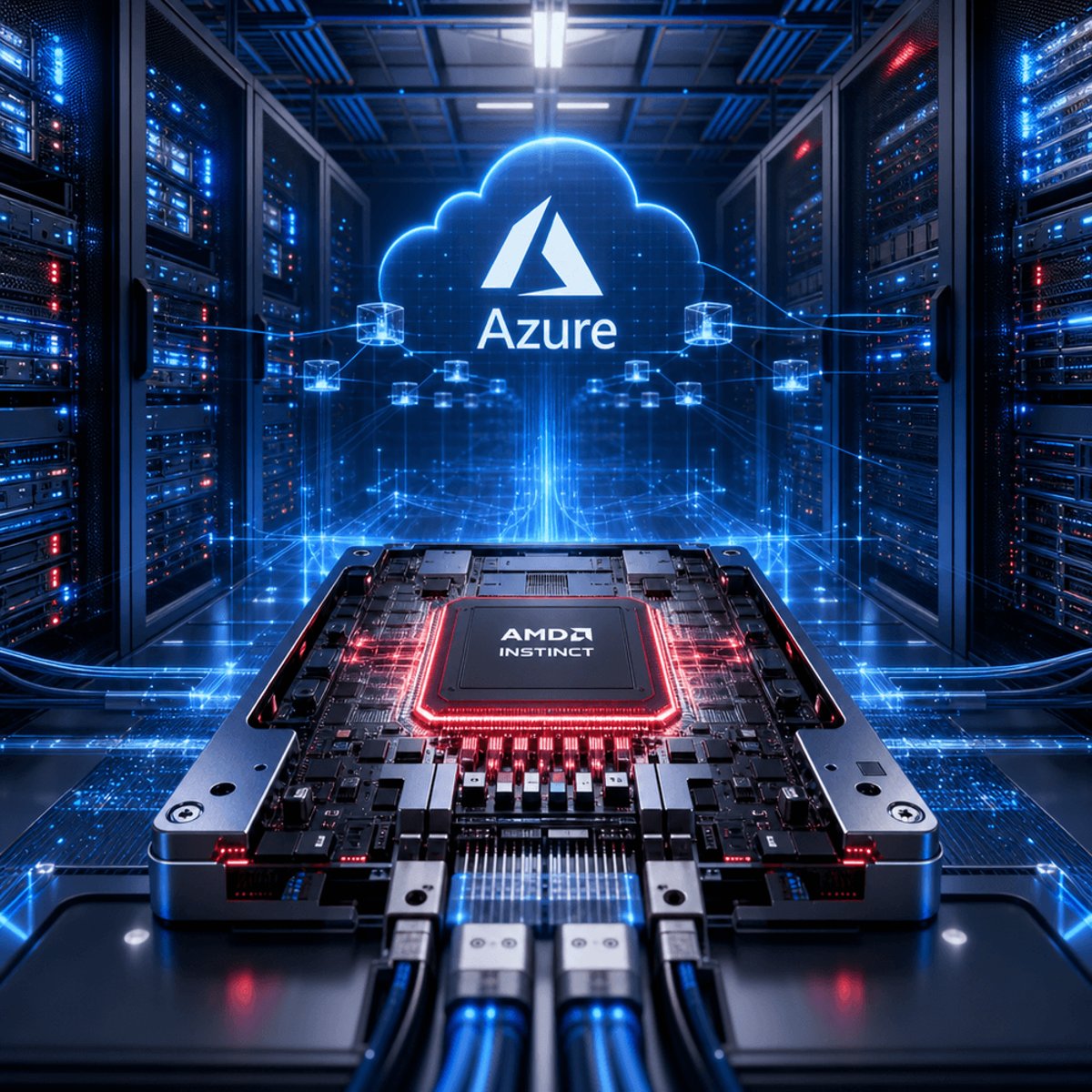
Microsoft is bringing AMD's newest Helios AI platform and 6th Gen EPYC processors to Azure in a major cloud infrastructure push. The expansion delivers three new virtual machine types - HDv2 for AI data systems, HXv2 for chip design workflows, and ND MI455X v7 for large-scale inference - as enterprise demand for specialized compute outpaces traditional infrastructure. The move signals Microsoft's bet on heterogeneous hardware to support the exploding variety of AI workloads, from agent coordination to semiconductor simulation.
Microsoft just expanded its cloud arsenal with AMD's most advanced AI silicon, rolling out three new Azure virtual machine families that target the bottlenecks slowing enterprise AI deployment. The announcement, published on Microsoft's official blog, marks a significant infrastructure bet as AI workloads fragment across training, inference, and the emerging category of agentic systems that demand entirely different compute profiles.
The centerpiece is Azure HDv2, a data-processing powerhouse co-designed with AMD specifically for the unglamorous but critical work of feeding AI models. With nearly 500 physical 6th Gen AMD EPYC cores, 4 terabytes of RAM, 32 terabytes of NVMe storage, and 400 Gbps Azure Boost networking, HDv2 tackles what Scott Guthrie, Microsoft's executive VP for Cloud and AI, calls the infrastructure that "eliminates bottlenecks" in agentic workloads. Without sufficient CPU compute to prep data and coordinate tasks, AI accelerators sit idle - training runs starve for input, and agents can't scale.
Then there's HXv2, aimed squarely at the semiconductor design firms racing to build the next generation of AI chips. Building on Azure's 2023 HX launch with AMD, the new HXv2 virtual machines feature 176 AMD 6th Gen EPYC cores clocked above 5 GHz, employing AMD's 3D V-cache technology that's proven critical for RTL simulation workloads. Cache per core jumps 50%, and VM configurations now reach up to 4 terabytes of RAM. The inclusion of 800 Gbps InfiniBand positions HXv2 for large-scale MPI simulations beyond just chip design.
AMD itself is a customer, according to Mark Papermaster, the company's executive VP and CTO, who told Microsoft's blog that "Azure HX is an important platform for scaling complex EDA workloads, and we're excited about Azure HXv2, which is designed to deliver even greater performance and scalability." It's a striking endorsement - AMD using Azure HX infrastructure to design the very EPYC CPUs and Instinct GPUs that power Microsoft's cloud.
Synopsys, the EDA software giant, is equally bullish. Chief Product Development Officer Shankar Krishnamoorthy noted the collaboration "demonstrates a shared vision for enabling customers to deliver next-generation AI systems with precision and scale in accelerated design cycles," according to the announcement. Synopsys customers are leveraging cloud-based compute to extend EDA workflows "beyond traditional infrastructure constraints," meeting aggressive schedules while maximizing design quality.
The third offering, ND MI455X v7, goes after production-scale AI inference. Powered by AMD's Helios rackscale solution, these VMs target the reasoning, search, and agentic workloads behind modern AI services. Microsoft positions ND MI455X v7 as expanding Azure's inference options with "strong performance and efficiency for demanding AI workloads," though technical specs remain light compared to the HDv2 and HXv2 disclosures.
This AMD expansion fits Microsoft's broader infrastructure strategy of avoiding single-vendor lock-in. The company has invested heavily in Nvidia GPUs for AI training while simultaneously developing custom silicon like the Maia AI accelerator and Cobalt CPU. Adding AMD's Helios and EPYC to the mix gives Azure customers more flexibility to optimize cost, performance, and energy efficiency across diverse workloads - a pitch that resonates as AI infrastructure bills balloon.
The timing is notable. AI compute demand is surging, but workloads are splintering. Training massive foundation models requires one type of infrastructure. Running inference at scale demands another. Agent-driven systems that orchestrate multiple models and external tools need yet another profile - heavy on CPU coordination and data throughput. Microsoft's bet is that no single chip architecture dominates across all three, making a heterogeneous approach the only viable path.
Azure's HDv2 specifically targets the data bottleneck that's emerged as a limiting factor in AI development. Models are only as good as the data pipelines feeding them, and agentic workflows that retrieve information, call APIs, and coordinate complex tasks are notoriously CPU-intensive. By dedicating nearly 500 EPYC cores per VM to these workloads, Microsoft is acknowledging that the sexier GPU infrastructure doesn't matter if data prep can't keep up.
The HXv2 announcement also underscores how AI infrastructure demand is creating knock-on opportunities in adjacent sectors. Semiconductor design firms are scrambling to tape out new chips for AI accelerators, and that means exponentially more EDA workload. Cloud-based chip design, once a niche use case, is becoming mainstream as companies race to iterate faster than traditional on-premises infrastructure allows. Microsoft and AMD are clearly positioning to capture that wave.
For more on Azure's high-performance computing capabilities, visit Azure.com.
Microsoft's AMD partnership expansion reflects the reality that AI infrastructure is fragmenting faster than any single vendor can address. By adding Helios and 6th Gen EPYC across three specialized VM families, Azure is betting that enterprise customers will increasingly need to mix and match compute types - GPU clusters for training, CPU-heavy instances for data prep and agent coordination, and specialized silicon for chip design workflows. The endorsements from AMD and Synopsys suggest this heterogeneous approach is resonating, particularly as AI workloads grow more diverse and infrastructure costs demand greater optimization. The question now is whether competitors like AWS and Google Cloud will follow suit or double down on their own custom silicon strategies.