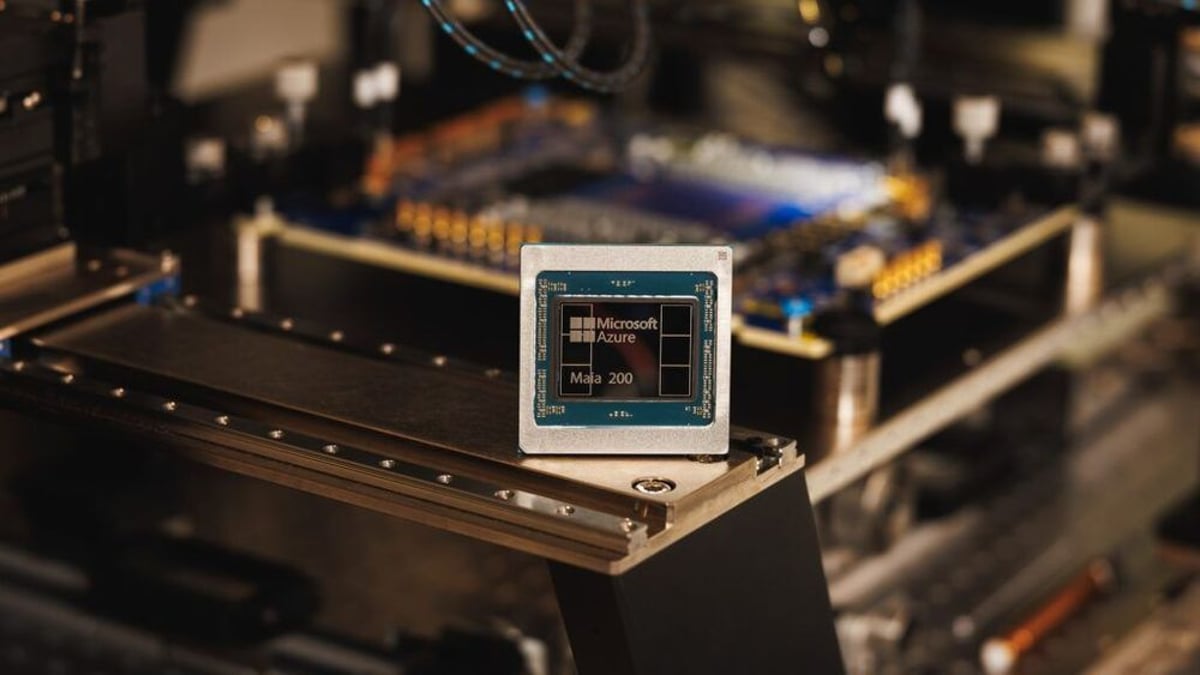
Microsoft just fired a major shot across the bow of Amazon and Google in the hyperscaler chip wars. The company unveiled Maia 200, its second-generation AI accelerator built on TSMC's 3nm process, claiming three times the FP4 performance of Amazon's Trainium 3 and superior FP8 performance over Google's TPU v7. Even more striking: Maia 200 delivers 30% better performance per dollar than Microsoft's current fleet, according to Scott Guthrie, EVP of Cloud + AI, in what marks the most aggressive custom silicon push from Redmond yet.
Microsoft isn't playing catch-up anymore in custom AI silicon. The Maia 200 launch represents the company's most aggressive move yet to reduce its dependence on Nvidia while undercutting cloud rivals on both raw performance and economics. The chip went from first silicon to datacenter deployment in half the time of comparable programs, a velocity that suggests Microsoft's betting big on custom hardware as a competitive moat.
The specs tell the story of a chip purpose-built for one thing: inference at scale. Each Maia 200 packs over 140 billion transistors fabricated on TSMC's bleeding-edge 3-nanometer process. It delivers over 10 petaFLOPS in 4-bit precision and over 5 petaFLOPS in 8-bit precision, all within a 750-watt thermal envelope. But Microsoft's real innovation shows up in the memory subsystem, a redesigned architecture centered on 216GB of HBM3e memory running at 7 TB/s bandwidth, plus 272MB of on-chip SRAM and specialized data movement engines that keep models fed without bottlenecks.
"FLOPS aren't the only ingredient for faster AI," Guthrie wrote in today's announcement. "Feeding data is equally important." That's a direct shot at competitors who've prioritized raw compute while letting memory bandwidth become the limiting factor. Microsoft's claiming Maia 200's memory architecture increases token throughput in ways that matter more than peak FLOPS numbers suggest.
The competitive positioning is sharp and deliberate. Microsoft published a comparison table showing Maia 200 outgunning both Amazon's third-generation Trainium and Google's seventh-generation TPU on key metrics. The FP4 performance advantage over Trainium 3 is particularly striking at 3x, while the FP8 performance edges out Google's TPU v7. These aren't apples-to-apples comparisons since each hyperscaler optimizes for different workloads, but Microsoft's making clear it now has credible first-party silicon that competes at the high end.
The real validation comes from OpenAI, which will run its latest GPT-5.2 models on Maia 200 infrastructure. That's a significant vote of confidence given OpenAI's intimate familiarity with Nvidia's platforms and its partnership stakes with Microsoft. The deployment starts in Microsoft's US Central datacenter region near Des Moines, Iowa, with the US West 3 region near Phoenix, Arizona, coming next. Microsoft 365 Copilot and Azure's Foundry platform will also tap Maia 200, bringing the performance-per-dollar advantages to enterprise customers.
Microsoft's Superintelligence team has another use case in mind: synthetic data generation and reinforcement learning for next-generation models. Maia 200's architecture accelerates the rate at which high-quality, domain-specific training data can be generated and filtered, feeding downstream training pipelines with fresher signals. It's a glimpse into how custom silicon enables new AI development workflows, not just faster inference on existing models.
At the systems level, Maia 200 introduces a two-tier scale-up network built on standard Ethernet rather than proprietary interconnects. Each accelerator exposes 2.8 TB/s of bidirectional scaleup bandwidth and supports high-performance collective operations across clusters of up to 6,144 accelerators. Within each tray, four Maia chips connect directly without switches, keeping latency low for inference workloads. The unified fabric scales from node to rack to cluster using the same protocols, simplifying programming and reducing stranded capacity.
Microsoft's also betting on a cloud-native development approach that validated the end-to-end system long before silicon arrived. A sophisticated pre-silicon environment modeled LLM computation and communication patterns with high fidelity, enabling co-optimization of silicon, networking, and system software as one integrated stack. The result: AI models ran on Maia 200 within days of first packaged parts arriving, and datacenter deployment happened in less than half the time of comparable programs.
The chip integrates with Azure's control plane for security, telemetry, diagnostics, and management at both chip and rack levels. Microsoft's second-generation closed-loop liquid cooling system handles thermal management, a critical detail given the 750-watt power envelope and dense rack configurations. These infrastructure investments translate directly into higher utilization and sustained performance-per-dollar improvements at cloud scale.
For developers, Microsoft's opening up the Maia SDK in preview today. The toolkit includes PyTorch integration, a Triton compiler, an optimized kernel library, and access to Maia's low-level programming language for fine-grained control. There's also a Maia simulator and cost calculator to optimize for efficiency before deploying to production. The SDK aims to make model porting across heterogeneous accelerators straightforward while giving power users the knobs they need.
The timing is deliberate. As AI inference costs become the dominant factor in serving large language models at scale, custom silicon optimized for token generation economics becomes a strategic imperative. Microsoft's claiming 30% better performance per dollar versus its current fleet, which likely includes a mix of Nvidia H100s and previous-generation accelerators. If that gap holds across diverse workloads, it gives Azure a real pricing lever against AWS and Google Cloud while improving Microsoft's own AI margins.
What to watch: how quickly Microsoft can scale Maia 200 deployment across its global datacenter footprint, and whether third-party Azure customers beyond OpenAI adopt the platform. The SDK preview will reveal how portable existing models are to Maia's architecture and whether developers hit unexpected friction. And the real test comes when AWS and Google respond with their own next-generation chips, likely within the next 6-12 months.
Microsoft's Maia 200 launch signals a fundamental shift in the cloud AI infrastructure game. Custom silicon is no longer just about cost optimization - it's becoming a competitive differentiator that enables new AI development workflows and pricing strategies. With OpenAI running GPT-5.2 on Maia 200 and the chip already deployed in production datacenters, this isn't vaporware or a research project. It's Microsoft betting that controlling the full stack from silicon to software gives Azure an edge in the AI era. The 30% performance-per-dollar improvement and 3x performance lead over AWS Trainium aren't just bragging rights - they're ammunition in the cloud wars where AI inference economics increasingly determine who wins enterprise deals.