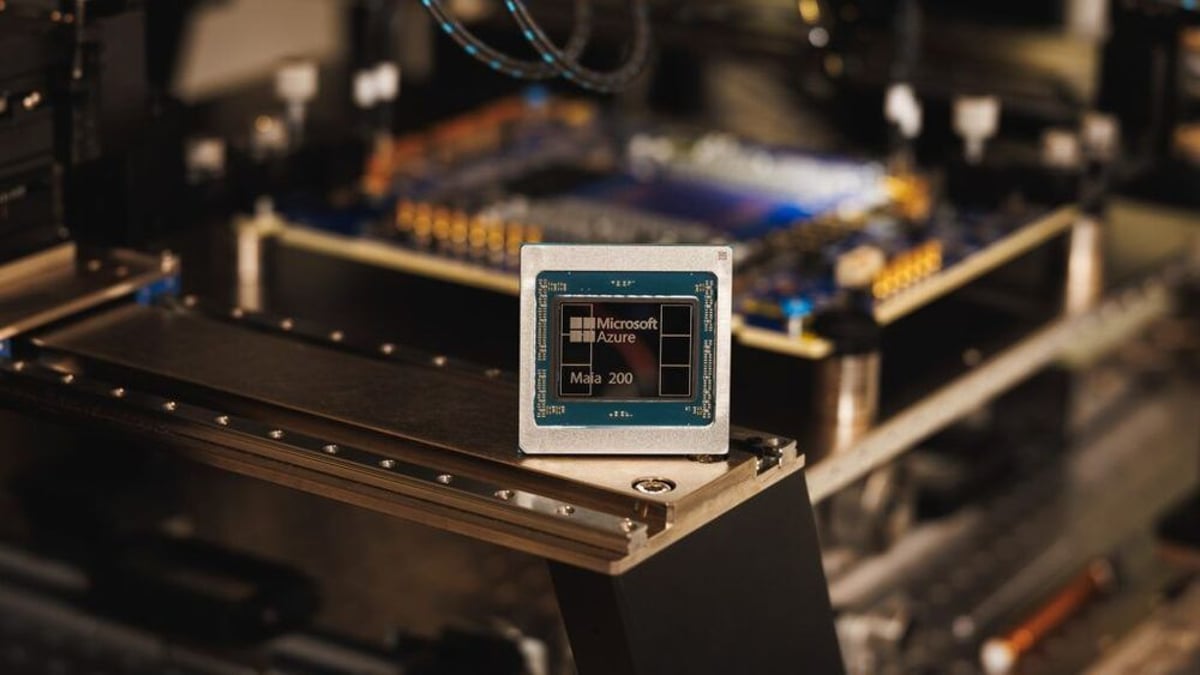
Microsoft just fired a shot across the bow of its Big Tech rivals. The company's new Maia 200 AI accelerator claims to deliver three times the performance of Amazon's third-generation Trainium chip and outpace Google's seventh-generation TPU. Built on TSMC's cutting-edge 3nm process with over 100 billion transistors, the chip marks a dramatic escalation in the cloud infrastructure wars - and Microsoft isn't being shy about it this time.
Microsoft isn't playing nice anymore. The company's latest salvo in the AI infrastructure battle - the Maia 200 chip - comes with performance claims that directly challenge Amazon and Google in ways the tech giant carefully avoided just 15 months ago.
The numbers tell the story. Microsoft says its new AI accelerator delivers three times the FP4 performance of Amazon's third-generation Trainium chip and beats Google's seventh-generation TPU in FP8 workloads, according to The Verge's coverage. Built on TSMC's 3nm manufacturing process, each Maia 200 chip crams in more than 100 billion transistors engineered specifically for large-scale AI workloads.
"Maia 200 can effortlessly run today's largest models, with plenty of headroom for even bigger models in the future," Scott Guthrie, executive vice president of Microsoft's Cloud and AI division, told The Verge. The claim carries weight - OpenAI's upcoming GPT-5.2 model will run on these chips, alongside workloads for Microsoft Foundry and Microsoft 365 Copilot.
The economics matter as much as the raw power. Microsoft is touting 30% better performance per dollar compared to its current fleet, a metric that resonates in an industry where AI training and inference costs have become a boardroom concern. For enterprises already locked into Azure, that efficiency gain translates directly to their cloud bills.
What's remarkable is the shift in Microsoft's competitive posture. When the company unveiled the Maia 100 in 2023, it deliberately avoided head-to-head comparisons with Amazon Web Services and Google Cloud Platform. Now it's leading with them, publishing benchmark charts that put its performance claims front and center against named competitors.
The timing isn't coincidental. Both Amazon and Google are deep into development of their own next-generation AI chips. Amazon is even partnering with Nvidia to integrate its upcoming Trainium4 chip with NVLink 6 and Nvidia's MGX rack architecture - a move that could leapfrog current performance benchmarks.
Microsoft's Superintelligence team gets first access to Maia 200, but the company is opening the doors wider than expected. Academics, developers, AI labs, and open-source contributors can now request early access to the Maia 200 software development kit. It's a play for ecosystem lock-in that mirrors how Nvidia built its CUDA moat over the past decade.
Deployment starts today in Microsoft's Azure US Central data center region, with additional regions rolling out in the coming months. The staged rollout suggests production volumes are ramping - a critical factor given how chip shortages have constrained AI infrastructure expansion across the industry.
The performance claims rest on specific precision formats. FP4 and FP8 (4-bit and 8-bit floating point) have become standard benchmarks for AI inference workloads, where lower precision can dramatically speed up computations without sacrificing model accuracy. Microsoft's 3x claim in FP4 suggests the Maia 200's architecture is optimized for the kind of mixed-precision inference that powers real-time AI applications.
For Microsoft's cloud customers, the chip represents a potential path away from Nvidia dependency. While Nvidia's H100 and upcoming Blackwell chips still dominate AI training workloads, custom accelerators like Maia 200 are increasingly competitive for inference - the phase where trained models actually serve user requests. And inference is where the volume is.
The broader industry is watching closely. Amazon's Trainium and Google's TPU families have given those cloud providers cost and performance advantages for their own AI services. Microsoft's aggressive performance claims suggest the gap is closing - or that Microsoft believes it can convince customers the gap has closed, which in cloud computing often amounts to the same thing.
Microsoft's Maia 200 launch signals a fundamental shift in how the company competes in cloud AI infrastructure. By directly benchmarking against Amazon and Google - and putting those comparisons in the press release - Microsoft is betting it can break the perception that AWS and Google Cloud hold insurmountable advantages in custom silicon. For enterprises evaluating AI infrastructure partners, the message is clear: Microsoft wants to be seen as a viable alternative to Nvidia-dependent architectures and competitor custom chips. Whether the performance claims hold up under real-world production workloads will determine if this marks a turning point in the cloud wars or just another round of benchmark oneupmanship.