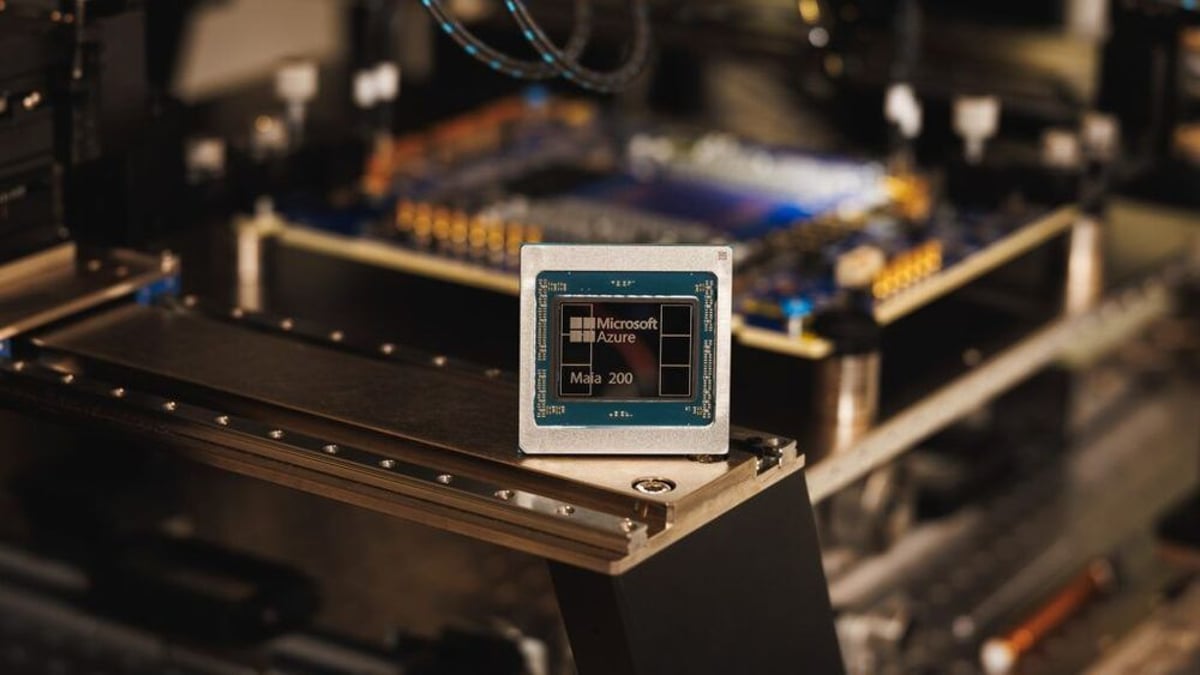
Microsoft just fired a major shot in the AI infrastructure race. The company launched Maia 200, a custom-built inference accelerator that delivers three times the performance of Amazon's latest Trainium chip and outpaces Google's TPU v7. Built on TSMC's 3nm process with 140 billion transistors, the chip is already running OpenAI's GPT-5.2 models in Azure datacenters, promising 30% better performance per dollar than any hardware in Microsoft's current fleet. For the hyperscale cloud wars, this is Microsoft staking its claim as the infrastructure leader in the AI era.
Microsoft just redrew the battle lines in cloud AI infrastructure. The tech giant announced Maia 200 today, a breakthrough custom silicon chip designed exclusively for AI inference that delivers triple the performance of Amazon Web Services' third-generation Trainium accelerator and surpasses Google Cloud's seventh-generation TPU in key benchmarks. The chip is already deployed and running production workloads in Microsoft's Iowa datacenter, powering OpenAI's latest GPT-5.2 models across Azure services.
Scott Guthrie, Microsoft's Executive Vice President for Cloud and AI, revealed in a company blog post that Maia 200 represents "the most performant, first-party silicon from any hyperscaler" and delivers 30% better performance per dollar than the latest generation hardware currently powering Azure. That's not just a marginal improvement - it's the kind of leap that reshapes cloud economics and could shift billions in AI infrastructure spending.
The chip's specs tell the story of Microsoft's multi-year bet on custom silicon. Fabricated on TSMC's cutting-edge 3-nanometer process, each Maia 200 chip packs over 140 billion transistors into a design optimized specifically for large language model inference. It cranks out over 10 petaFLOPS in 4-bit precision (FP4) and more than 5 petaFLOPS in 8-bit (FP8) performance, all while staying within a 750-watt power envelope. The memory subsystem features 216GB of HBM3e memory running at 7TB/s bandwidth, paired with 272MB of on-chip SRAM and specialized data movement engines designed to keep massive AI models fed with data at breakneck speed.
But raw compute is only half the equation. Microsoft engineered Maia 200 around a novel two-tier network architecture built on standard Ethernet rather than proprietary interconnects. Each accelerator exposes 2.8TB/s of bidirectional bandwidth and supports high-performance collective operations across clusters of up to 6,144 accelerators. Four Maia chips sit in each server tray with direct, non-switched links between them, while a custom Maia AI transport protocol handles inter-rack communication. The result is a unified fabric that scales seamlessly from single nodes to datacenter-wide clusters without the cost and complexity of exotic networking gear.
The competitive implications are immediate. Microsoft's published comparison charts show Maia 200 delivering three times the FP4 throughput of Amazon's Trainium 3 and exceeding Google's TPU v7 in FP8 workloads. Those aren't synthetic benchmarks - they're the precision formats that matter for running today's frontier AI models efficiently. For enterprises choosing between cloud providers for AI workloads, performance per dollar is the metric that directly hits the bottom line, and Microsoft just moved the goalpost significantly.
OpenAI is already leveraging Maia 200 in production. According to Guthrie, the chip is serving GPT-5.2 model inference across Microsoft Foundry and Microsoft 365 Copilot, while Microsoft's Superintelligence team is using it for synthetic data generation and reinforcement learning to train next-generation models. The synthetic data use case is particularly strategic - Maia 200's architecture accelerates the rate at which high-quality, domain-specific training data can be generated and filtered, creating a faster feedback loop for model improvement.
The deployment timeline shows Microsoft moving with unusual speed. Maia 200 is live now in the company's US Central datacenter region near Des Moines, Iowa, with the US West 3 region near Phoenix, Arizona, coming next and additional regions to follow throughout 2026. Microsoft says AI models were running on Maia 200 silicon within days of receiving the first packaged chips, and the time from first silicon to datacenter deployment was cut in half compared to comparable infrastructure programs. That rapid deployment cycle reflects years of pre-silicon validation work, including sophisticated modeling of LLM computation and communication patterns that allowed Microsoft to optimize the full stack - silicon, networking, and software - before chips ever left the fab.
For developers, Microsoft is opening access through the Maia SDK, now available in preview. The kit includes PyTorch integration, a Triton compiler, an optimized kernel library, and access to Maia's low-level programming language. There's also a Maia simulator and cost calculator to help developers optimize for efficiency before deploying production workloads. Microsoft is inviting AI startups, researchers, and enterprise developers to sign up for preview access starting today.
The broader context is a hyperscaler arms race around custom AI silicon. Google pioneered the category with its TPU line, now in its seventh generation. Amazon has invested heavily in both Trainium for training and Inferentia chips for inference. Microsoft's Maia program, first announced in 2023, represents the company's bid to control its AI infrastructure destiny rather than depending entirely on Nvidia's dominant GPU ecosystem. With Maia 200, Microsoft isn't just catching up - it's making a credible claim to leadership in inference performance and efficiency.
The economics matter enormously at cloud scale. A 30% improvement in performance per dollar, multiplied across the billions Microsoft is spending on AI infrastructure, translates to hundreds of millions in potential savings or competitive pricing advantages. For customers running massive inference workloads - whether that's serving chatbots, analyzing documents, or generating synthetic training data - those economics flow downstream as lower Azure prices or better performance for the same budget.
Microsoft emphasizes that Maia 200 is part of a heterogeneous infrastructure strategy, not a replacement for GPUs. The chip is optimized specifically for inference on large language models, while Nvidia's H100 and upcoming Blackwell GPUs remain crucial for training workloads and other AI tasks. But inference is where the volume is - every ChatGPT query, every Copilot interaction, every AI-powered search result represents an inference request, and those requests number in the billions daily across Microsoft's services.
Microsoft's Maia 200 launch signals a fundamental shift in the cloud AI landscape. By delivering demonstrably superior performance per dollar compared to Amazon and Google's custom chips, Microsoft isn't just competing on infrastructure - it's positioning Azure as the most cost-effective platform for enterprise AI at scale. The immediate deployment supporting OpenAI's GPT-5.2 models proves the chip isn't vaporware, while the SDK preview opens the door for developers to optimize workloads now. As the AI inference market explodes and every major cloud provider races to build custom silicon, Microsoft just established itself as the benchmark to beat. The real test comes in the months ahead as enterprises vote with their infrastructure budgets, but Microsoft's 30% cost advantage makes that choice considerably easier.