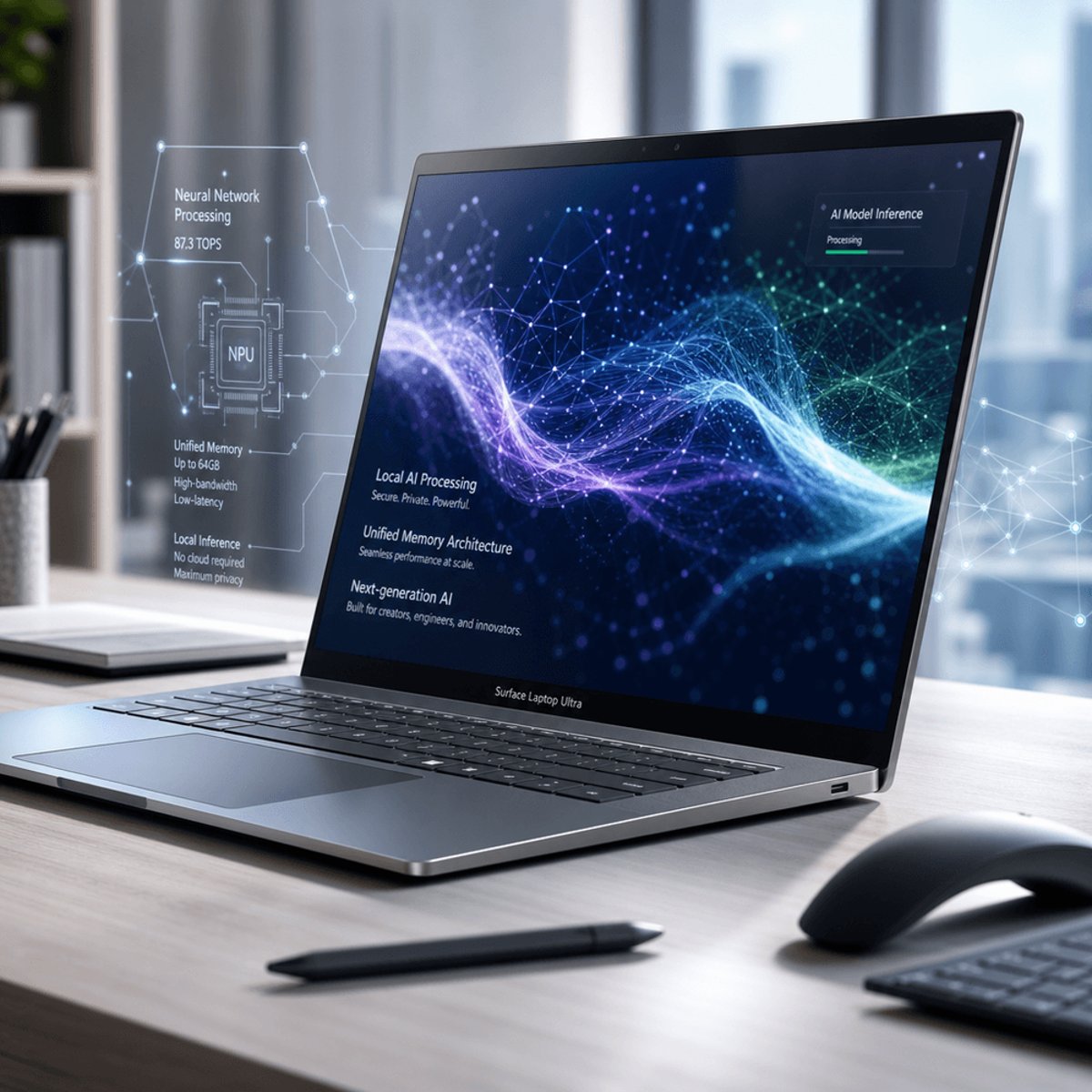
Microsoft just unveiled its most powerful Surface yet, and it's packing serious AI firepower. The Surface Laptop Ultra, revealed at Computex 2026, marks a dramatic shift in Microsoft's hardware strategy with Nvidia's brand-new RTX Spark chip and up to 128GB of unified memory. After getting hands-on time with the device in Taipei, it's clear Microsoft is making a play for developers, creators, and enterprise users who need local AI processing without compromise.
Microsoft didn't just refresh its Surface lineup at Computex - it completely rewrote what a Windows laptop can do. The Surface Laptop Ultra represents the company's most ambitious hardware bet since the original Surface Book, and after spending time with a pre-production unit on the show floor, the performance claims seem legitimate.
The star of the show is Nvidia's RTX Spark chip, a completely new architecture that breaks from the traditional discrete GPU model. Instead of separating system RAM from video memory, the Spark uses unified memory architecture similar to Apple's M-series chips. That means all 128GB can be dynamically allocated between CPU tasks, graphics rendering, and AI workloads. For developers running local large language models or training custom AI agents, this changes everything.
Microsoft has been inching toward this moment for years. The company's Copilot initiative and its massive investment in OpenAI signaled a software-first AI strategy, but the Surface Laptop Ultra shows Microsoft understands the hardware matters just as much. Running AI models locally means no cloud latency, better privacy controls, and the ability to work offline - critical advantages for enterprise customers.
The timing couldn't be more strategic. Apple has dominated the premium laptop space with its M1, M2, and M3 chips, leaving Windows OEMs scrambling to compete on both performance and battery life. The RTX Spark gives Microsoft a credible answer, at least on paper. The unified memory approach directly mimics Apple's winning formula, while the Nvidia partnership brings gaming and professional graphics chops that Apple still can't match.
During the brief demo session, Microsoft representatives showed the Surface Laptop Ultra running multiple AI workloads simultaneously - a local Stable Diffusion instance generating images while a large language model answered queries and Adobe Premiere Pro rendered video in the background. The system didn't break a sweat, though real-world battery life under that kind of load remains a question mark.
The physical design stays true to Surface's minimalist aesthetic, but with noticeably improved thermal management. The chassis is slightly thicker than the Surface Laptop 5, with larger vents along the back edge and what appears to be a vapor chamber cooling system. Microsoft learned from the Surface Laptop Studio's throttling issues - this machine is built to sustain high performance, not just burst to it.
For Nvidia, the RTX Spark represents a crucial expansion beyond its data center dominance. While the company's H100 and upcoming Blackwell chips power the cloud AI infrastructure, consumer devices have largely relied on older architectures. The Spark brings cutting-edge AI acceleration to laptops, potentially opening a massive new market as developers increasingly need local hardware for testing and deployment.
The competitive implications ripple across the PC industry. Dell, HP, and Lenovo will inevitably get access to the RTX Spark chip for their own premium laptops, but Microsoft gets first-mover advantage and the tightest hardware-software integration. The Surface Laptop Ultra will ship with Windows 11 optimizations specifically tuned for the Spark architecture, including enhanced AI model compression and intelligent memory management.
What Microsoft didn't reveal is just as telling as what it did. No pricing, no release date beyond "later this year," and no details on the base configuration specs. The 128GB unified memory option will clearly command a premium price, likely positioning the Surface Laptop Ultra above $3,000 to compete with maxed-out MacBook Pros and professional workstations.
The enterprise angle seems central to Microsoft's strategy. Corporate IT departments have been hesitant to deploy AI tools that send sensitive data to cloud APIs. A Surface Laptop Ultra running company-specific AI models entirely on-device solves that problem. Expect Microsoft to bundle this heavily with Microsoft 365 Copilot enterprise licenses and Azure AI development tools.
For developers, the Surface Laptop Ultra could become the new standard reference platform for Windows AI development, much like MacBook Pros dominate the Mac app ecosystem. The combination of high memory capacity, Nvidia's CUDA ecosystem, and Microsoft's AI toolchain creates a compelling story - assuming the price doesn't scare away the very developers Microsoft needs to attract.
The Surface Laptop Ultra marks Microsoft's most aggressive play yet in the AI hardware race, directly challenging Apple's silicon advantage while carving out a distinct identity around professional AI workloads. The partnership with Nvidia on the RTX Spark chip shows both companies recognize that AI's future isn't just in massive data centers - it's on the desks of developers, creators, and enterprise users who need serious computing power without cloud dependencies. Whether the price and battery life can match the performance promises remains to be seen, but Microsoft finally has hardware that matches its AI software ambitions. For the first time in years, Windows users have a legitimate answer when Mac users brag about their M-series chips.