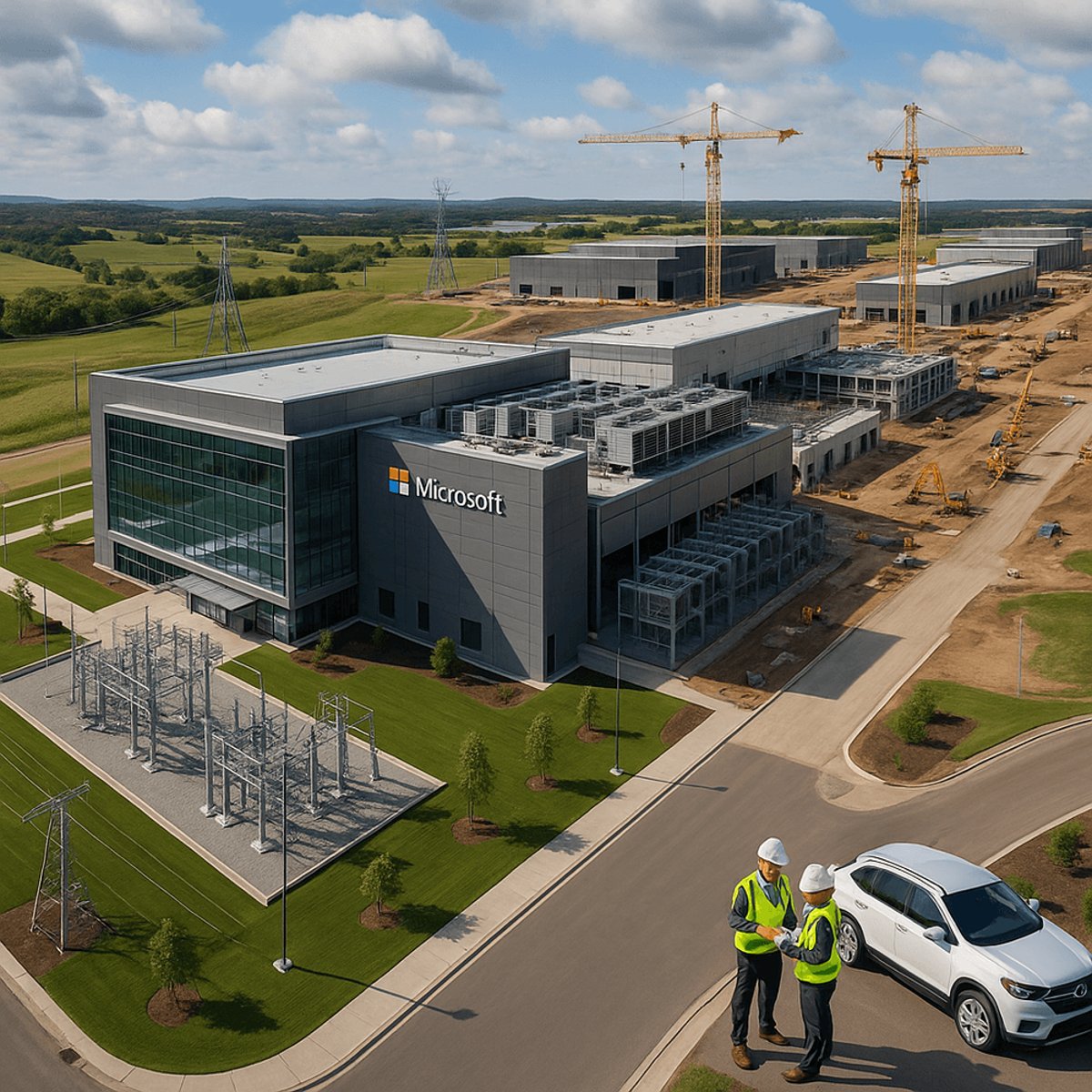
Microsoft just secured approval to build 15 massive data centers in Mount Pleasant, Wisconsin, transforming the infamous Foxconn site into a sprawling AI infrastructure hub. The unanimous Monday vote marks a stark contrast to the company's recent retreat from neighboring Caledonia, where residents successfully blocked similar plans. With a taxable value exceeding $13 billion and nearly 9 million square feet of building space, the expansion signals how desperate Big Tech is to find welcoming homes for power-hungry AI facilities.
Microsoft is racing ahead with one of its largest data center expansions yet, and it's doing so on ground that represents one of the biggest economic development failures in recent memory. Mount Pleasant's village board voted unanimously Monday to approve plans for 15 new data centers just northwest of Microsoft's existing Wisconsin campus, a project that carries a staggering $13 billion taxable value according to village documents reviewed by CNBC.
The site's history tells a cautionary tale about economic promises and political grandstanding. Back in 2017, Foxconn announced a $10 billion plant that President Trump championed as proof of his manufacturing revival agenda. The village bought up land, Wisconsin poured state tax dollars into infrastructure, and everyone waited for 13,000 promised jobs. By 2023, Foxconn employed just 1,000 people across the entire state, and Mount Pleasant was left holding over $250 million in debt.
Now Microsoft is stepping in where Foxconn stumbled, but the path hasn't been entirely smooth. Just months ago in September, the company abandoned rezoning attempts in the adjacent village of Caledonia after residents mounted fierce opposition. The contrast couldn't be sharper - in Mount Pleasant, six residents spoke in favor during Monday's public comment period, with only three raising concerns.
"I'm addressing this to all of the union folks that are here," Mount Pleasant village board president David DeGroot said during the meeting, pushing back against claims that construction jobs would be temporary. "When I heard that these jobs are temporary from somebody, if I was you, I would take umbrage to that, because it's my understanding that you are going to be out there on those sites for the next 10 years."
The economics driving Microsoft's expansion are straightforward - the company needs physical infrastructure to match the AI demand it's already booked. Additional data center capacity will let Microsoft recognize revenue from OpenAI and other clients who've signed contracts but are waiting for compute power. Amazon, Google, and Oracle are all racing to build similar facilities packed with Nvidia chips capable of training and running large language models.
But finding suitable locations has become increasingly difficult. The facilities require massive amounts of electricity that local utilities can't always provide, and community opposition is growing as residents worry about noise, water usage, and environmental impact. Microsoft's Wisconsin project shows how valuable willing municipal partners have become in this infrastructure arms race.
The approved plans span two lots that Microsoft assembled through purchases from the village and private owners in 2023 and 2024. The developments call for almost 9 million square feet of building area with three proposed substations to handle the enormous power requirements. On Wednesday, the village planning commission gave its own approval to site plans incorporating staff-recommended changes.
Water usage was a key concern during the planning commission meeting. Samuel Schultz, Mount Pleasant's community development director, assured commissioners that the 15 new data centers wouldn't require more than the 8.4 million gallons the village expects to receive annually from nearby Racine.
The project's scale reflects just how much capital Big Tech is pouring into AI infrastructure. While Microsoft hasn't disclosed the total construction cost, the $13 billion taxable value suggests an investment that dwarfs most corporate real estate projects. The company can now submit final civil engineering plans and start filing building permits.
For Mount Pleasant, Microsoft's commitment represents redemption after the Foxconn debacle. The village is trading its failed manufacturing dream for a role as an AI infrastructure hub, betting that steady tax revenue from data centers beats empty promises about factory jobs. It's a pragmatic choice that reflects how much the economic development landscape has shifted since 2017.
Microsoft's Wisconsin expansion shows how the AI infrastructure race is reshaping local economies and community dynamics across America. Mount Pleasant is betting its future on being a cooperative partner rather than an obstacle, trading the ghost of Foxconn's broken promises for the tangible reality of $13 billion in new development. As data center opposition grows in other communities, tech giants will increasingly reward municipalities willing to fast-track approvals. The next battleground won't just be over compute capacity or chip supply - it'll be over which towns and counties are willing to say yes when Silicon Valley comes calling with construction plans and power demands that would've seemed absurd just five years ago.