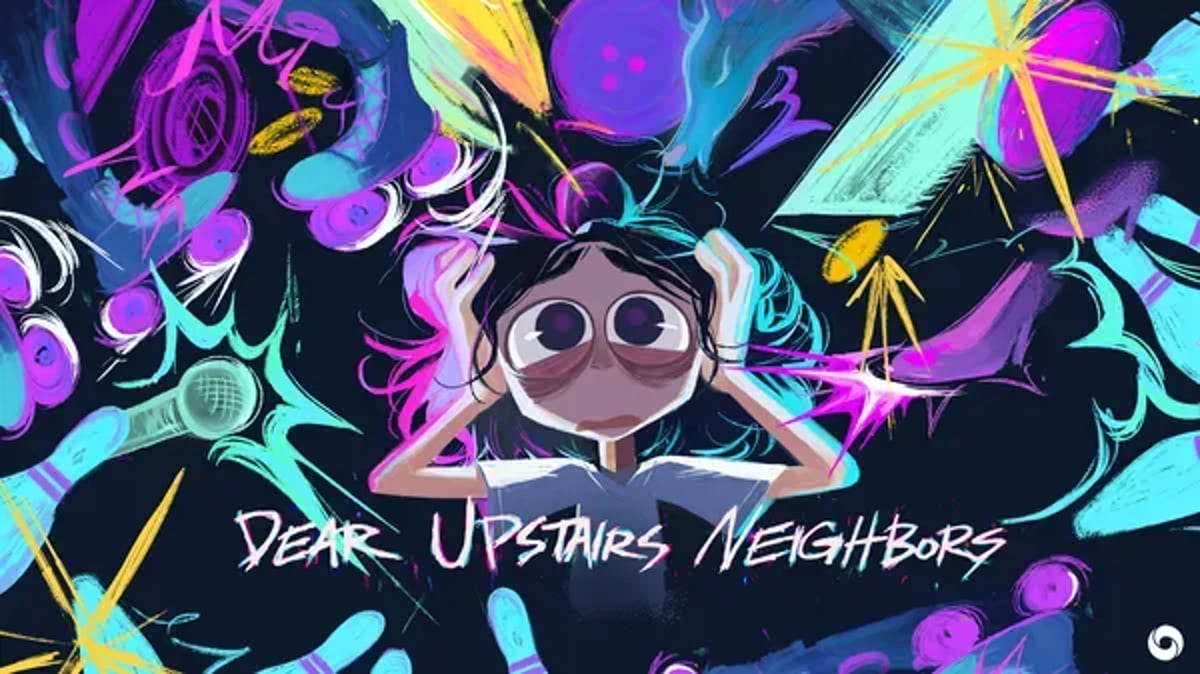
Google DeepMind just premiered its first animated short film at Sundance, and it's not your typical AI-generated content. 'Dear Upstairs Neighbors,' directed by Pixar veteran Connie He, showcases a groundbreaking collaboration between professional animators and AI researchers that challenges everything we thought we knew about creative AI tools. The film debuts at the Sundance Institute's Story Forum, demonstrating how Google's Veo and Imagen models can amplify - rather than replace - human artistry through custom fine-tuning and video-to-video workflows.
Google just crashed Sundance with something the film world hasn't seen before. The tech giant's AI research arm, Google DeepMind, unveiled 'Dear Upstairs Neighbors,' an animated short that blends traditional animation techniques with cutting-edge generative AI - and it's raising eyebrows about what's possible when human creativity meets machine learning.
The film tells the story of Ada, a sleep-deprived woman whose noisy upstairs neighbors send her spiraling into increasingly unhinged hallucinations. But the real story is happening behind the scenes, where director Connie He, a Pixar alum, and her team of animation veterans are pioneering workflows that could reshape how animated films get made.
'From the start, the team aspired to empower animation artists to benefit from the creative potential of generative AI without sacrificing artistic control,' supervising animator Cassidy Curtis wrote in Google's official announcement. That's a notable departure from the industry's growing anxiety about AI replacing human artists.
The production process reveals just how far Google's Veo video generation model has come. Instead of relying on text prompts - which Curtis admits produced 'random, uncontrolled, and often bizarre' results - the team developed custom video-to-video workflows. Animators created rough animation in their preferred tools like Maya and TV Paint, then fine-tuned Veo models transformed those sketches into fully stylized footage matching production designer Yingzong Xin's vivid expressionist artwork.
This isn't one-click generation. Every shot went through multiple rounds of 'dailies' reviews, with artists using localized refinement tools to edit specific regions of AI-generated video. When Ada's hair silhouette didn't look right in one scene, researcher Erika Lu added a rough mask indicating where more hair was needed, and Veo improvised an extra tuft that 'fits seamlessly into the rest of the shot.'
The technical achievements are impressive. The team fine-tuned Veo on just a few example images, teaching it Xin's unique visual concepts - not just surface-level details like color and texture, but deeper artistic principles like two-point perspective. In one striking example, the AI learned to maintain Ada's characteristic hair poof as part of her silhouette even as her head rotated, solving a problem that would violate the rules of traditional 3D animation.
'What Veo learned from our concept art surprised us,' Curtis noted, highlighting how the AI grasped fundamental design principles that typically require years of training for human artists to master.
But the project also exposed generative AI's limitations. Text-to-video generation with the fine-tuned Veo model produced footage that looked like Ada but moved in ways that were 'often bizarre.' Text alone couldn't convey the nuance needed for comedic timing, facial expressions, or precise camera movements. The solution? Animator Ben Knight created rough 3D animation in Maya, and researcher Andy Coenen used fine-tuned Veo models to transform it into the final look - preserving complete artistic intent.
The film's expressionist visual style presented another challenge. Ada's hallucinations feature a neon palette and rough painterly textures that are 'extremely difficult to achieve in traditional animation,' according to the team. These unique styles were so specific that researchers had to develop new capabilities for customization and control.
For the final theatrical presentation, Google used Veo's upscaling capability to bring shots to 4K resolution while preserving every nuance of the artistic style. That same 4K upscaling model is now available in Flow and coming to Google AI Studio and Vertex AI later this month, giving professional filmmakers access to the same technology.
The Sundance debut comes as the entertainment industry grapples with AI's role in creative work. Major studios are experimenting with generative tools, but artist unions have raised concerns about job displacement and copyright issues. Google's approach - positioning AI as a collaborator rather than replacement - could offer a template for the industry.
'Our artists found new creative powers through direct access to experimental research,' Curtis explained. 'Our researchers gained hands-on experience as technical artists, rapidly prototyping solutions to break through artistic and technological barriers.'
The multi-disciplinary team developed several hybrid workflows throughout production, combining hand-crafted animation's precise control with generative AI's stylistic flexibility and scalability. Not every experiment worked - the team shared blooper reels of Ada eating spaghetti in ways that 'violate the laws of physics, not to mention decorum.'
But those failures proved instructive. Each shot required multiple iterations, with artists and researchers collaborating daily to solve unique challenges. The process revealed that generative AI, at least for now, works best as a powerful tool in skilled hands rather than an autonomous creator.
The film showcases at the Sundance Institute's Story Forum, a venue specifically focused on artist-first tools and technologies. That positioning signals Google's awareness of the cultural moment - as AI capabilities explode, the company is making a case that the technology can amplify human creativity rather than erase it.
Whether that message resonates with the broader animation community remains to be seen. But with Veo's 4K capabilities rolling out to developers and enterprises this month, more creators will soon have the chance to test these workflows themselves.
Google DeepMind's Sundance debut signals a pivotal moment for AI in entertainment. By keeping human artists in control while leveraging generative AI for stylistic heavy lifting, 'Dear Upstairs Neighbors' offers a blueprint for collaboration rather than replacement. As Veo's 4K capabilities roll out to developers this month, the real test begins - can this human-AI partnership scale beyond experimental shorts to reshape production pipelines across the industry? The answer will determine whether generative AI becomes filmmaking's next essential tool or just another overhyped technology that couldn't deliver on its promises.