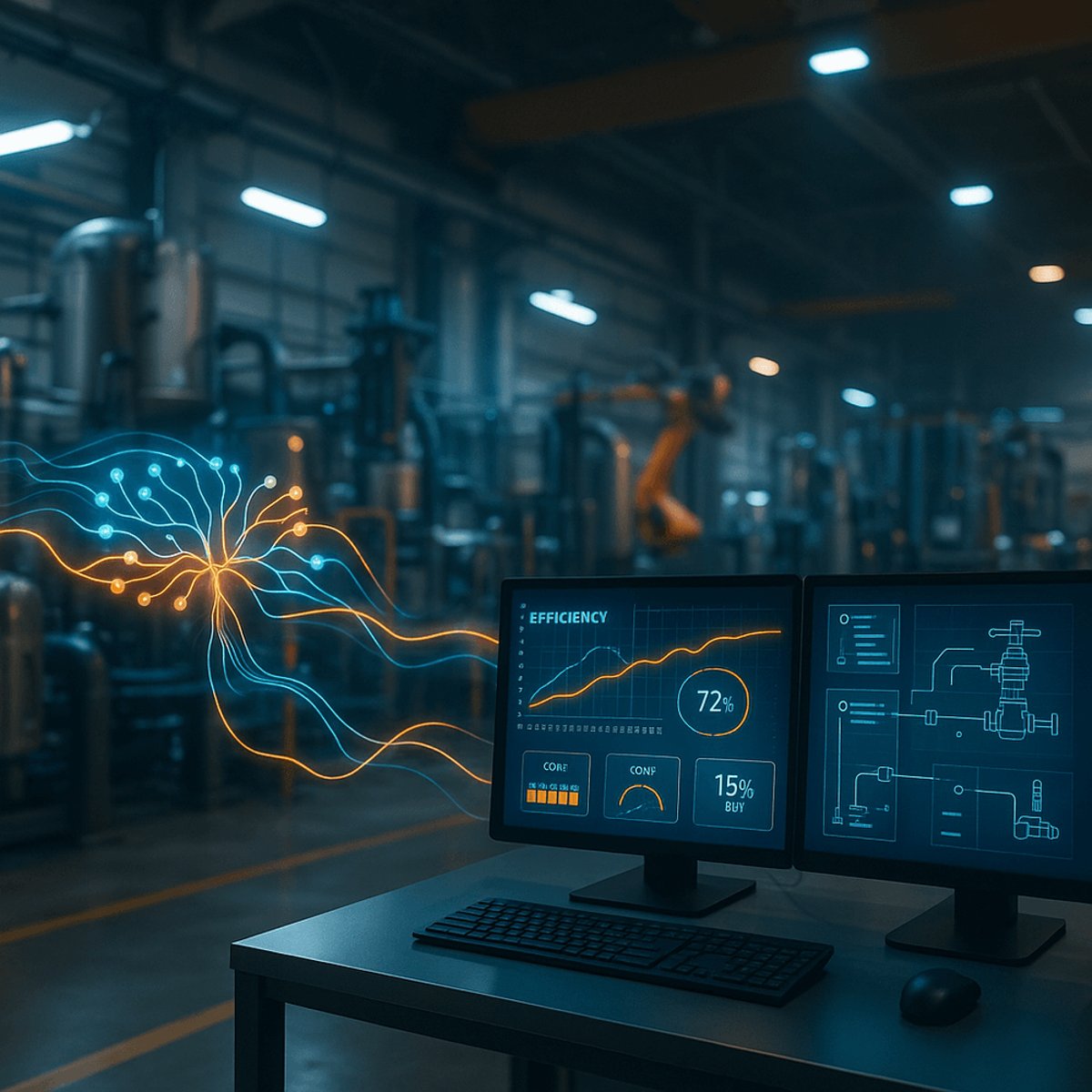
New York-based industrial AI startup CVector just closed a $5 million seed round to expand its AI-powered optimization platform across manufacturing plants and utilities. Led by Powerhouse Ventures with backing from Fusion Fund, Myriad Venture Partners, and Hitachi Ventures, the funding validates the company's pitch that factories desperately need software that translates tiny operational tweaks into real dollar savings. Founders Richard Zhang and Tyler Ruggles are now racing to prove their 'nervous system' for heavy industry can deliver measurable ROI at scale.
CVector just convinced investors that industrial America needs a digital nervous system. The New York startup closed a $5 million seed round to wire AI into factories, utilities, and chemical plants that desperately need to know whether flipping a single valve actually saves money. It's the kind of unglamorous question that keeps plant managers up at night - and one that Powerhouse Ventures is betting billions of dollars in industrial efficiency hangs on.
The financing, announced exclusively to TechCrunch, includes backing from Fusion Fund, Myriad Venture Partners, and Hitachi Ventures. It comes less than a year after CVector's pre-seed round last July, when founders Richard Zhang and Tyler Ruggles were still making the case that heavy industry needed AI at all.
That pitch got a lot easier. CVector now counts metals processors, advanced manufacturing facilities, chemical producers, and public utilities among its customers - companies dealing with the messy reality of optimizing century-old infrastructure with machine learning. One client, Iowa-based ATEK Metal Technologies, uses CVector's platform to predict equipment failures, track energy efficiency across its aluminum casting operations for Harley-Davidson motorcycles, and monitor commodity prices that swing raw material costs.
"One of the core things we're witnessing is customers really lack the tool to translate a small action, like turning on and off a valve, into did that just save me money?" Zhang told TechCrunch. That seemingly trivial valve adjustment can ripple through an entire facility's bottom line - the kind of invisible optimization that CVector's software layer is built to surface.
The company calls it "operational economics" - positioning its AI platform between the physical operation of industrial facilities and the financial margins those operations generate. It's finance meets factory floor, which explains why Zhang has been recruiting heavily from hedge funds and fintech. The 12-person team, now based in Manhattan's financial district, includes talent fluent in using data to gain financial edges - exactly the mindset needed to sell cost optimization to CFOs and plant managers simultaneously.
But CVector isn't just chasing legacy industrial clients. The startup also landed Ammobia, a San Francisco materials science company working to slash ammonia production costs, as a customer. Despite the contrast between century-old metals plants in Iowa and cutting-edge chemical startups in California, Zhang says the work CVector does for both is surprisingly similar. Both need to connect operational decisions to economic outcomes in real-time.
"The joy of the last six to eight months has been going to the industrial heartland, to all of these places that are just in the middle of nowhere, but have massive production plants that are either reinventing themselves or really transforming how they make decisions," Zhang said in the TechCrunch interview.
The timing couldn't be better. Industrial customers have gone from AI-skeptical to AI-hungry in the span of months. Zhang recalls that a year ago, mentioning AI in sales pitches was a coin flip - half the prospects embraced it, half dismissed the company outright. Now everyone's asking for AI-native solutions, even when the return on investment isn't crystal clear. Supply chain volatility and cost pressures have made industrial operators desperate for any edge.
"We're at this time when companies are really intimately worried about their supply chain and the costs and variability there, and being able to layer AI on top to make an economic model of a facility has really resonated with a lot of customers, whether it's old and industrial in the heartland, or whether it's new energy producers who are trying to do new and novel things," co-founder Tyler Ruggles told TechCrunch.
The $5 million will fund CVector's expansion into more industrial verticals and geographies. Zhang sees public utilities as particularly fertile ground - the valve example came from that sector, where minor operational tweaks can cascade into significant cost savings for rate-payers. With energy costs and grid reliability dominating headlines, utilities are under pressure to prove they're wringing every efficiency out of existing infrastructure before asking for rate hikes.
CVector's bet is that industrial AI adoption will mirror what happened in finance - data-driven decision making becomes table stakes, and companies that can't quantify the economic impact of operational decisions get left behind. The startup is threading a needle: complex enough to deliver real value in heavy industry, accessible enough that plant managers actually use it, and financially transparent enough that CFOs can justify the spend.
For Powerhouse Ventures, the investment fits a broader thesis around industrial decarbonization and efficiency. For Hitachi Ventures, it's a strategic play - the Japanese conglomerate has manufacturing and infrastructure businesses that could benefit from (or integrate with) CVector's platform. The mix of venture and strategic capital gives CVector both growth runway and potential enterprise distribution channels.
The company faces competition from legacy industrial software vendors like Siemens and Rockwell Automation, which are scrambling to bolt AI onto decades-old automation platforms. But Zhang and Ruggles are betting that starting with a clean slate - building AI-native software from the ground up rather than retrofitting it - gives them an edge with customers tired of enterprise bloatware.
CVector's $5 million seed round signals that investors believe industrial AI has moved past the hype phase into measurable value creation. The real test comes next: proving that an AI nervous system for factories and utilities can deliver returns substantial enough to justify enterprise deals in an industry where margins are thin and operational changes move slowly. If Zhang and Ruggles can turn valve adjustments and equipment uptime into quantifiable savings at scale, they'll have cracked a market worth hundreds of billions. If not, they'll join the pile of industrial AI startups that promised transformation but delivered dashboards.