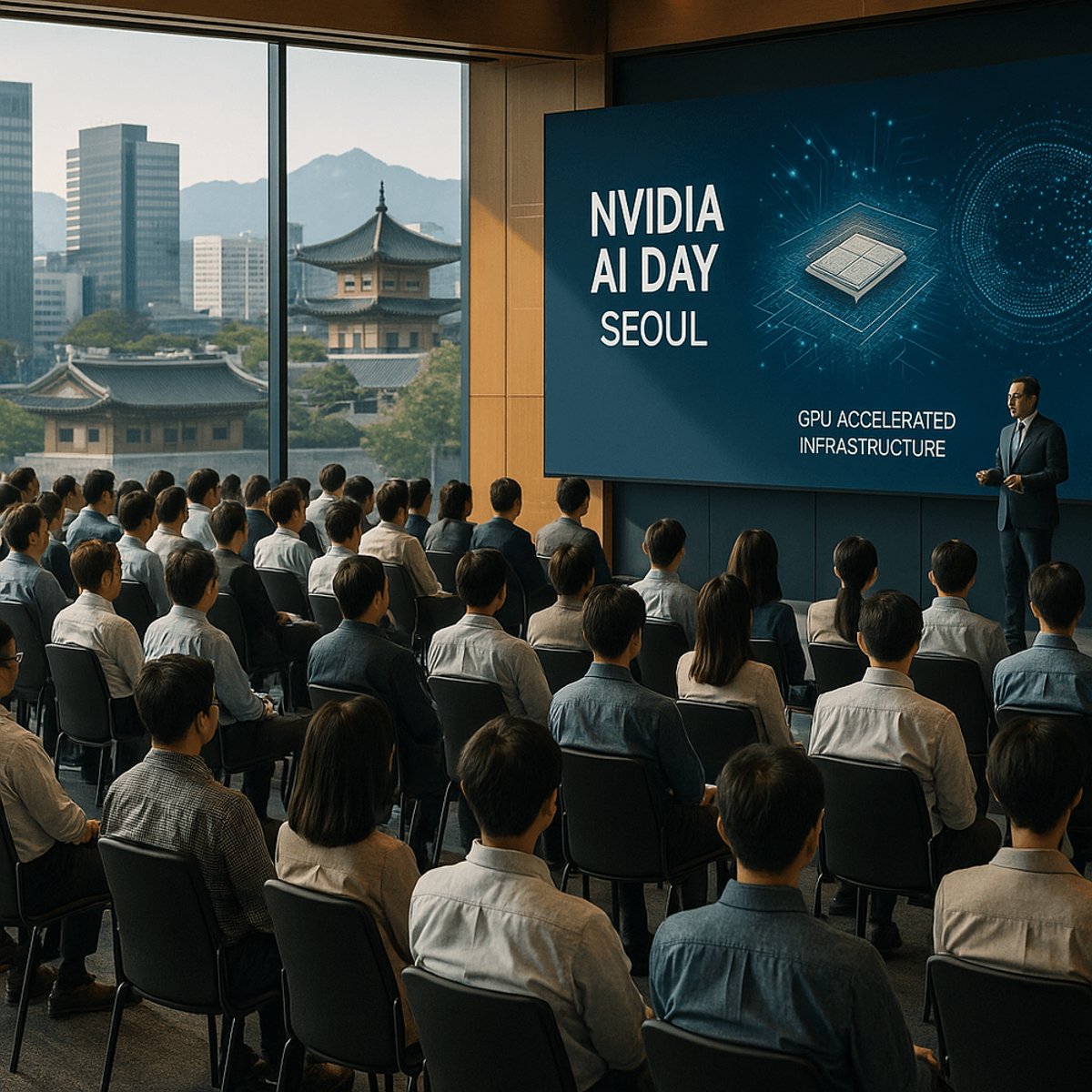
NVIDIA just wrapped its biggest AI Day in Korea yet, drawing over 1,000 attendees to Seoul last week for a deep dive into sovereign AI development. The event highlighted Korea's rapidly expanding AI ecosystem, with 700+ local startups now part of NVIDIA's Inception program and major conglomerates like Samsung and NAVER Cloud racing to build AI-powered infrastructure. As Korea prepares to harness 260,000 GPUs through a massive infrastructure initiative announced at the recent APEC Summit, the Seoul gathering offered a glimpse into how the nation is positioning itself as an AI powerhouse.
NVIDIA just delivered its most ambitious AI Day in Korea, and the numbers tell a compelling story about the nation's AI trajectory. More than 1,000 developers, researchers, and startup founders packed into Seoul last week, representing the largest turnout yet for the chip giant's regional showcase.
The timing couldn't be more strategic. Korea is sitting on the cusp of a massive AI infrastructure expansion, with 260,000 GPUs set to power the next phase of the country's digital transformation. "In the public sector, AI is already helping process documents, policies and regulatory information at scale, enabling citizens to receive the answers they need instantly," Shilpa Kolhatkar, global head of AI nations at NVIDIA, told attendees.
But it's the private sector momentum that's really catching attention. Korea now hosts over 700 startups in NVIDIA's Inception program, with 332,000 developers actively using NVIDIA technologies - a 40% jump from last year's figures. The Korean Ministry of SMEs and Startups awarded five finalists from the Inception Grand Challenge, highlighting what officials call "the momentum of Korea's AI startup community."
Samsung Electronics principal engineer Useong Kim captured the energy perfectly: "The best part of AI Day Seoul was definitely coming to the Q&A counter to directly ask questions and communicate with NVIDIA technical experts. It's invaluable to ask what you're curious about and get immediate feedback."
The corporate partnerships unveiled at the event reveal how deep Korea's AI integration has become. NAVER Cloud is building what CTO Yong-Jae Kwak calls "technological sovereignty" through expanded collaboration with NVIDIA, spanning GPU infrastructure to AI models and agent technologies. The company demonstrated its agentic AI system development using the NVIDIA NeMo Agent Toolkit, showing optimization insights that could reshape how Korean businesses approach automation.
LG AI Research took the stage to showcase advanced LLM training using the NVIDIA NeMo framework, achieving over 20% faster training through FP8 training recipes. The breakthrough represents a significant leap in training efficiency that could accelerate Korea's push toward homegrown large language models.
Perhaps most telling was Coupang's presentation on building its AI factory using NVIDIA DGX systems based on Hopper and Blackwell architectures. The e-commerce giant is deploying AI-powered solutions across demand forecasting, logistics route optimization, and ad personalization - exactly the kind of real-world applications that separate AI hype from genuine transformation.
The event featured four NVIDIA Deep Learning Institute training sessions alongside breakout sessions on agentic and physical AI. Ankit Patel, senior director of developer marketing at NVIDIA, led an all-conference session exploring agentic AI through scaling laws, emphasizing that reasoning models are "at the heart of the latest generation of AI."
One startup story particularly stood out. PYLER, an NVIDIA Inception member, became the first South Korean company to adopt an NVIDIA DGX B200 system. "The strong support from the Inception program enabled us to become the first in South Korea to adopt an NVIDIA DGX B200 system, as we continue to advance our globally leading, safe and reliable video understanding AI," CEO Jaeho Oh explained.
The government backing adds serious credibility to Korea's AI ambitions. "The 260,000-GPU AI infrastructure announced at the recent APEC Summit will play a major role in advancing the next phase of Korea's AI ecosystem," Kyungwon Cho, director of the Korean Ministry of SMEs and Startups, told the audience. "We expect this to help startups move faster in developing their technologies and spark new waves of innovation across industries."
Korea's AI Day Seoul reveals a nation moving beyond experimentation into serious AI infrastructure deployment. With 260,000 GPUs coming online and major conglomerates like Samsung and NAVER Cloud deepening their AI integration, Korea is positioning itself as a sovereign AI leader in Asia. The real test will be whether this infrastructure translates into breakthrough applications that can compete globally - but judging by the enthusiasm and corporate commitment on display in Seoul, Korea seems ready to find out.