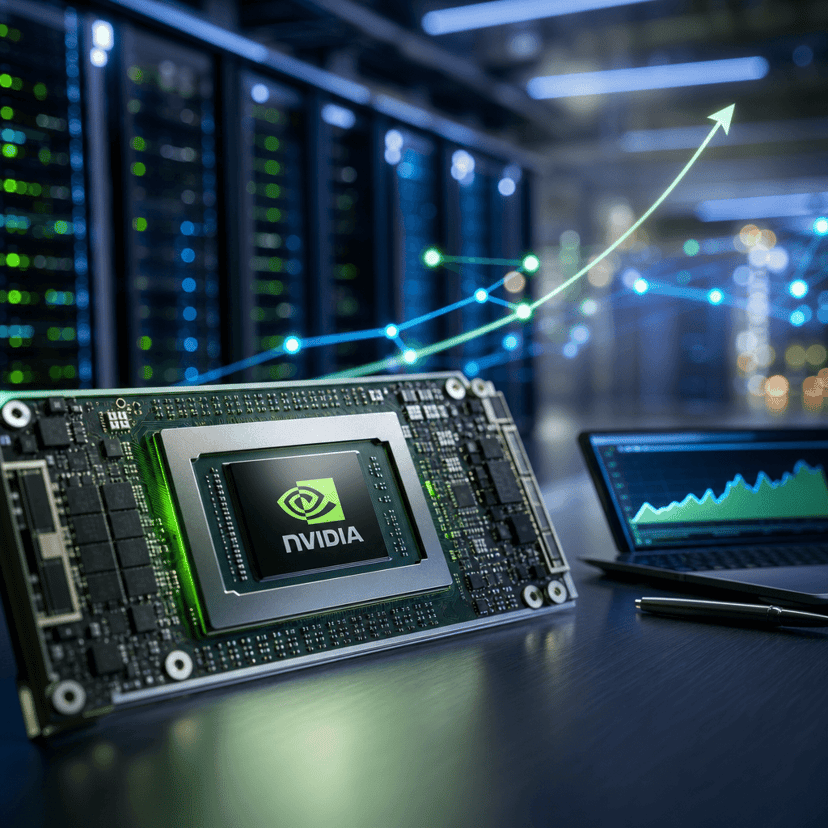
Nvidia just made a massive bet on the future of chip design, dropping $2 billion on Synopsys stock to create what could be the most powerful AI-driven engineering platform in the semiconductor industry. The move sends a clear signal that the AI giant isn't just content dominating datacenter chips - it wants to control the tools that design them too.
Nvidia just threw down $2 billion to reshape how the world designs computer chips. The AI powerhouse announced Monday it's purchased a massive stake in Synopsys, the company behind the software tools that virtually every major chipmaker uses to design their processors.
The deal isn't just about money - it's about control. By embedding its AI computing power directly into Synopsys' design tools, Nvidia is positioning itself at the very beginning of the chip creation process. Every time an engineer opens up Synopsys software to design a new processor, they'll now be working with Nvidia-powered AI assistance.
"Our partnership with Synopsys harnesses the power of Nvidia accelerated computing and AI to reimagine engineering and design," Nvidia CEO Jensen Huang said in the announcement, according to the official press release. The statement reveals how seriously Nvidia takes this strategic shift.
Markets responded immediately. Synopsys stock surged 7% in premarket trading while Nvidia shares dipped about 1%, suggesting investors see this as a win for the design tool maker. At $414.79 per share, Nvidia's investment represents a significant premium that signals just how valuable this partnership is to the chipmaker's long-term strategy.
The timing couldn't be more critical. As AI workloads demand increasingly sophisticated chip architectures, the design process has become a major bottleneck. Traditional chip design can take years, but AI-accelerated tools promise to compress those timelines dramatically. By getting its technology baked into Synopsys' platform, Nvidia ensures its AI capabilities become essential to how future chips get built.
This move also puts Nvidia in direct competition with other AI chip designers like AMD and emerging players. When competitors use Synopsys tools to design chips that might challenge Nvidia's dominance, they'll ironically be using Nvidia-powered AI to do it. It's a brilliant strategic play that creates revenue streams regardless of who wins specific chip battles.
The partnership covers what Nvidia calls "agentic AI engineering" - essentially AI agents that can autonomously optimize chip designs. These tools will help engineers simulate and test chip performance before manufacturing, potentially saving billions in development costs across the industry. The multi-year agreement also includes expanded cloud access and joint go-to-market initiatives.
For Synopsys, this represents validation of its position as the critical infrastructure layer for semiconductor design. The company's tools are already used by virtually every major chip manufacturer, from Apple to Samsung. Now with Nvidia's AI horsepower behind them, those tools become exponentially more powerful.
The implications stretch far beyond just these two companies. This partnership could accelerate the entire pace of chip innovation at a time when the industry faces mounting pressure to deliver more powerful, energy-efficient processors for AI applications. Every smartphone, laptop, and datacenter server could benefit from faster, more optimized chip designs.
What's particularly striking is how this reflects Nvidia's evolution from a graphics card company to something approaching a semiconductor platform. By controlling both the hardware that runs AI and now the tools that design chips, Nvidia is building an integrated ecosystem that competitors will find increasingly difficult to challenge.
Nvidia's $2 billion investment in Synopsys represents more than just a strategic partnership - it's a calculated move to control the entire chip design ecosystem from silicon to software. By embedding its AI capabilities into the tools that design tomorrow's processors, Nvidia ensures its technology remains essential regardless of which companies ultimately manufacture the chips. This could be the move that transforms Nvidia from an AI chip leader into the invisible infrastructure powering all semiconductor innovation.