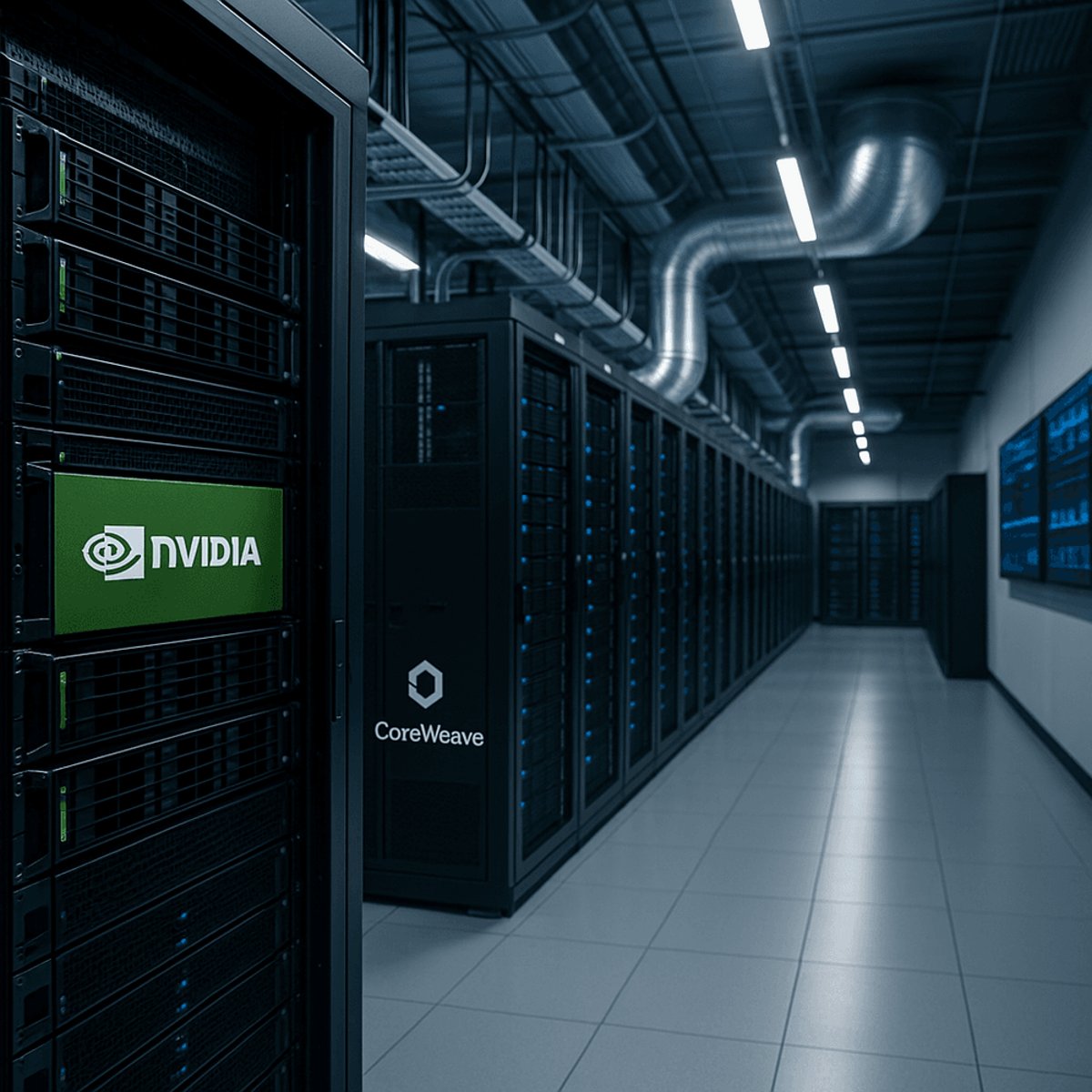
NVIDIA just made its biggest bet yet on AI infrastructure, pumping $2 billion into CoreWeave at $87.20 per share while the companies race to build more than 5 gigawatts of AI factories by 2030. The deal marks a dramatic escalation in the arms race for AI compute capacity, with NVIDIA essentially funding the construction of data centers that will exclusively run its chips. It's a strategic masterstroke that locks in demand while competitors scramble for power and real estate.
NVIDIA isn't just selling chips anymore - it's financing the entire AI infrastructure stack. The company revealed today it's investing $2 billion directly into CoreWeave, the AI-focused cloud provider that's become synonymous with rapid-fire GPU deployments. The deal values CoreWeave shares at $87.20 each and commits both companies to an ambitious plan: building over 5 gigawatts of AI factories before the decade ends.
The numbers are staggering. Five gigawatts could power roughly 3.75 million homes, but instead it'll fuel the next generation of AI models from companies racing to match or beat OpenAI and Google. "AI is entering its next frontier and driving the largest infrastructure buildout in human history," NVIDIA founder and CEO Jensen Huang said in the announcement.
What makes this deal unusual is how vertically integrated it is. NVIDIA isn't just investing cash - it's leveraging its balance sheet to help CoreWeave secure land, power contracts, and physical infrastructure. That's the hard part everyone underestimates. You can design the world's best AI chip, but if you can't get 100 megawatts of power and cooling capacity in the right location, you're dead in the water.
CoreWeave has built its reputation on speed. Founded in 2017, the company went public on Nasdaq last March under ticker CRWV and quickly became the go-to provider for AI startups that couldn't wait 18 months for traditional cloud providers to provision capacity. Now it's getting first access to NVIDIA's next-generation Rubin platform, Vera CPUs, and Bluefield storage systems - hardware that won't hit general availability for months or years.
"NVIDIA is the leading and most requested computing platform at every phase of AI, from pre-training to post-training, and Blackwell provides the lowest cost architecture for inference," CoreWeave co-founder and CEO Michael Intrator told investors. That's not marketing fluff - it's a statement about vendor lock-in that would make any CFO nervous.
But there's a software angle here that's equally important. NVIDIA and CoreWeave plan to validate CoreWeave's AI-native software stack, including its SUNK orchestration layer and Mission Control management platform. If that validation goes well, NVIDIA could include CoreWeave's tools in its reference architectures for other cloud service providers and enterprise customers. Translation: CoreWeave's operational expertise could become productized and sold through NVIDIA's channels.
The competitive implications are massive. Amazon Web Services, Microsoft Azure, and Google Cloud have all been building their own AI infrastructure, but they're constrained by existing data center footprints and multi-tenant architectures. CoreWeave builds single-purpose AI factories optimized for training and inference workloads. That specialization means higher utilization rates and potentially lower costs per token or per training hour.
Wall Street is watching this closely because it reveals NVIDIA's strategy for maintaining dominance as AI infrastructure spending approaches $200 billion annually. By financing the buildout directly, NVIDIA ensures CoreWeave buys NVIDIA chips exclusively while competitors like AMD and new entrants struggle to gain traction. It's the classic razor-and-blades model, except the razors cost millions of dollars and the blades are measured in gigawatts.
The deal also highlights how power availability has become the primary constraint on AI development. CoreWeave's forward-looking statements acknowledge the company is targeting "more than 5 gigawatts" but building that capacity requires years of utility negotiations, substation upgrades, and cooling infrastructure. NVIDIA's financial backing accelerates that timeline, potentially giving both companies a multi-year head start over competitors still negotiating power purchase agreements.
There's risk here too. NVIDIA's $2 billion investment ties its fortunes even more closely to the AI boom's continued expansion. If demand softens or if open-source models dramatically reduce compute requirements, both companies could be left with expensive infrastructure and no customers to fill it. The forward-looking statements in today's announcement are packed with caveats about market conditions, technology development, and execution risk.
But for now, the bet is paying off. AI labs are desperate for compute capacity, enterprises are building private AI deployments, and inference workloads are exploding as models move into production. CoreWeave's public listing last year gave it the currency to scale aggressively, and NVIDIA's investment provides the capital and technology access to maintain its velocity advantage over traditional cloud providers.
This isn't just a partnership announcement - it's NVIDIA writing the playbook for how chip companies maintain dominance in the AI era. By financing infrastructure, bundling software, and locking in exclusive deployments, NVIDIA is building moats that go far beyond semiconductor manufacturing. For CoreWeave, the deal provides capital, technology access, and validation that could position it as the backbone of AI infrastructure for the next decade. The real question is whether 5 gigawatts will be enough, or if this is just the opening bid in an infrastructure arms race that's only getting started.