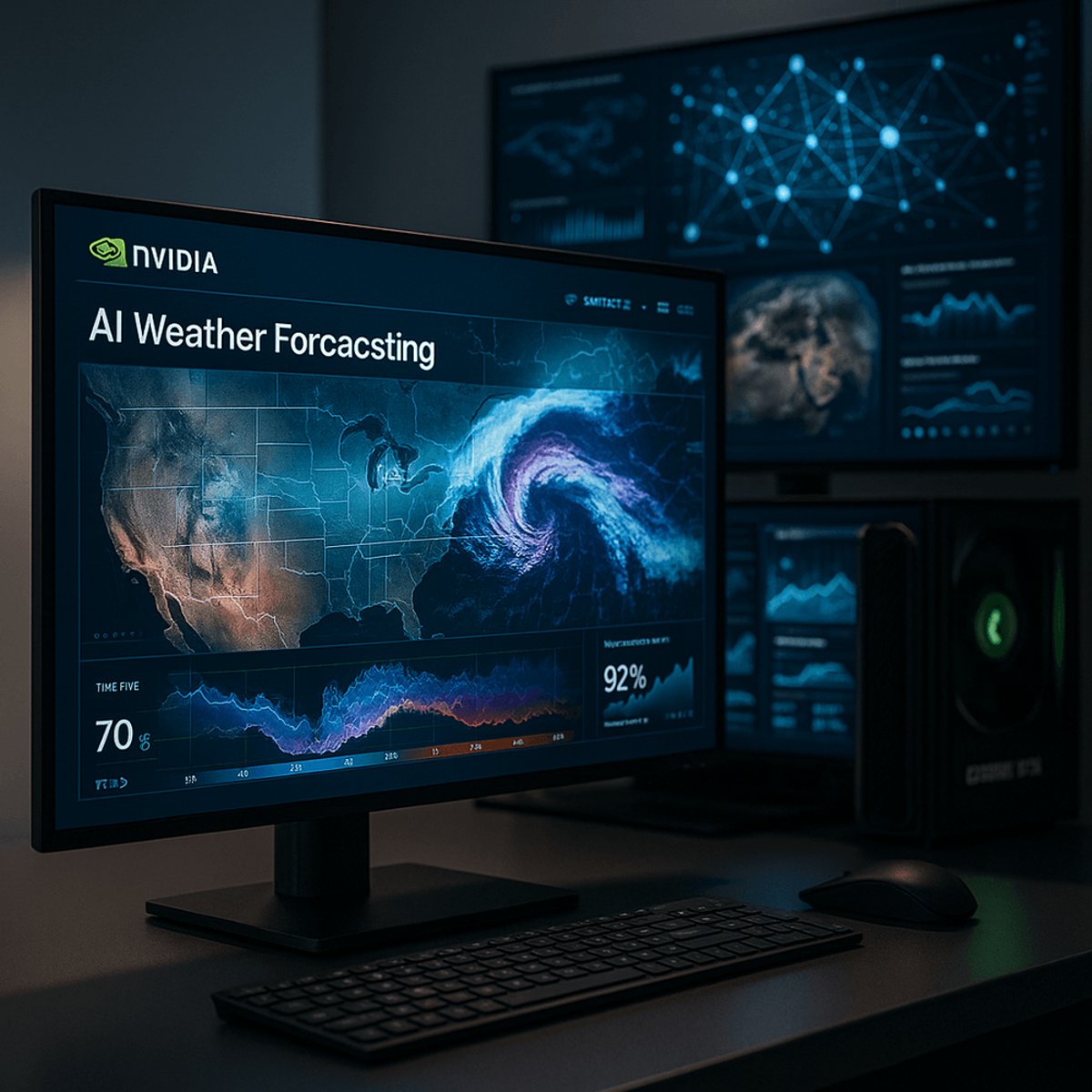
Nvidia just unveiled three AI weather models that could reshape how the world predicts storms, and the timing couldn't be more dramatic. As a major winter storm hammers the U.S. with wildly inconsistent forecasts, the chip giant claims its new Earth-2 Medium Range model outperforms Google DeepMind's GenCast on more than 70 weather variables. The announcement, made at the American Meteorological Society meeting in Houston, signals Nvidia's push beyond gaming and data center chips into climate prediction infrastructure that governments and energy companies desperately need.
Nvidia is making a calculated bet that AI can do what traditional physics-based models struggle with - predict weather accurately weeks in advance without burning through supercomputer budgets. The company's new Earth-2 suite, announced Monday, arrives as a major winter storm exposes the gaps in current forecasting, with snowfall predictions for some U.S. regions swinging wildly in recent days.
The flagship Earth-2 Medium Range model directly challenges Google DeepMind's GenCast, which the search giant released in December 2024 claiming significant accuracy improvements over traditional 15-day forecast models. Nvidia says its system beats GenCast on more than 70 weather variables, though the company hasn't yet published peer-reviewed validation data.
"Philosophically, scientifically, it's a return to simplicity," Mike Pritchard, director of climate simulation at Nvidia, told reporters before the announcement. "We're moving away from hand-tailored niche AI architectures and leaning into the future of simple, scalable, transformer architectures."
That simplicity comes from Nvidia's new Atlas architecture, which underpins the Medium Range model. The company promised more technical details would emerge Monday, but the approach marks a shift from specialized weather AI designs toward general-purpose transformer models - the same technology powering large language models like ChatGPT. It's a gamble that raw computing power and better training data can outperform decades of meteorological domain expertise baked into traditional forecasting systems.
The Earth-2 suite includes two other models tackling different time horizons. Nowcasting handles the zero-to-six-hour window when storms are already forming, using satellite data to help meteorologists predict severe weather impacts. "Because this model is trained directly on globally available geostationary satellite observations, rather than region-specific physics model outputs, Nowcasting's approach can be adapted anywhere on the planet with good satellite coverage," Pritchard said.
That global accessibility matters for smaller countries and regions that can't afford dedicated weather supercomputers. The Global Data Assimilation model addresses another bottleneck - processing raw data from weather stations, balloons, and satellites into usable starting conditions for forecasts. "It consumes roughly 50% of the total supercomputing loads of traditional weather [forecasting]," Pritchard explained. "This model can do that in minutes on GPUs instead of hours on supercomputers."
Nvidia's pitch centers on democratizing weather prediction, but the business model remains murky. The company says meteorologists in Israel and Taiwan already use an earlier Earth-2 model called CorrDiff, which generates high-resolution forecasts from coarse predictions. The Weather Company and Total Energies are evaluating Nowcasting, though Nvidia didn't disclose whether these are paid deployments or pilot programs.
The new models join existing Earth-2 tools including FourCastNet3, which models individual variables like temperature and humidity. Together, they form what Nvidia describes as "fundamental building blocks" for weather services, financial firms, and energy companies. That positioning suggests Nvidia sees weather AI as infrastructure it can license rather than consumer-facing forecasts.
"This provides the fundamental building blocks used by everyone in the ecosystem - national meteorological services, financial service firms, energy companies - anyone who wants to build and refine weather forecasting models," Pritchard said. The appeal for corporations is clear: energy traders need accurate wind forecasts, insurers want better hurricane predictions, and agricultural companies depend on rainfall timing.
But Pritchard emphasized that sovereignty drives many potential customers. "For some users, it makes sense to subscribe to an enterprise centralized weather forecasting system. But for others like countries, sovereignty matters," he said. "Weather is a national security issue, and sovereignty and weather are inseparable."
That framing positions Nvidia's GPU-based forecasting as an alternative to both traditional supercomputers and cloud-based services from competitors like Google. Countries wary of relying on foreign tech giants for critical weather data could run Earth-2 models on domestic Nvidia hardware - a compelling pitch as climate change makes extreme weather more frequent and unpredictable.
The accuracy claims will face scrutiny from meteorologists who've seen AI weather models overpromise before. GenCast itself drew skepticism despite strong performance in Google's testing, with some forecasters questioning whether AI models trained on historical data can handle unprecedented climate conditions. Nvidia's decision to announce during an active weather emergency - when traditional forecasts struggled - feels like a pointed demonstration, but real-world validation will take months of operational use.
What's clear is that Nvidia sees weather forecasting as another application for its GPU dominance. The same chips powering OpenAI's language models and corporate AI deployments now promise to predict next week's blizzard. Whether that's a genuine breakthrough or clever repositioning of existing technology depends on data Nvidia hasn't fully shared yet.
Nvidia's Earth-2 suite represents a significant push into climate infrastructure, but the real test comes when meteorologists rely on these models for high-stakes forecasts that affect millions of lives. The company's transformer-based approach could genuinely democratize weather prediction for resource-constrained nations, or it could be another chapter in the overhyped AI application playbook. Early adopters in Israel, Taiwan, and major corporations will provide the first real-world verdict. For now, Nvidia has positioned itself as the alternative to both legacy supercomputer forecasting and Google's cloud-based approach - a positioning that appeals to sovereignty-conscious governments and cost-conscious enterprises alike. The winter storm chaos that coincided with this launch certainly made for compelling marketing timing.