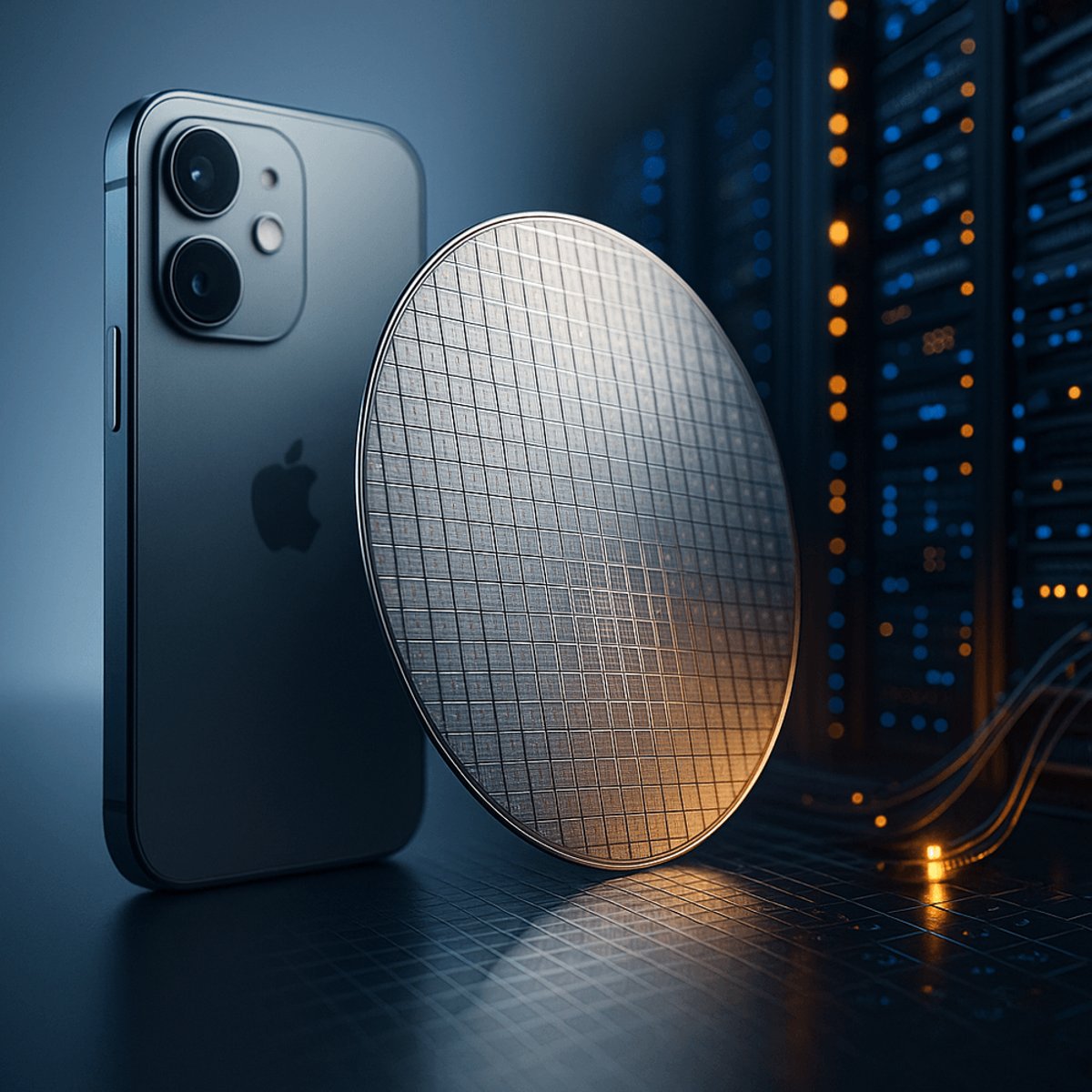
The chip industry just witnessed a changing of the guard. Nvidia has officially surpassed Apple as TSMC's largest customer, CEO Jensen Huang confirmed this month - fulfilling a decades-old promise he made to TSMC founder Morris Chang. The swap marks a fundamental realignment in semiconductor manufacturing as AI infrastructure demand eclipses consumer electronics, reshaping the dynamics of the world's most advanced chip foundry.
When Jensen Huang first met Morris Chang decades ago, Nvidia's CEO made a bold prediction: his company would one day become Taiwan Semiconductor Manufacturing Company's biggest customer. That promise became reality this year, and Huang couldn't hide his satisfaction when discussing the milestone on a recent podcast. "Morris will be happy to know Nvidia is TSMC's largest customer now," he said, marking a fundamental power shift in the semiconductor industry.
The numbers tell the story of AI's gravitational pull. Creative Strategies chief analyst Ben Bajarin projects Nvidia will generate $33 billion in TSMC revenue this year - roughly 22% of the foundry's total. Apple, which held the top spot for years manufacturing A-series iPhone chips and M-series processors, is projected to contribute $27 billion, or about 18% of revenue. "The scale of this drastically changed," Bajarin said. "A couple years ago, you could just see how much more capacity Nvidia was demanding from TSMC."
The repositioning isn't just about volume - it's about complexity and cost. Nvidia's AI accelerators are bigger and more intricate to manufacture than Apple's mobile chips, commanding premium pricing per unit. And the demand shows no signs of slowing. TSMC's high-performance computing sales, dominated by Nvidia's AI chips, made up 55% of net revenue in the December quarter, a dramatic leap from 40% in 2022 when OpenAI's ChatGPT kicked off the generative AI boom.
Huang's relationship with TSMC runs deep - and he's making sure everyone knows it. He visited Taiwan five times last year, including a November appearance at TSMC's annual sports day where he wore the same red shirt as company employees. During that trip, he toured TSMC's fab equipped with 3-nanometer technology currently producing Nvidia's Rubin chip, which enters full production later this year. The visits underscore what's at stake: TSMC controls an estimated 70% of the global chip manufacturing market, according to TrendForce.
TSMC CEO C.C. Wei is feeling the pressure - and the opportunity. During the company's recent earnings call, he revealed plans to spend as much as $56 billion on capital expenditures this year, with investments coming online in 2028. The company projects AI chip revenue will grow at a "mid-to-high-fifties" compound annual rate through 2029, driven by direct requests from cloud service providers scrambling to secure capacity. "Our customers' customer, who are mainly the cloud service providers, are also providing strong signals and reaching out directly to request the capacity to support their business," Wei said, according to a company transcript.
But Wei isn't betting the farm without hedges. When asked about an AI bubble, he admitted nervousness about committing tens of billions to capacity that won't come online for years. "I'm also very nervous about it, you bet," he said. "Because we have to invest about $52 billion to $56 billion for the CapEx, right?" The caution is understandable - TSMC's top 10 customers accounted for 76% of net revenue as of March, meaning the foundry's fortune hinges on a handful of players.
The swap reveals how dramatically the tech landscape has shifted. Apple provided TSMC with stable, high-volume orders that justified aggressive investments in cutting-edge manufacturing nodes. That predictability fueled TSMC's dominance in leading-edge production. Now Nvidia - and to a lesser extent AMD - has assumed that role as the anchor customer driving next-generation capacity expansion. "It just changes the dynamic where what was the driving force for TSMC - Apple - now shifts to Nvidia, and to some degree AMD, which is sort of the guarantee-scale customer that helps you justify the increase in CapEx to each new node," Bajarin explained.
The growth trajectories make the shift inevitable. Nvidia expects to report 66% growth to $213 billion in sales for its fiscal 2026 ending this month, according to analyst estimates. Apple's fiscal 2025 growth, by comparison, clocked in at 6.4%. Nvidia's momentum isn't slowing - the company's successive chip generations (Hopper to Blackwell to Rubin) are delivering performance improvements that double or triple with each iteration, Wei noted on the earnings call. Meanwhile, Apple reports first-quarter earnings Thursday with forecasts calling for 12% revenue growth at best.
For competitors trying to challenge TSMC's manufacturing dominance, the Nvidia partnership creates an even steeper hill to climb. Intel, which has publicly stated ambitions to manufacture leading-node chips in the U.S., has yet to announce an anchor customer. The company's stock plunged 13% Thursday after reporting soft guidance and production concerns, raising questions about its foundry strategy.
Wei's assessment of the industry's chokepoint is telling: "From my point of view, the bottleneck in the AI industry remains TSMC's wafer supply." It's a remarkable position for a company planning to spend $56 billion this year on new capacity. But with Nvidia's chips powering the infrastructure behind ChatGPT, Microsoft's Copilot, Google's Gemini, and virtually every other major AI platform, TSMC finds itself at the center of the tech industry's biggest buildout in decades.
The historical symmetry isn't lost on industry watchers. Apple's partnership with TSMC defined the smartphone era, enabling the power-efficient chips that made iPhones category leaders. Now Nvidia's ascendance signals the AI era's arrival, with massive GPUs replacing sleek mobile processors as the semiconductor industry's North Star. For TSMC, sitting between these two giants, the transition represents both validation of its manufacturing prowess and a bet that AI infrastructure will prove as durable a market as consumer electronics. Wei's nervous optimism suggests even he isn't entirely sure which way that wager will land.
The changing of the guard at TSMC's customer roster is more than corporate musical chairs - it's a real-time measure of where tech's center of gravity now sits. As AI infrastructure spending eclipses consumer device sales, the semiconductor industry is realigning around new winners. For Nvidia, overtaking Apple validates its position as the AI era's defining hardware company. For TSMC, the shift means navigating the tension between capitalizing on explosive AI growth and avoiding overinvestment in a market that even its CEO admits makes him nervous. And for Apple, losing the top spot doesn't signal decline so much as the reality that smartphones - no matter how many billions are sold - can't match the economics of data center GPUs powering the next computing paradigm. Wei's comment that wafer supply remains the AI industry's bottleneck suggests this dynamic will persist for years, cementing TSMC's role as kingmaker in determining who wins the AI infrastructure race.